About this place
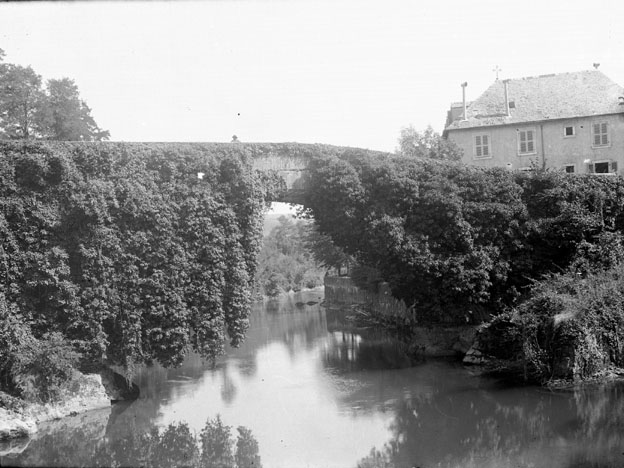
Pont de Bétharram in Montaut, in the heart of the Pyrénées-Atlantiques department, is a single-arch stone bridge that has spanned the Gave de Pau for more than three centuries. It links Montaut with the neighboring town of Lestelle-Bétharram and has long served as a key crossing point on the route toward the Pyrenees. Today it draws travelers not only as a feat of historic engineering, but also as the gateway to one of the region's most important Marian shrines and to a set of caves carved by water deep inside a limestone massif.
How far back does the crossing at this spot go?
Traces of a crossing here date back to the 14th century. The first bridge was most likely built by the inhabitants of Montaut around 1308, and in 1335 the community of Lestelle was granted the same right to construct its own section. In 1631 the two sides signed an agreement dividing maintenance duties: Lestelle was responsible for the two side beams of the structure, while Montaut maintained the central beam. The wooden crossing proved no match for the mountain river's temper, and floods destroyed it in 1646, 1676, and 1678.
Following the last flood, residents petitioned the parliament of Pau for permission to rebuild, which was granted on August 3, 1678, with Lestelle contributing 2,000 livres and Montaut 1,000 livres toward the cost. A few years later, on March 23, 1681, local master masons committed to raising the bridge as a single arch at the narrowest point of the Gave, right where the slope descends from Montaut. Work was completed in 1687 under the direction of contractor Daniel Bairon of Lescar. That stone structure still stands today and was listed as a French historic monument on June 4, 1925.
Where does the name Bétharram come from?
The name Bétharram comes from the Béarnese phrase "beth arram," meaning "beautiful branch." According to local tradition dating to the 15th century, the Virgin Mary is said to have saved a young girl from drowning in the swollen waters of the Gave by holding out a branch for her to grab. That legend became the foundation of a Marian devotion that gradually turned this spot into one of Béarn's major pilgrimage destinations.
What else is worth seeing near the bridge?
Just steps from the bridge stands the Sanctuary of Notre-Dame de Bétharram, only about 15 kilometers from Lourdes and roughly 25 kilometers from Pau. In the early 17th century, the priest Hubert Charpentier established a hospice here for pilgrims and clergy, enlarged the existing chapel, and founded a monastery, laying out a Way of the Cross leading up to the shrine. Between 1620 and 1642, more than eighty miraculous healings were recorded here, cementing Bétharram's reputation as a place of pilgrimage.
The second attraction is the Grottes de Bétharram, a system of underground passages discovered in 1810 and opened to visitors in 1903 through the efforts of Léon Ross. The caves span five levels with an 80-meter difference in elevation and roughly 5 kilometers of galleries carved out by water in the limestone rock — a process still ongoing today.
How should you plan a visit?
The bridge, the sanctuary, and the caves all sit close together, making it easy to combine all three into a single outing. It's a convenient stop for travelers heading toward Lourdes or exploring the Pyrenean foothills out of Pau.
Frequently Asked Questions
How old is the bridge at Bétharram? The current stone structure was completed in 1687, though a crossing has existed at this spot since the early 14th century.
Where does the name Bétharram come from? It comes from the Béarnese phrase "beth arram" (beautiful branch), referring to the legend of a girl saved from drowning by the Virgin Mary.
Is it worth combining the bridge with the sanctuary and caves? Yes — both sites sit right next to the bridge and form a natural sightseeing route together.
How far is it from here to Lourdes? The Sanctuary of Notre-Dame de Bétharram is about 15 kilometers from Lourdes.
Nearby places

Earn badges for the places you visit
Download NextOnTrip, discover new places and check off your trails.