Save this place and discover nearby attractions with NextOnTrip
In the app you can add it to your favorites, see what else is worth visiting nearby on the map, and earn a badge for your visit.
The app is available for iPhone and Android.
About this place
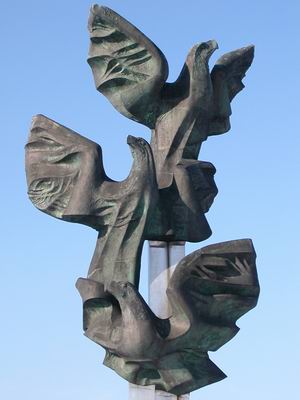
The Monument to the Polish Endeavour in Szczecin is one of the city's most recognisable landmarks: three huge bronze eagles with outstretched wings, each set on a slender steel column and rising above the greenery of a park. Locals call it the Three Eagles Monument, or simply the Eagles' Nest. You can spot it from far away, and up close it is even more striking.
Where is the monument and how do you get there?
It stands at the edge of Jan Kasprowicz Park, on the square of Jasne Błonia named after John Paul II, close to Juliana Fałata Street. This part of town lies west of the compact city centre and is surrounded by greenery and wide avenues. The walk from Aleja Wojska Polskiego is easy, and strolling through the park is a pleasant way to begin exploring this side of Szczecin. Nearby you will find walking paths and large open spaces where city ceremonies are usually held.
When was it built and who designed it?
The monument was unveiled on 3 September 1979, on the 40th anniversary of the German invasion of Poland. The sculptures are the work of Gustaw Zemła, a leading Polish sculptor, who collaborated on the project with Eugeniusz Kozak. The stainless steel obelisk follows a design by Jerzy Piskorz-Nałęcki. Around it you will find inscriptions with the names of the creators and donors, a reminder that the monument was a joint effort by many people.
What is it made of and how big is it?
The scale is impressive. The whole structure is 22.5 metres tall. Each of the three eagles weighs about 20 tonnes and has a wingspan of roughly 6.5 metres. The sculptures were cast in bronze at a mechanical works in Warsaw, while the steel pedestal was built by the Szczecin Shipyard named after Adolf Warski. That detail matters: the monument is partly the work of local shipbuilders, which suits the port character of the city.
What do the three eagles symbolise?
The three birds stand for three generations. According to one interpretation, they are the Poles who built the state over a thousand years, those who shape it today, and those who will strengthen it in the future. Local tradition also reads the symbolism in the context of Szczecin itself: the eagles represent the pre-war Polish community, the generation of Szczecin pioneers who settled and rebuilt the city after the war, and today's generation that continues to develop it. This makes the monument more than a decoration for a square. It speaks of continuity and of how firmly Szczecin has become part of Poland.
Why visit?
Since 1979 the monument has witnessed the most important events in the city's history. From the very beginning it has been a place of patriotic gatherings, regardless of participants' religious or political views. State and anniversary ceremonies are still held here today, with flowers laid and candles lit. If you arrive on the day of such an event, you will see how much the place means to the people of Szczecin.
For photographers it is a good target at any time of day. It looks best in side light, when the bronze takes on a warm colour and the silhouettes of the eagles stand out sharply against the sky. Shots from a low angle emphasise the monumental height of the columns. In the evening, in changing light, the monument has a completely different mood than in full sun.
How to plan your visit
A quarter of an hour is enough to see the monument itself, but it is worth adding a walk through Kasprowicz Park and the surrounding avenues. It is a good break from sightseeing in the centre, especially if you want to relax among trees. The site is open, with no gate to pass through, and the surroundings are flat and comfortable for families with children and for people who move more slowly.
Frequently asked questions
Who designed the Monument to the Polish Endeavour? The sculptures were made by Gustaw Zemła together with Eugeniusz Kozak, and the steel obelisk was designed by Jerzy Piskorz-Nałęcki.
When was it unveiled? On 3 September 1979, on the 40th anniversary of the outbreak of the Second World War.
How tall is it? It is 22.5 metres high, and each eagle weighs about 20 tonnes with a wingspan of around 6.5 metres.
What do the three eagles mean? They symbolise three generations: past, present and future, and in the local reading also pre-war Poles, Szczecin's pioneers and today's residents.
Is there an entrance fee? No, the monument stands in open urban space and can be seen at any time.
Nearby places

Earn badges for the places you visit
Download NextOnTrip, discover new places and check off your trails.