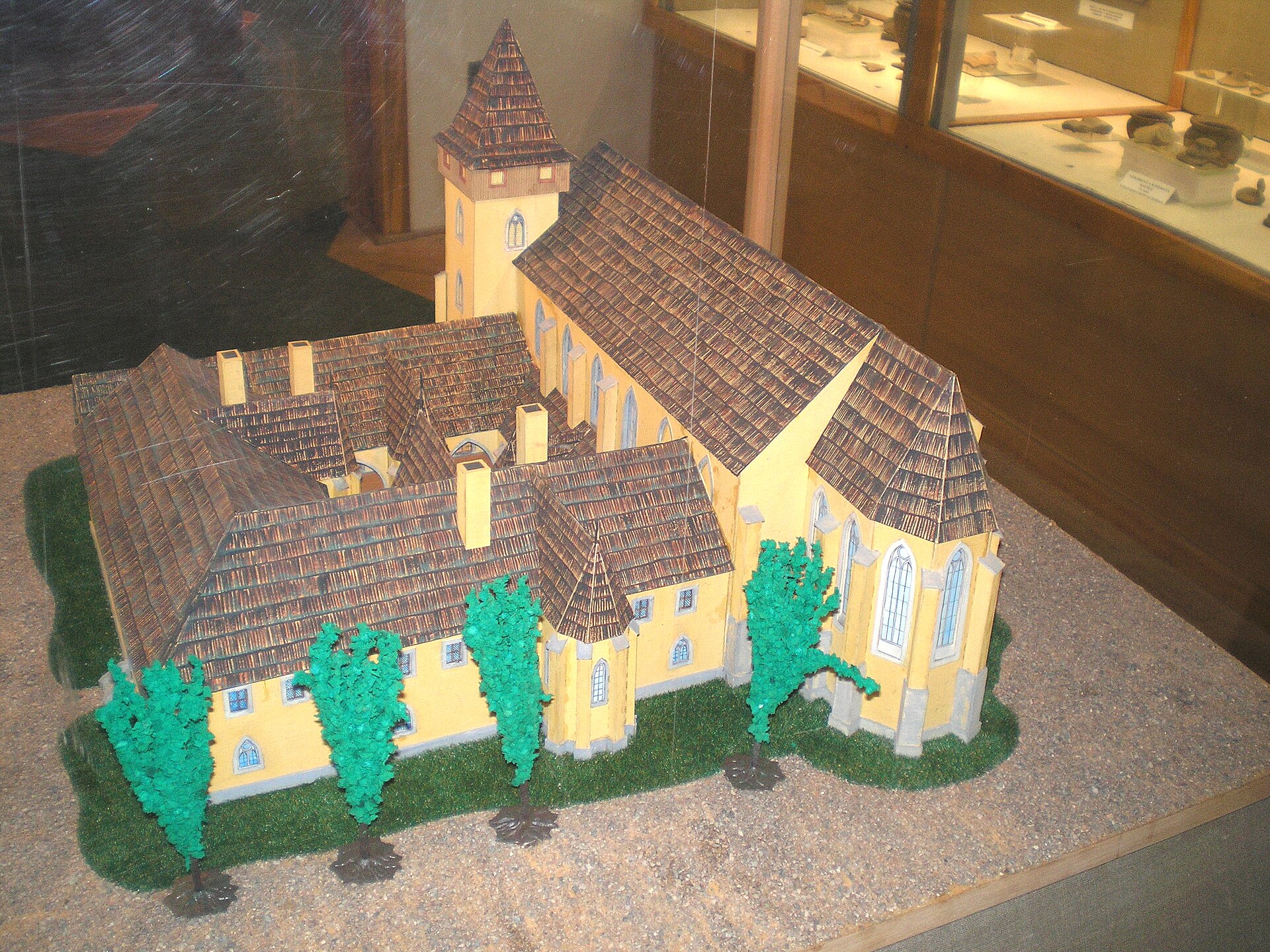
About this place
Podlažice Monastery is the site of a ruined medieval Benedictine abbey in Podlažice, now part of the town of Chrast in eastern Bohemia, Pardubice Region, Czech Republic. The place is best known as the presumed birthplace of the Codex Gigas, the famous "Devil's Bible" and the largest surviving medieval manuscript in the world.
How to get there?
Podlažice lies right next to Chrast, about 15 kilometers southeast of Chrudim and under 20 kilometers from Pardubice, the regional capital, at roughly 49.894°N, 15.949°E. Car is the most practical way to reach it, since the area lies off the main tourist routes, making it a good day trip from Pardubice or Chrudim. In Chrast itself, the town museum is worth a stop — it displays a Codex Gigas replica along with material on the monastery's history.
What will you see?
The abbey was founded around 1159 through a land donation by the knight Vrbata of Kostelec. Its first monks likely came from the abbey of Opatovice nad Labem, and Hugo is thought to have been the first abbot at Podlažice. Built in the Romanesque style, the monastery's completion in 1159 coincided with its elevation from a priory to a full abbey.
The monks of Podlažice cleared forest land, founded villages, farmed the surrounding countryside, and pursued education and manuscript art. It was within this community that the Codex Gigas is believed to have been produced — an enormous manuscript containing the complete Latin Bible along with additional texts, including the Chronicle of Bohemia by Cosmas of Prague. The book weighs around 75 kilograms and is recognized today as the largest surviving handwritten manuscript in the world. Facing financial difficulties, the monastery pawned the manuscript to the abbey at Sedlec in 1245. Legend holds the codex was written in a single night by a monk atoning for broken monastic vows, with the devil's help, whose portrait appears on one of its pages. Historians estimate the real work took a single scribe two to three decades.
Later abbots are also recorded, including Artleb, mentioned in 1318, and Domaslav the following year. By 1360, the pope had granted Podlažice's abbots the right to wear the mitre and other episcopal vestments during services, a sign of the community's elevated status. The monastery's decline came abruptly in April 1421, when Hussite forces burned the abbey to the ground; the last abbot, John, and two fellow monks were executed at nearby Rychmburk Castle. The estate first passed under Hussite administration, then came under the Bohemian crown in 1432.
In 1656, Cardinal Harrach purchased the estate for the Diocese of Hradec Králové. On the abbey's former foundations, Bishop Jan František Kryštof of Talmberk built the Church of St. Margaret, completed in 1721, which still stands today. The remaining ruins survived another century, until Bishop Karel Hanl ordered their final removal in 1834.
When to visit?
The site is best visited in the warmer months, from spring through early autumn, when conditions are pleasant for walking the grounds and visiting the Church of St. Margaret. It's worth pairing the trip with a visit to the town museum in Chrast, which covers the story of the Codex Gigas and displays its replica — the original has been held at the Royal Library in Stockholm since the mid-17th century, seized as war booty during the Thirty Years' War.
Frequently asked questions
What was Podlažice Monastery? A Benedictine monastery founded around 1159 and destroyed by Hussite forces in 1421, best known as the presumed birthplace of the Codex Gigas.
What is the Codex Gigas? The largest surviving handwritten manuscript in the world, weighing about 75 kilograms and containing the Latin Bible along with other texts; legend says it was written in a single night by a monk with the devil's help.
Where is the original Codex Gigas today? It has been kept at the Royal Library in Stockholm since the Thirty Years' War, when it was taken as war booty by Swedish forces.
What remains of Podlažice Monastery today? The monastery buildings themselves did not survive — the Church of St. Margaret was built on their foundations in the 18th century, and the last visible ruins were removed in 1834. A replica of the codex can be seen at the museum in Chrast.
Nearby places

Earn badges for the places you visit
Download NextOnTrip, discover new places and check off your trails.