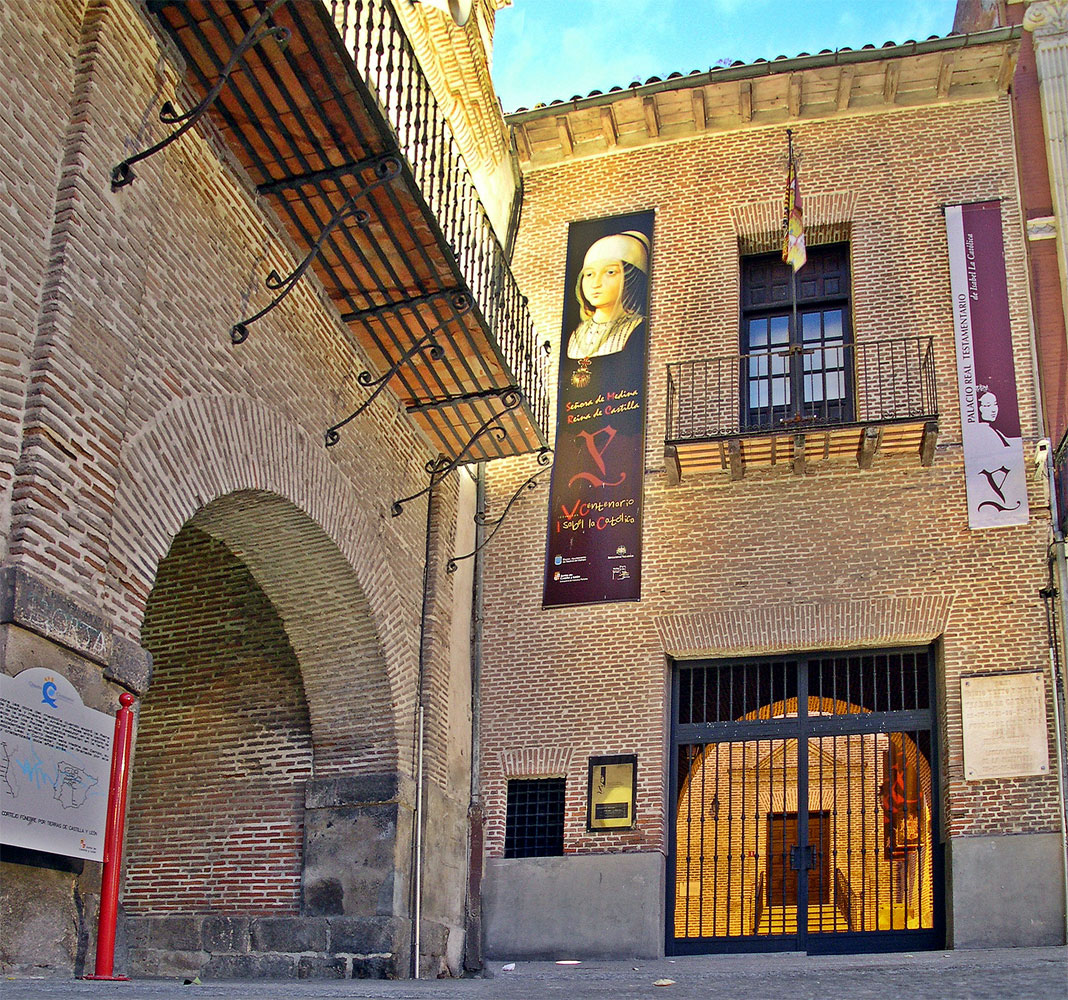
About this place
Palacio Testamentario is a historic palace in Medina del Campo, in the province of Valladolid, remembered as the place where Queen Isabella the Catholic died in 1504. The building was originally raised in the 14th century in the Mudéjar style and became one of the queen's favourite residences — she felt particularly at home in Medina del Campo. It was here, on 26 November 1504, that Isabella dictated her last will and codicil, and died only hours later. That event gave the palace its name: Testamentario, "of the testament."
Very little of the original medieval structure survives today. The current building is largely a didactic reconstruction, the result of a thorough restoration and museum-design project. Work was completed on 26 November 2003 — the anniversary of the queen's death — when the palace opened to the public as an interpretation centre dedicated to the figure of Isabella the Catholic.
What will you see inside?
The interior is arranged as an educational space that walks visitors through the queen's life and historical significance. Films, interactive screens and other multimedia exhibits cover different chapters of her biography: her childhood and youth, her rise to power, the years of her reign, and her religious devotion. The centrepiece of the exhibition is a facsimile of Isabella's original will and codicil, which visitors can explore through an interactive display explaining its contents. One room also recreates the painting "The Testament of Isabella the Catholic" by Eduardo Rosales, a 19th-century work depicting the queen dictating her final wishes — the original hangs in Madrid's Museo del Prado.
How do you get there?
Palacio Testamentario stands in the centre of Medina del Campo, a town roughly 45 km south of Valladolid. The easiest way to arrive is by car along the A-6 or A-62 motorways, or by train — Medina del Campo sits on an important rail junction with good connections to Valladolid, Salamanca and Madrid, served by both AVE high-speed and regional lines. From the train station it's usually a short walk of around fifteen minutes through the historic town centre to reach the palace.
When should you visit?
Spring and autumn are the best times to come, when temperatures across Castile are mild and the summer heat doesn't get in the way of exploring. Since the visit is mostly indoors, weather matters less here than at open-air sites, though the surrounding squares and streets of Medina del Campo are more pleasant to wander outside the hottest hours of the day. Many visitors combine the palace with other landmarks tied to Castilian history nearby, such as La Mota Castle.
How long does a visit take?
Given the compact but content-rich multimedia programme, a full visit to the interpretation centre typically takes between 45 minutes and an hour and a half, depending on how much time you spend with the audiovisual displays.
Frequently asked questions
Why is the palace called "Testamentario"? The name refers to the events of 26 November 1504, when Queen Isabella the Catholic dictated her will and codicil inside the building and died that same day.
Is the original building from Isabella's time still standing? Not entirely — very little remains of the original medieval Mudéjar structure. The current building is largely a reconstruction completed as part of a restoration finished in 2003.
What can you see at the interpretation centre? A multimedia exhibition on the life of Isabella the Catholic, a facsimile of her will and codicil with an interactive explanation of its contents, and a recreation of Eduardo Rosales's painting showing the moment she dictated her testament.
How far is Medina del Campo from Valladolid? About 45 km; the trip by car or train usually takes under an hour.
Nearby places

Earn badges for the places you visit
Download NextOnTrip, discover new places and check off your trails.