About this place
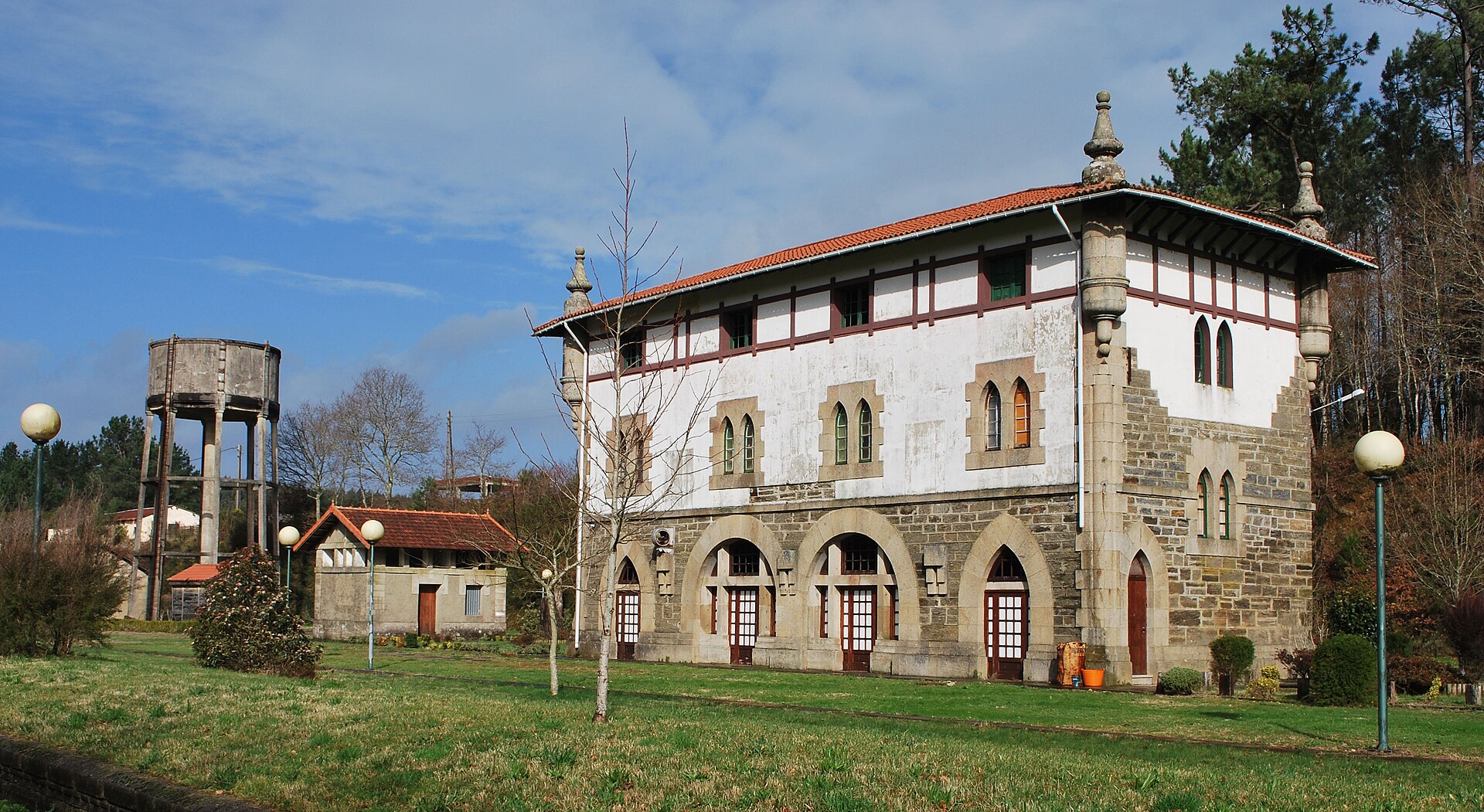
Ordes - A Pontraga train station is a disused railway station in the municipality of Ordes, in Galicia, now converted into a recreational area along a walking and cycling greenway.
Where exactly is the station?
The building stands away from the center of Ordes, in the parish of Parada, at a spot known as A Estación. This is the very place where the Lengüelle river marks the boundary between the municipalities of Ordes and Tordoia, so the station has always sat right on the edge between the two. Its coordinates are roughly 43.0536 N, 8.4469 W.
What is the history behind this place?
The station was built in 1943 as part of the railway line linking Zamora with A Coruña. The station building was designed by architect Ramón Cortázar de Urruzola (1867-1945), who modeled it on the station at Azpeitia in the Basque province of Gipuzkoa — a building that today houses a Railway Museum. The old Ordes-Pontraga station served travelers for more than six decades until 2005, when a new station opened on the same line and took over passenger traffic. The original building then lost its function as an active stop.
What can you see there today?
The main passenger building has not been fully restored and still awaits a renovation project, but the grounds around it were converted in 2008 into an open recreational area, free for locals and visitors to enjoy. The station sits along the Vía Verde de Compostela-Tambre-Lenguelle, a walking and cycling route laid out on the old railway embankment through the Lengüelle river valley. It makes for a quiet stop for a walk or bike ride, with views of the historic railway architecture set against Galicia's rural landscape. The building itself is worth a closer look — its resemblance to the Azpeitia station gives it a genuine architectural value rarely found in such a small station.
The whole complex — two plots of land and several buildings covering nearly 30,000 square meters in total — was recently and formally handed over to the Ordes municipality by ADIF, Spain's rail infrastructure manager. That transfer opens the door to further restoration of the site as local heritage.
When is the best time to visit?
Given its recreational, walking-and-cycling character, spring and autumn are the most comfortable seasons, when Galician temperatures suit longer walks or rides along the Lengüelle valley. In summer, the surrounding greenery and the shade of trees along the old track bed make it a pleasant stop during a longer outing on the Vía Verde. There are no fixed opening hours like at a ticketed attraction — it is an open public space, accessible all year round.
How do you get there?
The easiest way to reach it is by car or bicycle — the station sits directly on the Vía Verde route, so it can be worked in as a stop on a longer bike ride connecting the Ordes area with the Tambre river valley. For walkers and cyclists it acts as a natural landmark on the trail, easy to spot thanks to its distinctive station building.
Frequently asked questions
Does the Ordes - A Pontraga station still serve trains? No. The station stopped passenger service once the new station opened in 2005, and today it functions purely as a recreational site.
What is there to see at this location? The historic 1943 station building, modeled on the Azpeitia station, and the recreational grounds around it along the Vía Verde de Compostela-Tambre-Lenguelle route.
Can you visit by bicycle? Yes, the station is a stop along the walking and cycling route built on the old railway embankment beside the Lengüelle river.
Who owns the site today? The land and buildings were recently transferred to the municipality of Ordes by ADIF, Spain's rail infrastructure manager.
Nearby places

Earn badges for the places you visit
Download NextOnTrip, discover new places and check off your trails.