About this place
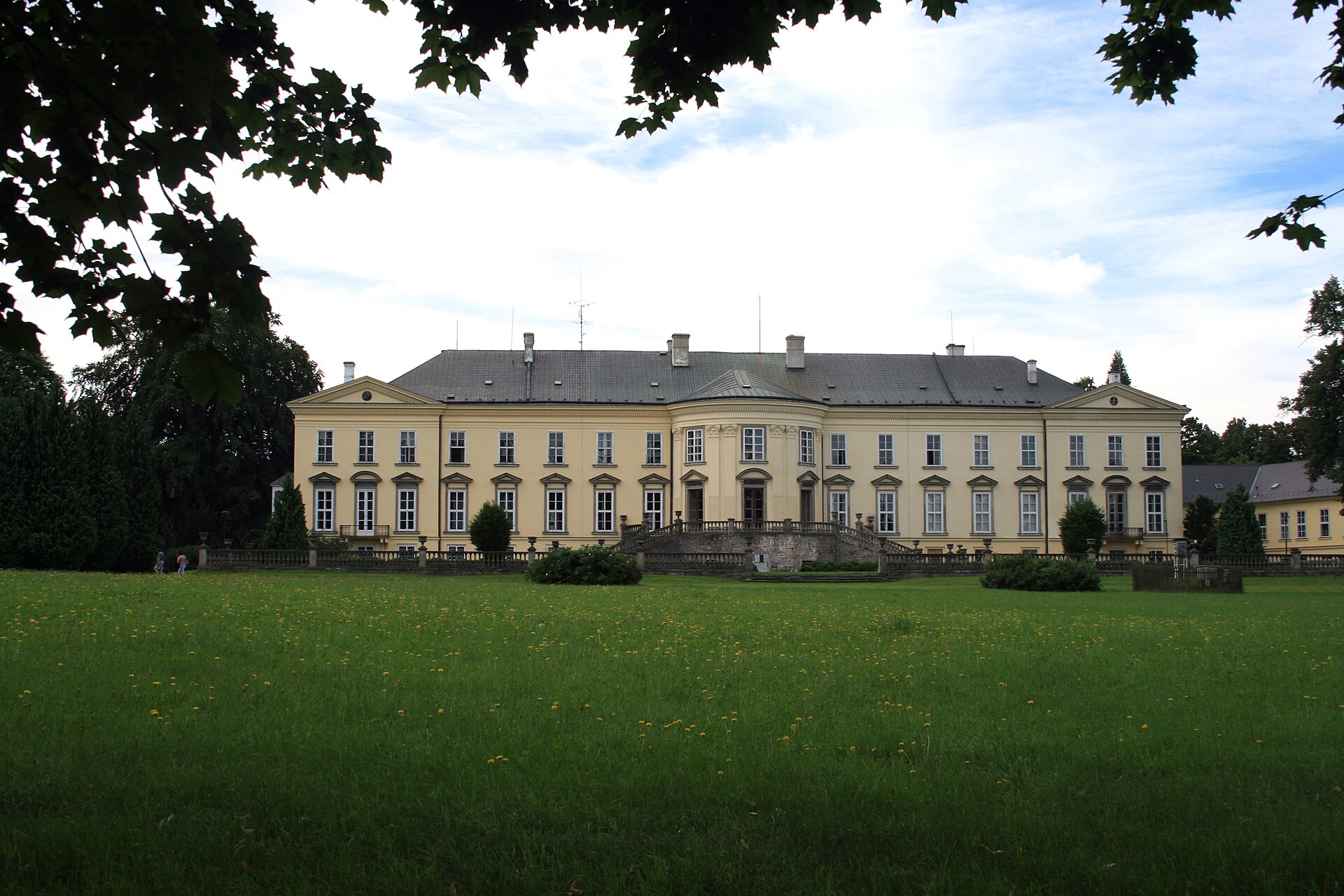
Nové Hrady Castle stands in the small South Bohemian town of the same name, close to the Austrian border at the foot of the Novohradské hory. What visitors see today is not a medieval fortress but an Empire-style residence built for the Buquoy family on the site of an older Gothic stronghold — one of the clearest examples in the region of a noble family trading a defensive castle for a classicist country house.
How did a Gothic guard post become an Empire château?
The site began as a Gothic watch-post raised in the mid-13th century to secure a trade route, held by the Rosenberg (Rožmberk) family. It suffered through the Hussite wars, burned down in 1467, was rebuilt in the first half of the 16th century, then took further hits from a gunpowder explosion in 1573 and an earthquake in 1605.
In 1620 the estate passed to Charles Bonaventura Buquoy, an imperial military commander rewarded with the property by Emperor Ferdinand II for his campaigns. The Buquoys enlarged the old castle in Baroque style, but by the mid-18th century it no longer matched the family's expectations of comfort and prestige. Johann Nepomuk Buquoy began planning an entirely new residence in the 1760s; construction of the Empire-style château, modelled on French examples, was only completed in 1806, finished by his widow, Countess Terezie Paarová, after his death.
What is inside the château?
The two-storey, three-wing building with lower flanking wings holds a handful of unusual interiors. The standout is the round Blue Salon on the first floor — a two-storey room lined in blue-and-white striped fabric meant to evoke a military campaign tent, a nod to Charles Bonaventura Buquoy's own battlefield successes. The château also has a 120-seat theatre hall, one of only three Empire-period theatres still standing in the Czech Republic — a genuine rarity.
What does the castle serve as today?
The Buquoy family lived in the château until the estate was nationalised in 1945. Afterwards the building housed a children's home and then an agricultural secondary school; it has been protected as a listed cultural monument since 1963. Today it operates as an academic and conference centre linked to the Academy of Sciences, so parts of the château can be visited on guided tours while the rest continues to serve research and conference purposes.
A short trip from the château leads to Terčino údolí, a romantic English-style landscape park associated with Countess Terezie Buquoyová, still dotted with garden follies such as the so-called Swiss house.
Frequently asked questions
Is this the same castle as the "Nové Hrady" near Litomyšl? No. Two different Czech municipalities share the name Nové Hrady — this one lies in the České Budějovice district in South Bohemia, while the other, in the Ústí nad Orlicí district, has its own separate castle ruin.
Can visitors go inside? Yes, several representative rooms, including the Empire theatre, are open on guided tours, though the building is mainly used for academic and conference purposes.
What is the château's biggest draw? The circular Blue Salon and the 120-seat Empire theatre, one of just three surviving examples of its kind in the country.
Is it worth combining with a walk nearby? Yes — the romantic park at Terčino údolí, a few kilometres away, makes a natural extension of a visit to the former Buquoy estate.
Nearby places

Earn badges for the places you visit
Download NextOnTrip, discover new places and check off your trails.