About this place
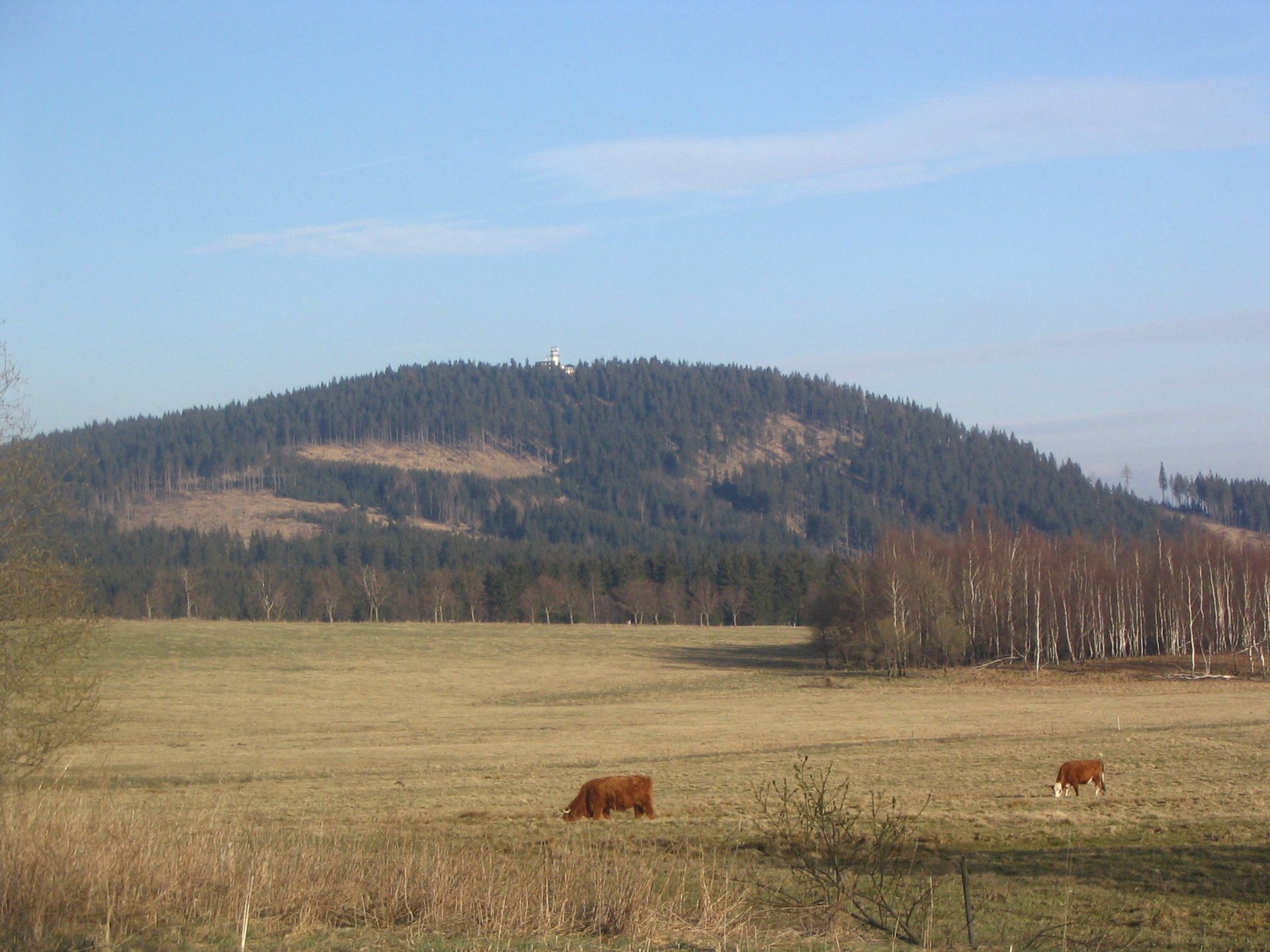
Nad Ryžovnou is an unassuming but rewarding rise in the Ore Mountains (Krušné hory), right next to the town of Boží Dar on the Czech side of the border. It's actually a small massif made up of five closely spaced summits and elevation points, whose highest section (marked HLV 254) reaches 1054 m above sea level. The hill once carried the German name Wagner Berg, a reminder of the region's history, when the area was predominantly German-speaking until the mid-20th century. Nad Ryžovnou sits right next to Božídarský Špičák, the second-highest peak in the Czech part of the Ore Mountains, placing this stretch of highland among the loftiest parts of the whole range.
Where is it and how do you get there?
The rise sits on the high plateau of the Ore Mountains, within the municipality of Boží Dar — the highest-situated town in Central Europe, at 1028 m above sea level. Boží Dar is the natural base for exploring the area: it lies on the road connecting Karlovy Vary with the German side of the mountains (a border crossing sits close to the town), and local roads and marked trails fan out from there across the plateau. The most convenient approach is to drive to Boží Dar and continue on foot or by bike — the terrain here is gently rolling with no steep climbs, making it well suited to family outings.
What will you see nearby?
The landscape around Nad Ryžovnou is typical of the Ore Mountains' high plateau: broad peat bogs, damp meadows, and spruce forest, opening up here and there into exposed, wind-swept stretches. Close by lies the Božídarské rašeliniště nature reserve, protecting some of the most valuable high-altitude peat bogs in the Czech Republic, with its distinctive bog flora. Božídarský Špičák itself, visible from the Nad Ryžovnou area, is an unusual geological feature — a nephelinite volcanic plug formed during the Miocene, the tallest formation of its kind in the entire Ore Mountains and in Central Europe. Its summit lies deep inside the reserve and has no marked trail leading to it, so it's best admired from a safe distance, for instance along the routes around Nad Ryžovnou.
When should you visit?
Summer and early autumn are when the area is most accessible — the peat bogs dry out enough for safe walking on marked paths and wooden boardwalks, and the open stretches offer views across the Ore Mountains and, on clear days, toward the Erzgebirge on the German side. In winter the Boží Dar region turns into one of the Czech Republic's most popular cross-country skiing destinations — the high plateau holds snow for a long season, and the network of ski trails extends into the area around the Nad Ryžovnou massif as well. That makes winter the season to come for cross-country skiers rather than hikers.
Frequently asked questions
Is there a marked hiking trail to Nad Ryžovnou? The massif sits in an area criss-crossed by local roads and paths radiating from Boží Dar, popular with walkers and cyclists; check a current hiking map of the area before setting out.
Is it worth combining a visit with Božídarský Špičák? Yes, the two rises sit close together and form one of the higher stretches of the Ore Mountains — though the summit of Špičák itself is off-limits to visitors, as it lies within a nature reserve with no marked trails.
How high is Nad Ryžovnou? The massif's highest point (HLV 254) reaches 1054 m above sea level, slightly below nearby Boží Dar (1028 m) and Božídarský Špičák (1116 m).
Is this a good spot for families with children? Yes — the surrounding terrain is gently rolling with no demanding climbs, making it well suited to easy, short walks through the scenery of a high mountain plateau.
Nearby places

Earn badges for the places you visit
Download NextOnTrip, discover new places and check off your trails.