About this place
Moulin de Plaisance in Beslé
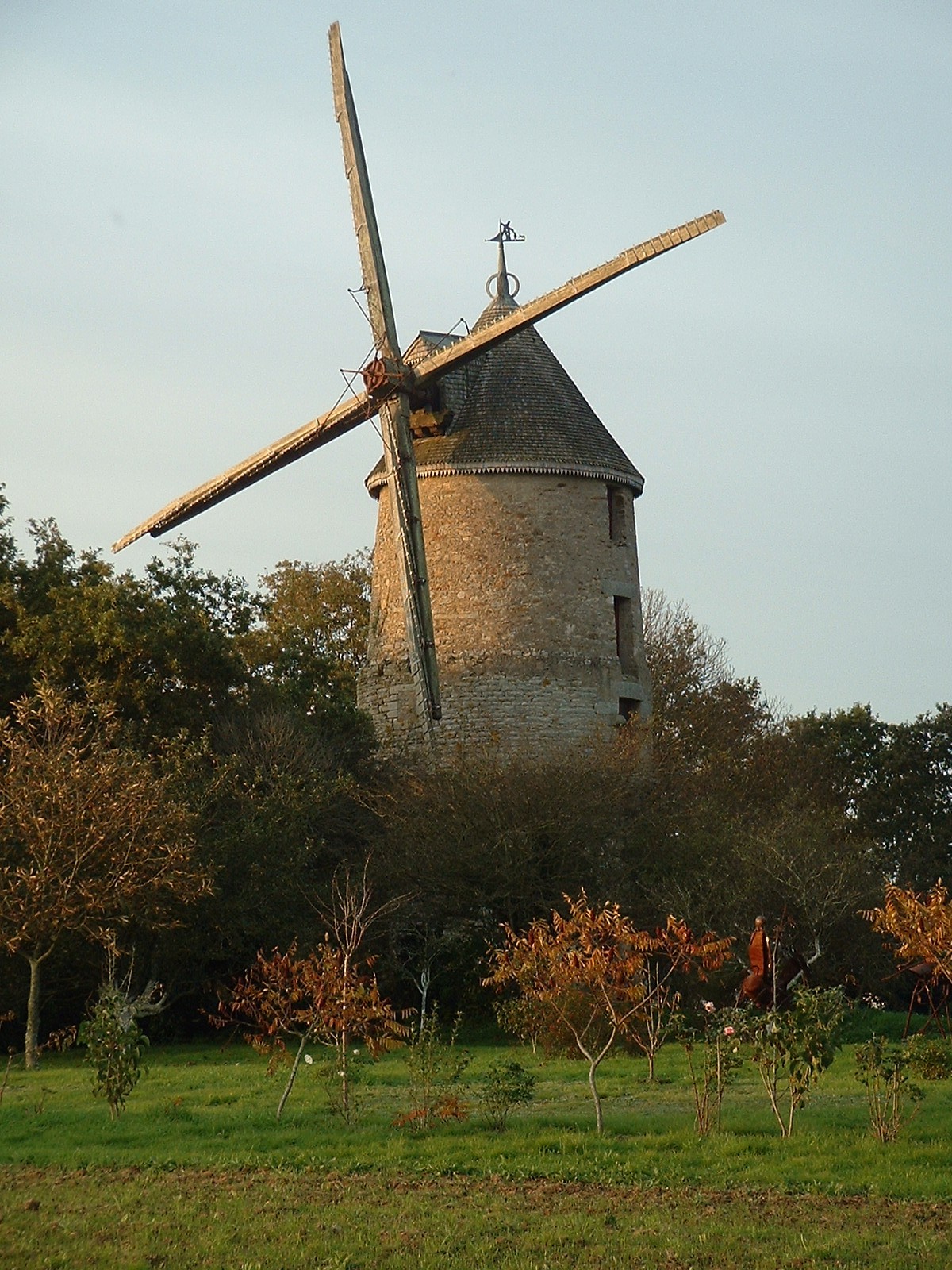
Moulin de Plaisance is a former windmill standing on a hilltop above Beslé, a hamlet in the commune of Guémené-Penfao, in the Loire-Atlantique department of France. Built to grind grain, the mill worked for about a century and a half before being converted into holiday accommodation, while still keeping the machinery installed during its industrial years on display.
Where exactly does the mill stand?
The building sits on a low hill locally known as the "butte de Plaisance," just south of Beslé near the hamlet of Richebourg. Villagers nicknamed this rise the "hill of the two mills," because a rival windmill, the Moulin de la Grenouillère, once stood only about 150 metres away. Two windmills sharing a single hilltop was no accident: the spot catches winds funnelled up from the Vilaine valley below, which is exactly what made it worth building on in the first place.
When was it built, and who owned it?
No exact construction date survives for Moulin de Plaisance. What is known is that in 1836 the cadastral records for the area still listed only the Grenouillère mill, which suggests Plaisance was raised sometime afterward, most likely in the second half of the 19th century. For decades the property belonged to the Baudouin family, who held onto it until 1935, the same year it was sold and began its transition into an industrial building.
Local storytelling adds a rivalry to the picture: the miller at Plaisance is said to have accused his neighbour at Grenouillère of "stealing his wind" and demanded the other mill's sails be taken down. A surviving early-20th-century postcard, however, shows the Grenouillère mill still fitted with sails afterward, so the tale reads more as village folklore than documented history.
Why did the sails disappear and motors take their place?
Like many French windmills of its era, Plaisance went through a wave of mechanization during the 20th century. Its sails, which had once turned the millstones directly, were removed and replaced by a steam engine installed around 1935. A second round of upgrades followed in the 1960s, when two diesel engines were fitted. One of them, a Ruston & Hornsby unit built in the 1920s, was bought second-hand from a sawmill in Nantes and hauled to the site by truck in pieces.
When did the mill stop working?
Milling activity at Moulin de Plaisance ended in 1987, closing out roughly a century and a half of continuous use. The tower still stands today, and so do the traces of that later industrial phase: the diesel motors and the gearing that once drove the millstones remain visible inside.
What is there to see at Moulin de Plaisance now?
The mill buildings have since been converted for tourism. The old grain store now houses a holiday cottage called "Le Magasin," while the building that once held the milling equipment has become a second gîte, "La Minoterie." Both sit high enough on the hill to look out over the Pays de Redon countryside and the marshy stretches along the Vilaine. Because the site lies roughly midway between Nantes, Rennes and Vannes, the Atlantic coast is only about an hour's drive away.
Frequently asked questions
Was Moulin de Plaisance a watermill or a windmill? It was a windmill. Its original power came from sails catching wind on the hilltop, not from the current of the nearby Vilaine river.
Where exactly is the mill located? On the "butte de Plaisance" hill next to Beslé, in the commune of Guémené-Penfao, Loire-Atlantique, close to the hamlet of Richebourg.
Did it have a rival mill nearby? Yes — the Moulin de la Grenouillère stood about 150 metres away, and local legend links the two mills through a story of quarrelling millers.
Can visitors stay overnight at the mill? Yes, the former grain store and milling building now operate as two gîtes, "Le Magasin" and "La Minoterie."
Nearby places

Earn badges for the places you visit
Download NextOnTrip, discover new places and check off your trails.