About this place
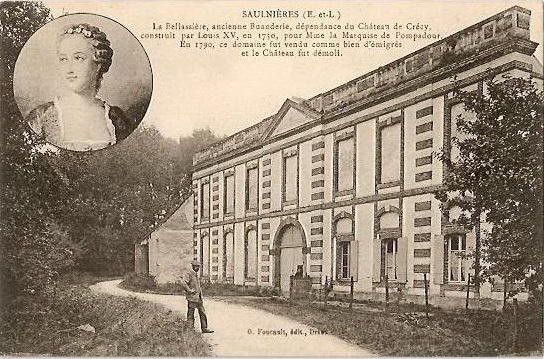
Moulin de la Bellassière is an old watermill in the village of Crécy-Couvé, in the Eure-et-Loir department of France, standing on the banks of the Blaise river at the southern end of the Bellassière canal. What draws visitors here is not the milling machinery but an extraordinary 18th-century facade commissioned by the Marquise de Pompadour — one of the more unusual examples of architectural trompe-l'œil found anywhere in France.
How old is the mill and where does its story begin?
The mill's roots go back to the 11th century, when it operated as an ordinary grain mill grinding wheat for the surrounding farmland. Its fortunes changed sharply in 1746, when Louis XV gave the nearby château of Crécy to Madame de Pompadour. Between 1750 and 1754 she carried out a full remodeling of the village, and the mill became part of that broader plan.
Why does the mill's facade look like it belongs to a different building?
Around 1750, on the marquise's orders, an ornamental facade-fronton was erected in front of the working mill. Its purpose had nothing to do with grinding grain — it was built purely to hide the mill from view and to match visually with the small château d'Aunay, both of which could be seen from the terraces of the château de Crécy. Pompadour wanted the outlook from her residence to feel harmonious, so the new facade was made entirely blind: the window openings are only marked into the stonework, with no glass and no rooms behind them. Its most recognizable features are the cornice, a balustrade topped with acroteria, and a small triangular pediment set above the entrance porch. The facade was added to the French register of historic monuments by a decree issued in December 1992.
What happened inside the mill after Pompadour's renovation?
Around the same time, roughly 1750, the interior of the mill was converted for the château's household use, becoming a laundry and a winter garden serving the estate. The château de Crécy itself no longer exists today, which makes the mill and its striking fronton one of the few tangible traces left of Pompadour's presence in the area.
What is there to see in the Garden of Six Senses?
Since 2003 a local association has run activities at the mill, organizing exhibitions, talks, and visits for groups interested in the site's history. In May 2013 the grounds opened a garden called "Pas de sens interdit," the Garden of Six Senses, designed from the outset to be usable by everyone — children, older visitors, and people with disabilities alike. The garden is laid out as a series of separate plant "rooms": an ornamental garden in a classical style, vegetable beds, an orchard of old apple, pear, and peach varieties trained as espaliers, and a corner devoted to medicinal plants. Species were chosen for how they look, smell, taste, and feel, so a walk through the garden engages several senses at once rather than just sight.
How can visitors plan a trip to the Moulin de la Bellassière?
Access to the mill and garden is by prior arrangement with the association that runs the site. Beyond scheduled visits, the mill also opens for occasional events during the year, including France's Journées du Patrimoine (Heritage Days), when guided tours and extra background on the mill and the Marquise de Pompadour are typically on offer.
Frequently asked questions
Where exactly is the Moulin de la Bellassière located? In Crécy-Couvé, in the Eure-et-Loir department, on the banks of the Blaise river at the southern end of the Bellassière canal.
Was it originally a working grain mill? Yes, records trace it back as a grain mill to the 11th century, before its role changed in the 18th century under Madame de Pompadour.
What exactly is the facade-fronton? It is an ornamental, entirely blind facade built around 1750 to conceal the mill and improve the view from the château de Crécy — a notable case of architectural trompe-l'œil.
Is the facade a protected historic monument? Yes, the facade-fronton was listed as a monument historique by a decree dated December 1992.
What is the "Pas de sens interdit" garden? It is a Garden of Six Senses opened in May 2013, designed to be accessible to all visitors, with sections for ornamental planting, vegetables, an orchard, and medicinal herbs.
Do you need to book a visit in advance? Yes, visits to the mill and garden are arranged in advance with the association that manages the site.
Nearby places

Earn badges for the places you visit
Download NextOnTrip, discover new places and check off your trails.