About this place
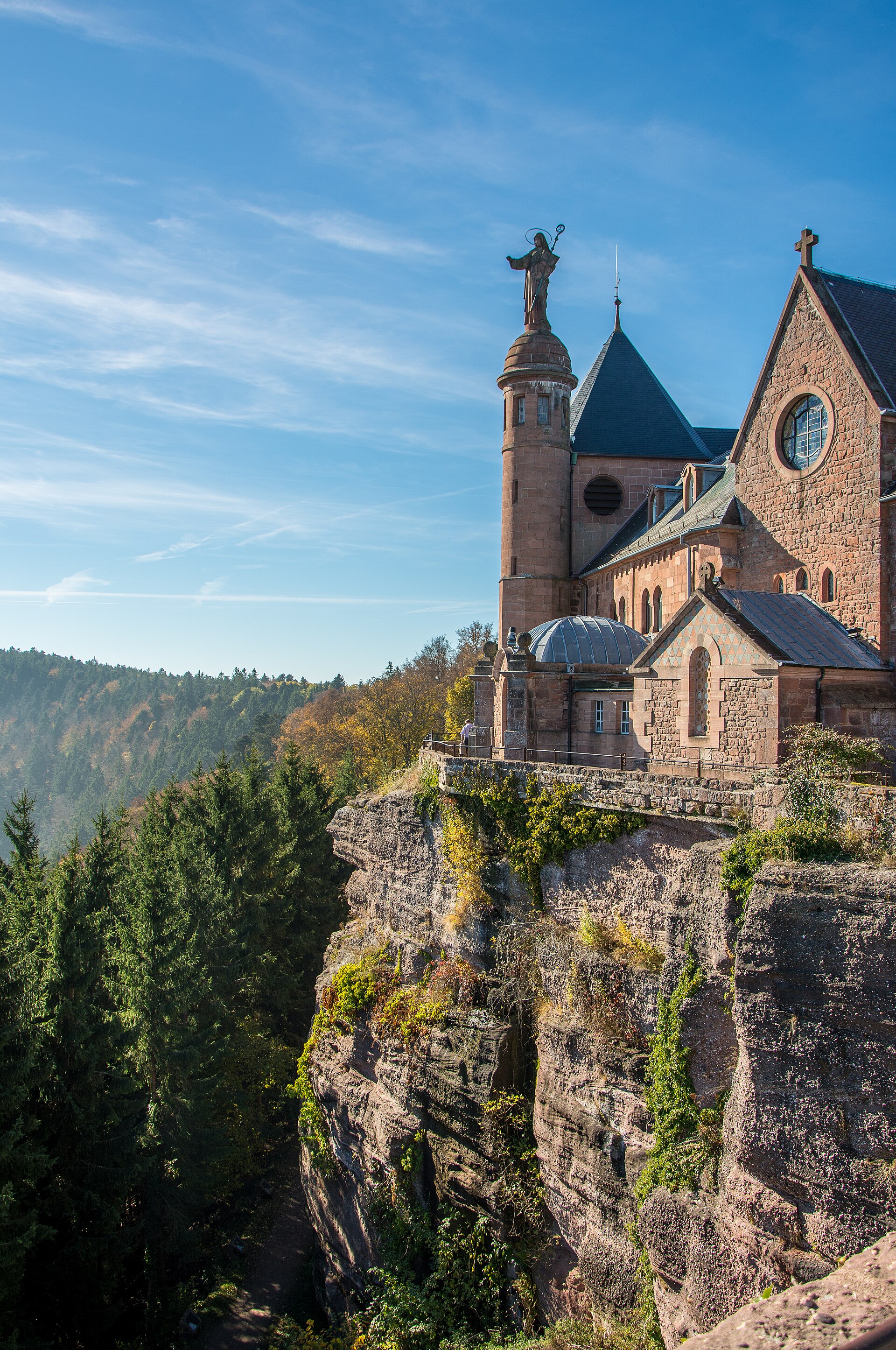
Mont Sainte-Odile Abbey (also called Hohenburg Abbey) crowns one of the best-known summits of the Vosges mountains, above the village of Ottrott in the Bas-Rhin department of Alsace. Perched at roughly 760 metres above sea level, the abbey has been the region's foremost pilgrimage destination for over a thousand years, forever linked to Saint Odile, the patron saint of Alsace.
Where exactly is the abbey located?
The abbey sits on Mont Sainte-Odile in the Vosges range, close to the towns of Ottrott and Obernai, which serve as the starting points for most walking trails up the mountain. From the terrace beside the monastery, visitors get sweeping views over the Alsace plain and the Rhine valley, and on clear days even across to the Black Forest on the German side of the border. That panorama has drawn both pilgrims and travelers here for centuries.
Who was Saint Odile, and why was an abbey founded here?
According to tradition, Odile was born blind at the end of the 7th century, the daughter of Adalric (Etichon), Duke of Alsace. Her father is said to have rejected her because of her blindness and her sex, so she was sent away to be raised at a monastery in Burgundy. The story goes that at age twelve she was baptized by the itinerant bishop Erhard of Regensburg, who gave her the name Odile — and that she miraculously regained her sight at the moment of her baptism. When her father later fell seriously ill, Odile returned to nurse him, and the two reconciled. Adalric is then said to have founded a monastery for his daughter at the mountain's summit, where she became the first abbess. Odile later established a second community lower down, at Niedermünster, which included a hospital for the sick.
Why is Odile considered the patron saint of Alsace?
Veneration of Saint Odile as protector of the region, and of the blind and those suffering from eye ailments, had already existed for centuries before Pope Pius VII formally confirmed her patronage in 1807. Her feast day falls on 13 December, observed in Alsace itself a day later, on 14 December. A spring on the abbey grounds has long been credited with healing properties, particularly for eye conditions, and remains one of the reasons pilgrims still come here seeking cures or quiet reflection.
What else is worth seeing nearby?
Encircling the summit of Mont Sainte-Odile is the so-called Pagan Wall (Mur Païen), a massive stone rampart roughly 10 kilometres long, built from hundreds of thousands of rock blocks. Its exact age and origin are still debated among researchers, but its sheer scale makes it a popular stop for walkers combining a hike with a visit to the abbey. The monastic complex itself, with its chapels, shrines, and viewing terrace, continues to function as a living religious community and place of prayer, rather than existing purely as a historic monument.
Frequently asked questions
Can visitors tour the abbey? Yes, the abbey grounds are open to the public, and the chapels remain accessible to both pilgrims and tourists.
How do you get to Mont Sainte-Odile? Most visitors approach via Ottrott or Obernai; given the mountainous terrain, many choose to walk up through the forest rather than drive all the way to the top.
What is the Pagan Wall? It is an extensive stone wall encircling the summit for about 10 kilometres, whose precise origin remains a subject of archaeological research.
Why does Saint Odile matter so much to Alsace? Tradition holds that she founded both the abbey at the summit and the second monastery at its foot, and her cult as patron saint of the region and of those with eyesight problems has continued unbroken since the Middle Ages.
Nearby places

Earn badges for the places you visit
Download NextOnTrip, discover new places and check off your trails.