About this place
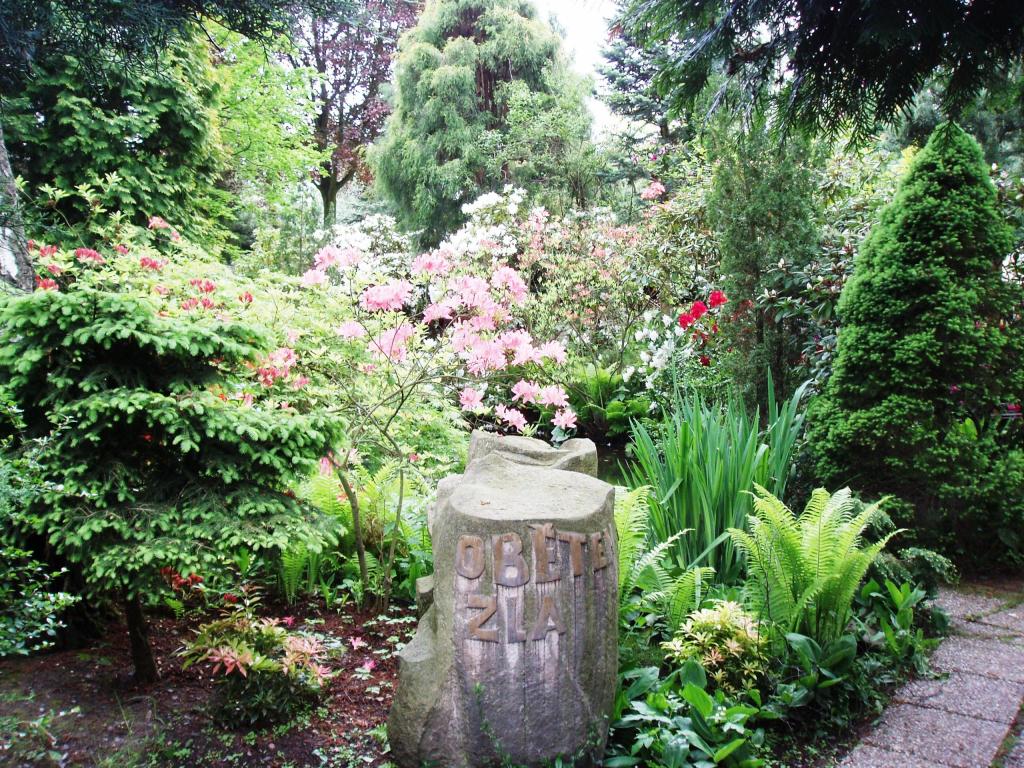
Meditation Garden in Pilsen (Meditační zahrada) is an unusual site that blends a landscaped park with a memorial to the victims of totalitarian rule. It grew out of a family orchard in the Doudlevce district, on the southern edge of the city, and today ranks among Pilsen's most distinctive attractions — not for its scale, but for the story behind it.
Who created the garden?
The Meditation Garden was the life's work of Luboš Hruška (1927–2007), a political prisoner of the communist era. Sentenced to 18 years in prison in the late 1940s, he actually spent 11 years behind bars. While imprisoned, he made himself a promise: if he survived and returned home, he would turn his family's fruit orchard into a place commemorating the victims of evil. After his release in 1960, he began carrying out that plan — gradually removing the fruit trees and replacing them with hundreds of conifers and rare ornamental plants, shaping a unique green space in the style of an English landscape park, complete with two ponds.
What will you find on site?
At the heart of the site stands a stone Way of the Cross, created between 1986 and 1991 by academic sculptor Roman Podrázský. It consists of fourteen stations depicted across twelve life-size figures carved from Hořice sandstone. The spiritual center of the whole complex, known as the Memorial to the Victims of Evil, is the Chapel of St. Maximilian Kolbe — a Polish Franciscan friar who gave his life for a fellow prisoner at Auschwitz. Beyond the sculptural and sacred elements, the garden impresses with its dense collection of conifers and ornamental plants arranged around the two ponds, creating a calm, contemplative setting rather than a conventional sightseeing stop.
How to get there and when to visit?
The garden lies in the Doudlevce district near Tyršův Bridge, south of Pilsen's city center — an easy walk or short ride on public transport for anyone staying in the city. It operates seasonally, roughly from spring to mid-autumn (April through mid-October), typically open Wednesday through Sunday during daytime hours, with Mondays and Tuesdays closed. A modest admission fee applies. Because opening hours can shift from year to year, it's worth checking the garden's current schedule before visiting.
Who is it for?
The Meditation Garden suits visitors looking for a quiet break away from the city's bustle, as well as anyone interested in modern Czech history — the communist-era repressions and the fate of political prisoners. It's a rare example of personal suffering channeled into a lasting, publicly accessible act of remembrance rather than kept private. Walking among the conifers, the ponds, and the stations of the Way of the Cross is a different kind of experience than visiting a typical monument — closer to contemplation than classic sightseeing.
What happened to it after 1989?
Following the Velvet Revolution, the garden opened to the public in 1990. In 1995, Luboš Hruška donated the entire site to the Diocese of Plzeň, which remains its owner today and maintains both the greenery and the sacred parts of the memorial.
Frequently asked questions
Who founded the Meditation Garden in Pilsen, and why? It was founded by Luboš Hruška, a communist-era political prisoner who, after 11 years in prison, turned his family orchard into a memorial to the victims of evil, fulfilling a promise he made to himself while incarcerated.
What can visitors see in the garden? A stone Way of the Cross with fourteen stations carved in sandstone by Roman Podrázský, the Chapel of St. Maximilian Kolbe, two ponds, and hundreds of conifers and rare ornamental plants.
Where exactly is the garden located? In Pilsen's Doudlevce district, near Tyršův Bridge, on the southern edge of the city.
Is the garden open all year round? No — it operates seasonally, roughly from spring to autumn, typically Wednesday through Sunday, closed on Mondays and Tuesdays. It's best to check current hours before a visit.
Who owns the garden today? Since 1995 the garden has belonged to the Diocese of Plzeň, donated to it by its founder, Luboš Hruška.
Nearby places


Earn badges for the places you visit
Download NextOnTrip, discover new places and check off your trails.