About this place
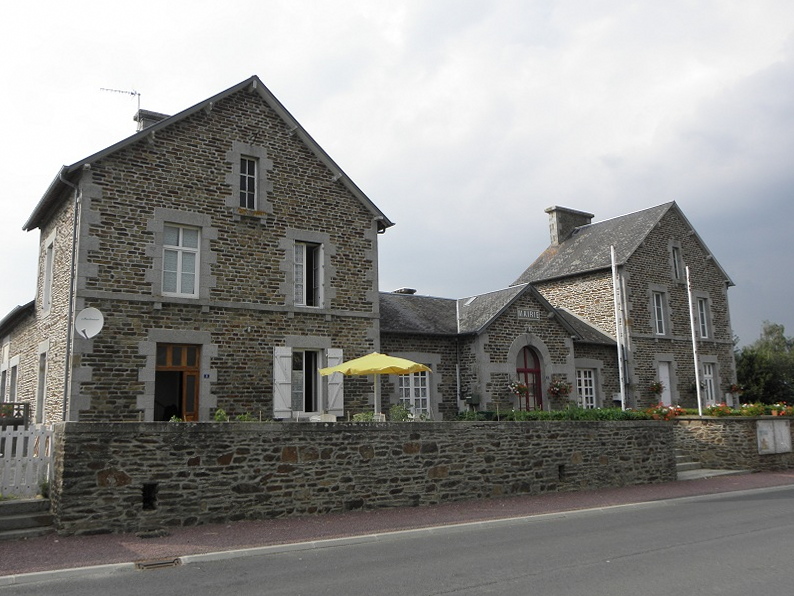
Mairie déléguée de Bellefontaine is the former town hall of the small village of Bellefontaine, now one of seven delegated communities that make up Juvigny les Vallées, a commune in the Manche department of Normandy. The new commune's name — "Juvigny les Vallées" — refers to the valleys of the Sée and Sélune rivers and their many tributaries that cross the local landscape. Bellefontaine, home to fewer than 140 residents, has kept its own identity and its former town hall building, though residents now handle administrative business at the main town hall in Juvigny-le-Tertre.
Where does the name Bellefontaine come from?
The village name appears in records as far back as the 12th century, in Latin forms such as "apud Bellum fontem" and "de Bello fonte." It derives from the Latin "fontana," the root of the French word "fontaine," which originally simply meant a spring. "Belle" is a straightforward complimentary adjective, so the whole name literally means "beautiful spring." The modern spelling "Bellefontaine" was already fixed in documents by the 17th century.
What is the history behind this place?
Traces of ancient settlement have been found on the territory of present-day Bellefontaine, leading some researchers to link the site with the Roman settlement of Ambibarii. In the medieval period, the village was tied to the Avenel family — one of whom, lord of Biards and Bellefontaine, accompanied Robert of Mortain and Duke William on the conquest of England in 1066. In 1654, King Louis XIV elevated the local barony to a marquisate. The last lord of Bellefontaine was the Marquis de Cerisy-la-Salle, Georges de Cheverue, who emigrated to Jersey after the Revolution in 1790 and was still living there in 1805. The village's modern chapter began on 1 January 2017, when Bellefontaine merged with six neighboring communes — Chasseguey, Chérencé-le-Roussel, Juvigny-le-Tertre, La Bazoge, Mesnil-Rainfray and Mesnil-Tôve — to form the new commune of Juvigny les Vallées.
What can visitors see near the old town hall?
The main landmark in Bellefontaine is the Church of Saint Martin, built in the 17th and 18th centuries. A distinctive feature is its ridge cross decorated with a fleur-de-lis motif, dating from the 15th century — considerably older than the church building itself. Inside, visitors will find an 18th-century main altar with its retable, a pulpit from the same period, and a baptismal font dating back to the Middle Ages. It's a modest but genuine record of the region's centuries-old religious history.
Families traveling with children often make a stop at Village Enchanté, an amusement park created in 1972 on fifteen hectares by schoolteacher Gilbert Lefèvre and his wife Janine, a farmer by trade. The park's original concept drew on the fairy tales of Andersen, the Brothers Grimm, and Charles Perrault, which still gives it the feel of a family attraction rooted in classic storytelling.
Who is this destination for?
Bellefontaine and the surrounding Juvigny les Vallées area suit travelers who appreciate quiet, rural Normandy away from the crowds: river valleys, small parish churches, and local history reaching back to the Norman conquest of England. It also makes a convenient base for families thanks to the nearby theme park.
Frequently Asked Questions
Does Bellefontaine still have its own town hall? No — since the 2017 merger of communes, residents' administrative business is handled centrally at the Juvigny les Vallées town hall, located in Juvigny-le-Tertre.
Where does the name Bellefontaine come from? The name derives from a Latin phrase meaning "beautiful spring" and has appeared in documents since as early as the 12th century.
What is there to see in Bellefontaine itself? Chiefly the Church of Saint Martin, built in the 17th–18th centuries, notable for its 15th-century ridge cross and its medieval baptismal font.
Is Bellefontaine a good destination for families with children? Yes — nearby is the Village Enchanté amusement park, founded in 1972 and inspired by classic European fairy tales.
Nearby places

Earn badges for the places you visit
Download NextOnTrip, discover new places and check off your trails.