About this place
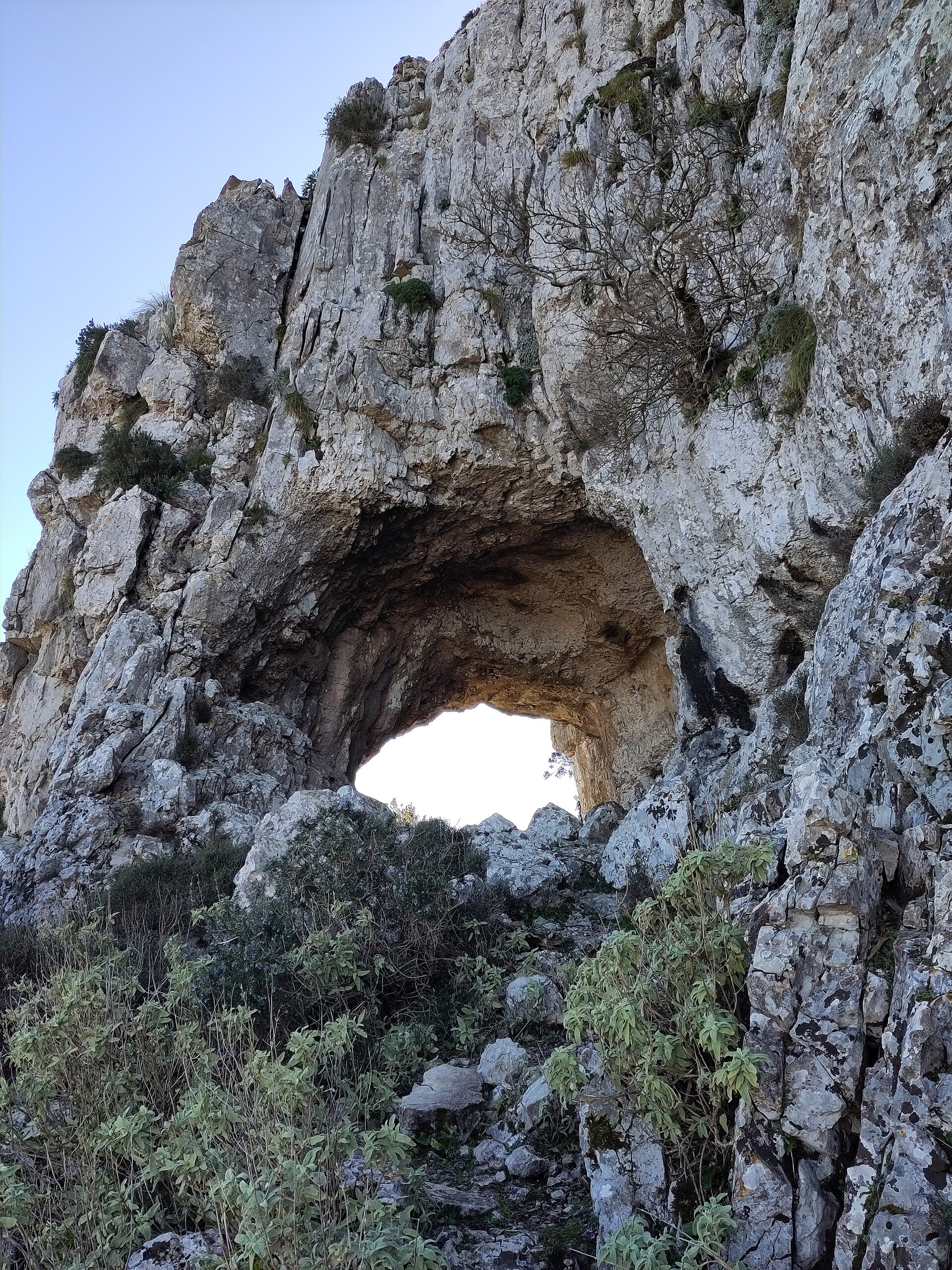
l'Ull de Déu, in the municipality of Escorca, is a natural hole carved through the rock on the slopes of Puig de ses Moles, deep in Mallorca's Serra de Tramuntana. The Catalan name translates as "Eye of God," describing the striking window-like opening visible from a distance in the mountain ridge. Locally it's also known as "Forat de ses Moles," and in Spanish as "Ojo de Dios."
Where is l'Ull de Déu?
The opening sits on the north face of Puig de ses Moles, in a remote and rugged stretch of the Tramuntana range. From here the ground drops away toward Lavanor and Mortitx, with the Pollença area beyond, and on clear days the northern coastline of Mallorca appears in the distance. The setting is stark: bare rock and low, hardy scrub dominate, typical of the range's higher reaches.
How do you get to l'Ull de Déu?
Two main hiking routes lead to the formation, and both demand solid fitness and preparation.
The first starts at the Mortitx estate, reached from the Ma-10 road between Lluc and Pollença, around kilometre 10.9. The path follows the Camí de Lavanor, passing the Lavanor refuge and the Font Blanca spring, with the Embalse de ses Comes reservoir and the Coll Ciuró pass also visible along the way. This route covers roughly 12 km with over 500 metres of elevation gain, and typically takes 6 to 7 hours round trip.
The second option begins at the Femenia estate, from the Coll de Femenia pass on the Pollença–Lluc road, crossing the Femenia Nou and Femenia Vell grounds. The entire route runs through private land, so staying on the path and leaving no trace matters here. This variant is often combined with a climb to the neighbouring Puig Caragoler de Femenia and a crossing of the Pas des Puig section, stretching the total distance to about 12.7 km with over 800 metres of climbing.
Both routes include technical stretches — scrambling over rock, narrow passages, and steep sections — so this isn't a hike for beginners.
What will you see there?
The rock opening itself is striking simply for its shape: a natural window framing the valley below and the folds of the Tramuntana beyond. The viewpoint at Ull de Déu ranks among the more dramatic in this part of the range, pairing jagged close-up rock with a distant sweep of coastline. Depending on the route taken, the walk also passes springs, mountain passes, and traces of old shepherd trails.
When should you visit?
Autumn, winter, and spring are the best seasons, since mountain temperatures are far more forgiving than in summer — heat and a lack of shade can turn this long, technical route exhausting. One thing to check before setting out: between February and June, access to the Mortitx estate is often restricted to the Lavanor refuge only, as this is the nesting season for the black vulture (voltor negre), a protected species breeding in these cliffs. Local access rules should be confirmed ahead of any visit.
Frequently asked questions
Is the hike to Ull de Déu difficult? Yes — it's a moderate-to-demanding route with technical scrambling sections, a long duration (6–7 hours), and considerable elevation gain, making it unsuitable for inexperienced hikers.
Where's the best place to start the hike? Most hikers start from the Mortitx estate off the Ma-10 road between Lluc and Pollença, following the Camí de Lavanor. An alternative is the approach from Coll de Femenia, though that route crosses private land that must be respected.
Is access to Ull de Déu restricted in summer? Not in summer — rather, between February and June, access to the Mortitx estate is often limited to the Lavanor refuge because of the black vulture's nesting season in the surrounding cliffs.
What can you see from Ull de Déu? From the rock opening and the nearby viewpoint you can look out over Lavanor, Mortitx, and the Pollença area, with a stretch of Mallorca's northern coast visible on clear days.
Nearby places

Earn badges for the places you visit
Download NextOnTrip, discover new places and check off your trails.