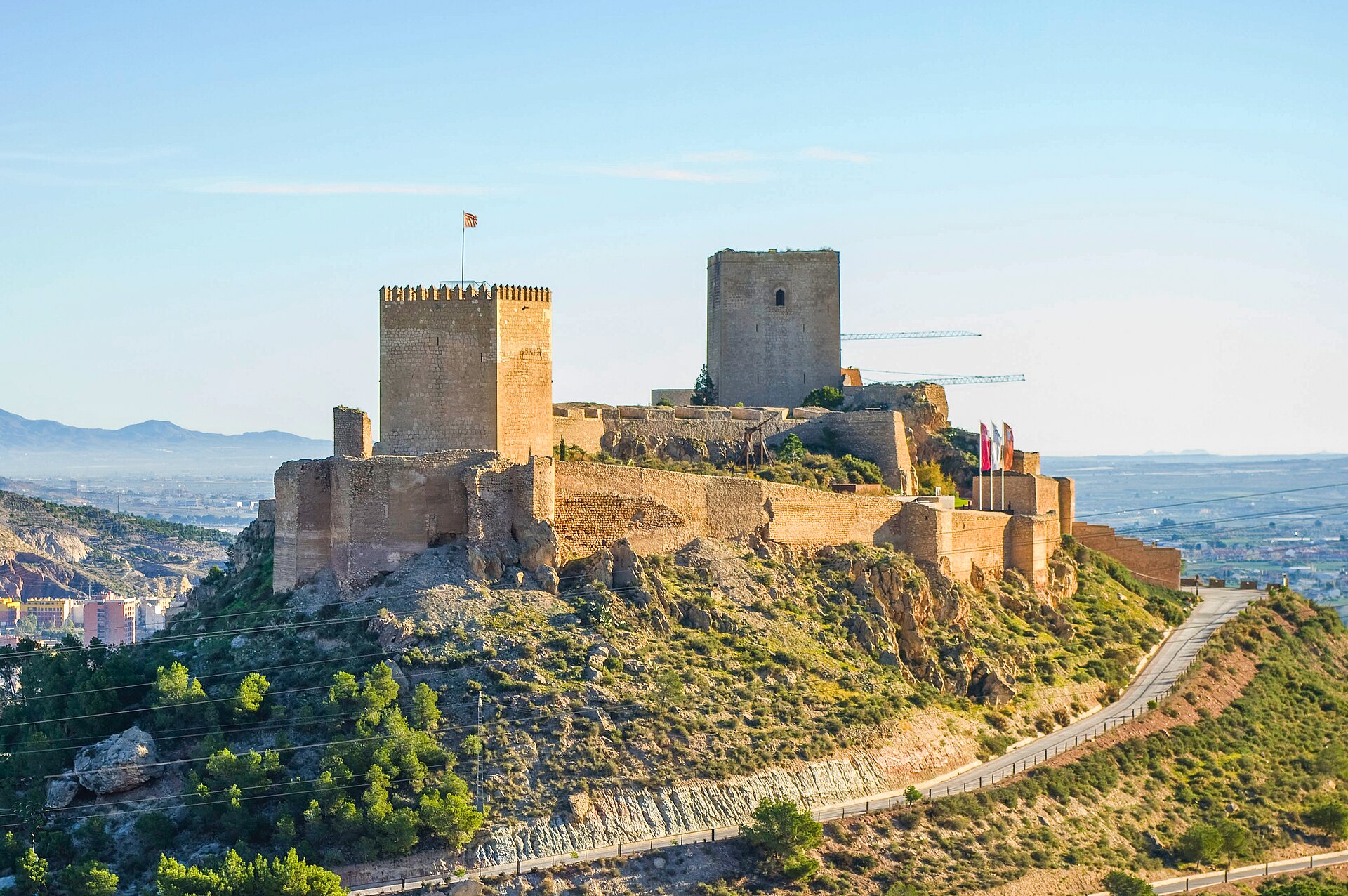
About this place
Lorca Castle, also known as the Fortaleza del Sol (Fortress of the Sun), overlooks the town of Lorca in the Murcia region of southeastern Spain. Built in stages between the 9th and 15th centuries, it ranks among the largest castles in the country, stretching roughly 640 meters in length and 120 meters in width. For centuries this fortress was a frontline stronghold on the border between the Christian and Muslim territories of the Iberian Peninsula.
How do you get there?
The castle hill rises directly above Lorca's historic center, so the walk up from the main square is the most straightforward option. A local tourist train also runs from the former Convent of La Merced up to the fortress. Drivers will find parking near the entrance, followed by a short but steep climb to the main gate.
What can you see inside?
The complex is dominated by two towers built on the orders of King Alfonso X the Wise after he conquered the town in 1244: the Alfonsina Tower and the Espolón Tower. Alfonso X expanded and reinforced the fortifications, turning Lorca into one of the key border points between the Christian Kingdom of Murcia and the Muslim Emirate of Granada — a frontier that held for roughly 250 years until Granada fell in 1492.
Inside the walls runs the so-called Espaldón Wall, which split the older Muslim-era fortress into two zones: a western section once used for grain storage and livestock, and an eastern section built for defense and residential use.
One of the castle's most remarkable finds is a 14th-century Jewish quarter, uncovered during archaeological work ahead of the parador's construction. Spread across roughly 5,700 square meters, the site revealed twelve houses and a Gothic-style synagogue — the only one discovered so far in the Murcia region. Surviving traces inside the synagogue include a Torah niche, a raised bimah platform, and a separate area set aside for women.
Today the castle also functions as a luxury parador hotel, letting visitors experience the fortress atmosphere well into the evening. The site hosts historical re-enactments through the "Lorca Taller del Tiempo" project, which brings the daily life of a medieval border town back to life for visitors.
It's worth knowing that the 2011 Lorca earthquake seriously damaged sections of the defensive walls and the Espolón Tower; their current condition reflects ongoing restoration work carried out since then.
When is the best time to visit?
Because the approach is steep and largely unshaded, spring and autumn offer the most comfortable conditions, avoiding Murcia's peak summer heat. In summer, evening visits let you skip the midday sun and catch the town skyline at sunset.
Frequently asked questions
Is Lorca Castle a protected heritage site? Yes. It was declared a National Historic Monument in 1931, after earlier being recognized as a Site of Cultural Interest (Bien de Interés Cultural).
Can you stay overnight inside the castle? Yes — a parador, part of Spain's state-run network of heritage hotels, operates within the castle walls.
What was found in the Jewish quarter? Excavations uncovered twelve houses and a Gothic synagogue with a Torah niche, a bimah, and a women's section — the only synagogue of its kind found in the Murcia region.
Why was the castle so strategically important? For about 250 years it marked the border between the Christian Kingdom of Murcia and the Muslim Emirate of Granada, only losing its strategic role after Granada fell in 1492.
Nearby places

Earn badges for the places you visit
Download NextOnTrip, discover new places and check off your trails.