About this place
Liblice Chateau
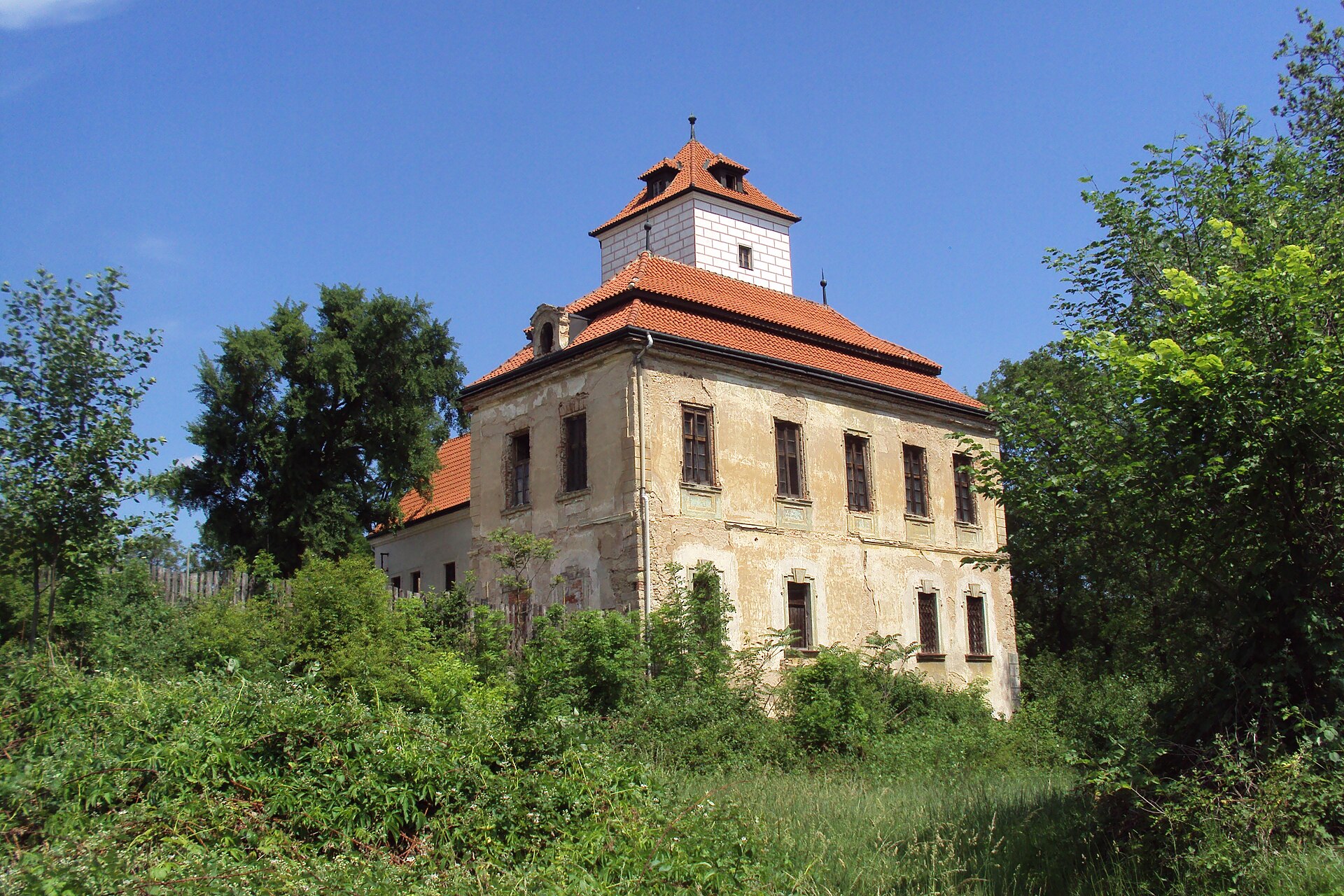
Liblice Chateau is a Baroque residence in the village of Liblice, in the Mělník district, about 9 km southeast of Mělník and 28 km northeast of Prague. It ranks among the most significant and best-preserved monuments of Czech High Baroque, and in the 20th century it gained further fame as the venue of a landmark conference on Franz Kafka.
Who built the chateau, and when?
The present building went up between 1699 and 1706 for Count Arnošt Josef Pachta of Rájov. The design came from Italian architect Giovanni Battista Alliprandi, who based his plan on a concept by Johann Bernhard Fischer von Erlach but left out some of the sculptural decoration the original scheme called for. The result is a compact, elegant palace form ranked among the finest Baroque achievements in the Czech lands.
What was added in the following decades?
After 1770, sculptor Ignác František Platzer enriched the entrance balcony with two pairs of rococo allegorical putti. The fresco decoration of the sala terrena — the reception hall linking the interior with the garden — dates from the same period.
How did ownership change over time?
In the first half of the 19th century, Vojtěch Dejm ze Stříteže bought the estate from the Pachta family. By 1863 it belonged to Countess Antonie von Wallenstein, who had part of the chateau rebuilt in an eclectic style with neo-Renaissance detailing. It later passed to the Thun-Hohenstein family, whose legacy survives in the park as an octagonal pseudo-Romanesque burial chapel.
Why does Liblice matter to literary history?
On 27–28 May 1963, the chateau hosted what became known as the Liblice Conference, dedicated to the work of Franz Kafka. It was the first international scholarly conference on Prague German literature, organized by Eduard Goldstücker, Alexej Kusák, and František Kautman, with foreign guests including Roger Garaudy from France, Ernst Fischer from Austria, Anna Seghers and Ernst Schumacher from East Germany, and Roman Karst from Poland. Although the conference set out to give Kafka's work a Marxist reading, in practice it broke the long-standing taboo surrounding his fiction, and it is now regarded as one of the impulses behind the liberalization that led to the Prague Spring of 1968.
What happened to the chateau after 1945?
After the Second World War the property passed into state ownership. Since 1952 it has served as a conference and recreational facility of the Academy of Sciences, which kept it closed to general tourism for decades. That changed with an extensive reconstruction, co-financed by EU funds, completed in 2007. Since then the chateau has operated as a hotel with restaurants and a wellness section, combining its conference and educational role with tourism.
What is worth seeing in the chateau park?
The chateau grounds cover almost 40 hectares and include a French garden, an English park, and a hunting ground (obora), open daily and free of charge until 22:00 (the hunting ground until 19:00). The French garden holds notable trees, among them tulip trees, Chinese dawn redwoods, white poplars, mature plane trees, oaks, and chestnuts, plus a small pond home to protected amphibians such as brown frogs, tree frogs, and common toads. Part of the park is protected as the natural monument "Zámecký park Liblice," while the neighboring "Slatinná louka u Liblic" is a nature reserve sheltering rare plant species.
Frequently Asked Questions
Where is Liblice Chateau located? In the village of Liblice, Mělník district, about 9 km southeast of Mělník and 28 km northeast of Prague.
Who designed the chateau? Italian architect Giovanni Battista Alliprandi, drawing on a concept by Johann Bernhard Fischer von Erlach, for Count Arnošt Josef Pachta of Rájov. It was built between 1699 and 1706.
What was the 1963 Liblice Conference? The first international scholarly conference devoted to Franz Kafka, now seen as one of the impulses behind the political liberalization in Czechoslovakia that led to the Prague Spring of 1968.
Can the chateau be visited today? Yes. Following a reconstruction completed in 2007, it operates as a hotel and conference center run by the Academy of Sciences, with restaurants and a wellness section, and the park is open to the public.
What can visitors see in the chateau park? A French garden, an English park, and a hunting ground spread over nearly 40 hectares, featuring notable trees, a pond with protected frogs, and a pseudo-Romanesque burial chapel of the Thun-Hohenstein family.
Nearby places

Earn badges for the places you visit
Download NextOnTrip, discover new places and check off your trails.