About this place
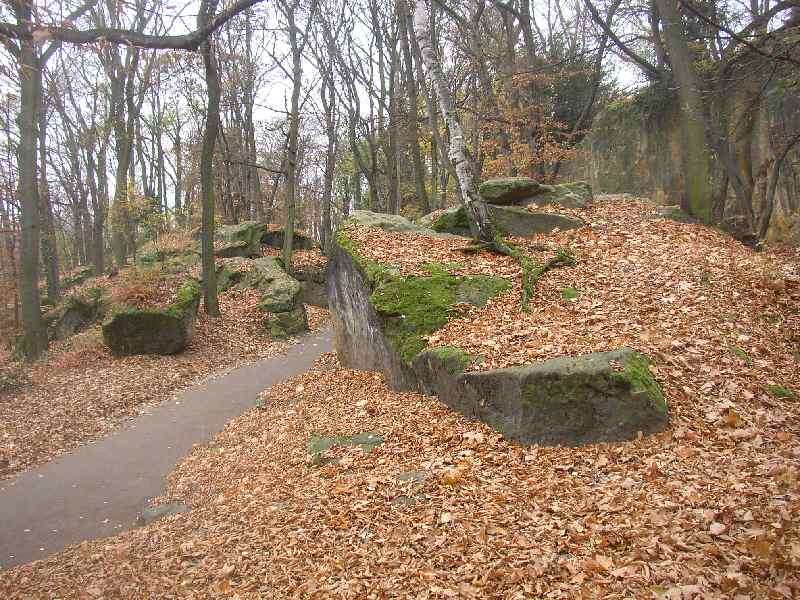
Letenský profil is a modest-looking but scientifically remarkable nature monument on the western slope of Letná in Prague, where bare rock exposures tell a story hundreds of millions of years old. The protected area was designated in 1988 to safeguard rock outcrops of outstanding scientific value that cannot be studied in comparable detail anywhere else.
Where exactly is it located?
The protected site isn't a single continuous plot but consists of two separate parts on the western section of the Letná slope. One lies below the Hanavský Pavilion, a well-known Prague viewpoint overlooking the Vltava. The other stretches as a narrow strip along Chotkova Street and the Pod Bruskou lane, descending toward Malá Strana. Because of this layout, visitors walking Letná's popular paths may pass right by these outcrops without realizing their scientific importance.
What makes it geologically special?
The protection targets outcrops of the Letná Formation, dating from the Ordovician period, specifically the Beroun Stage. It is one of the most accessible and best-preserved exposures of this formation anywhere, which is why it serves as its stratotype — the reference profile that geologists elsewhere use when describing and comparing the same rock unit. The layers are exposed here in considerable thickness, making it possible to study the middle sections of the formation in a way that fragmentary outcrops elsewhere simply don't allow.
Why does it matter so much to paleontologists?
The rocks of Letenský profil contain abundant fossil fauna. This richness and diversity of fossils is precisely what makes the site one of the most valuable paleontological localities of this formation in the eastern part of the Prague Basin — there is no comparably rich site in the region. For researchers reconstructing Ordovician marine life, this profile is a recurring reference point that successive generations of scientists keep returning to.
What is the purpose of protecting this area?
The main goal behind establishing the nature monument is to preserve the exposed geological profile so it remains available for further scientific study. This isn't about scenic landscapes or rare plant species — it's about a record written in stone, an archive that can be reread again and again as analytical methods keep improving. The City of Prague oversees the site, and management plans set out how it should be cared for over the coming decades.
What should you know before visiting?
Letenský profil isn't a conventional tourist attraction with visitor infrastructure, information boards, or a fully marked educational trail — first and foremost, it's a site of scientific value. Even so, its location along Letná's popular walking routes means it's easy to combine a visit with a stroll to the Hanavský Pavilion or along Chotkova Street toward Malá Strana.
Frequently asked questions
When was the Letenský profil nature monument established? The area was placed under protection in 1988.
From which geological period do the exposed rocks date? The rocks belong to the Letná Formation from the Ordovician period, specifically the Beroun Stage.
Why is this site called a stratotype? Because the outcrop is so well preserved and accessible that it functions as the reference profile for the Letná Formation, used when describing the same geological unit elsewhere.
Can fossils be found in the rocks here? Yes, the site is known for its abundant fossil fauna and is considered one of the most important paleontological localities of this formation in the eastern Prague Basin.
Where exactly are the two parts of the protected area located? One lies below the Hanavský Pavilion, and the other runs along Chotkova Street and the Pod Bruskou lane, toward Malá Strana.
Nearby places

Earn badges for the places you visit
Download NextOnTrip, discover new places and check off your trails.