About this place
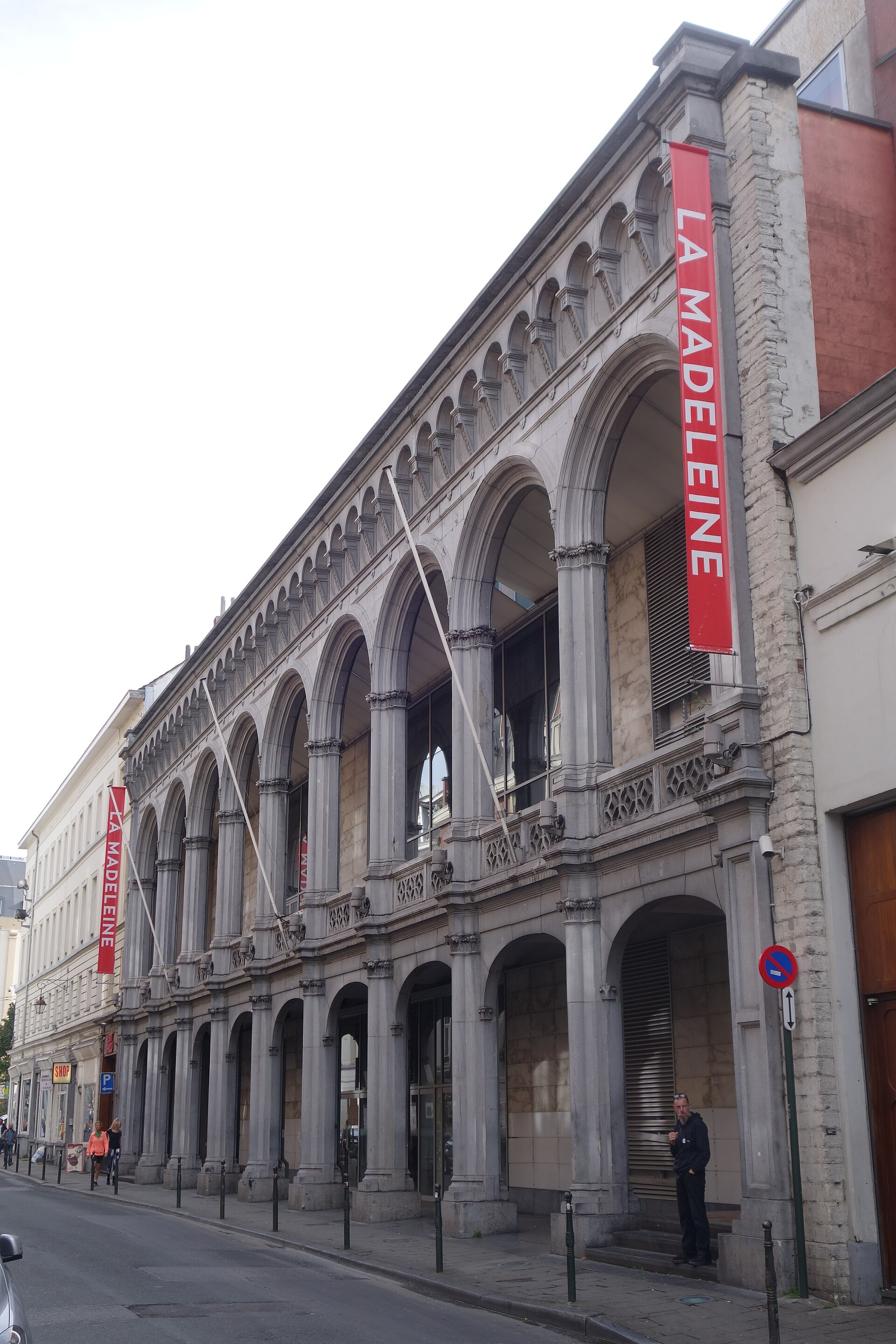
La Madeleine is a concert and event hall in the heart of Brussels, on rue Duquesnoy, best known for its surviving 19th-century façade and for its present-day role as a venue for concerts, balls, and cultural events run by the City of Brussels.
Where did the building come from?
The hall was built at the initiative of a man named Bortier, who proposed to the city authorities the construction of a covered market — the Marché de la Madeleine. The commission went to architect Jean-Pierre Cluysenaar, who was responsible for a number of other Brussels buildings of the period. Constructed between 1847 and 1848, it was the first covered market in the city, designed as a space for retail and street trade. The name comes from the surrounding street and neighbourhood, both called Madeleine.
What does the façade look like, and where did its style come from?
The building's defining feature is its neo-Renaissance, Italian-inspired façade. Its design draws directly on the Loggia dei Lanzi in Florence, the open arcaded gallery that has stood for centuries as one of the emblems of Italian Renaissance architecture. Cluysenaar borrowed the rhythm of its arcades and its classical proportions and transplanted that Italian model onto a Brussels street. It is this façade, rather than the interior of the original market hall, that has survived to the present day and remains the most recognisable part of the whole complex.
What happened after the market closed?
The Madeleine market operated for more than a century, but in 1957 the original market hall itself was demolished. A new, considerably more modern event hall was built in its place, while Cluysenaar's 19th-century façade was preserved and incorporated into the new structure. This is a classic Brussels example of façadism — the practice of keeping a historic street frontage while replacing the building behind it entirely. As a result, anyone walking along rue Duquesnoy today still passes the same neo-Renaissance front that residents saw in the mid-19th century, even though an entirely different building now stands behind it.
What is the hall used for today?
The present-day Salle de la Madeleine functions as a modular concert and event venue, with a capacity that can be adjusted from around 400 to 1,400 spectators depending on the type of event. That flexibility makes it suitable for both intimate concerts and larger gatherings. Over the decades it has hosted a wide range of cultural and entertainment events, and for many years it was also the traditional home of the Bal des Fonctionnaires (Civil Servants' Ball), an annual dance event for city administration staff. Management of the hall has since been officially entrusted to Brussels Expo, aligning its operations with the rest of the city's exhibition and events infrastructure.
Frequently asked questions
Where exactly is La Madeleine located? The hall stands in central Brussels on rue Duquesnoy, just a short walk from the Grand-Place.
Can visitors go inside just to look around? Access to the interior depends on the events calendar, since the hall operates primarily as an event venue; the façade itself, however, can be admired from the street at any time.
How does today's building differ from the original? The original 1847–1848 market hall was demolished in 1957, and only Cluysenaar's neo-Renaissance façade survives, now built into a more modern event hall structure.
How many people can the hall hold? Thanks to its modular layout, capacity can range from roughly 400 to 1,400 people.
Nearby places

Earn badges for the places you visit
Download NextOnTrip, discover new places and check off your trails.