About this place
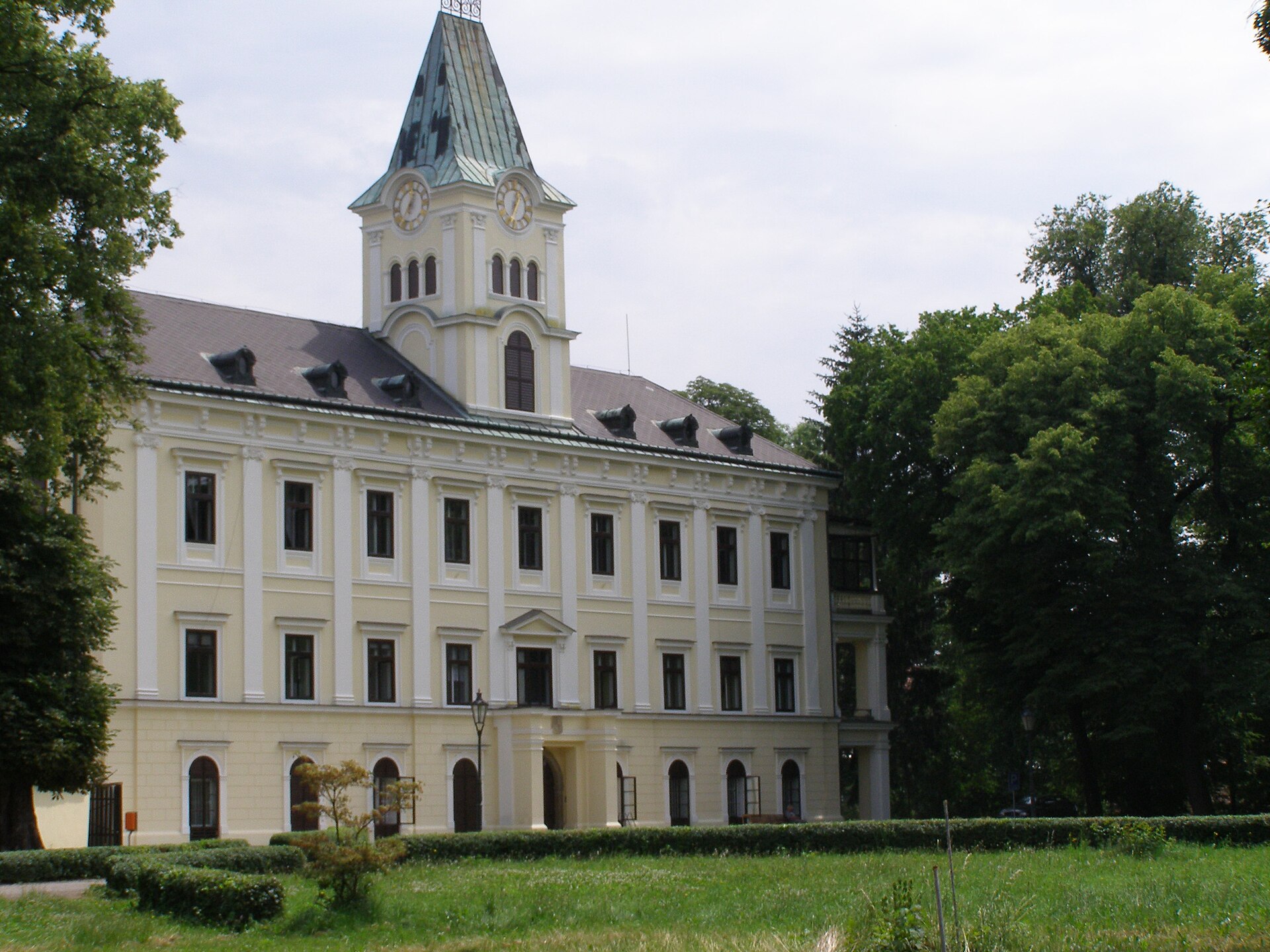
Kvasice Castle is a classicist chateau standing on the northern edge of the village of Kvasice, in the Kroměříž district of Moravia, set within a large landscape park.
How did a medieval stronghold turn into a castle?
The village of Kvasice itself is recorded as early as the 12th and 13th centuries, but a fortified manor on the site of today's castle is first documented only in the mid-14th century, as the seat of the noble Benešov family. During the Hussite wars the stronghold burned down almost completely and had to be rebuilt from the ground up; a moat was added at that time, giving it more the character of a water fortress than an ordinary manor house. Ownership changed hands several times over the following decades — the Kuzel family held it through the 15th century, followed by the Šternberk family from the early 16th century.
What changed during the Renaissance rebuild?
The turning point came in the 1580s, when the estate passed to Havel Kurovský of Vrchlabí. Under his ownership the old stronghold was rebuilt in Renaissance style, and it was then that the courtyard gained its distinctive arcaded galleries running along all four wings. That layout, though later partly bricked up, is still legible in the building's structure today. In the following century the estate belonged to the Rottal family, who held it from the first half of the 17th century until the mid-18th century.
How did the castle get its current classicist look?
From 1763 the property passed to the Lamberg family, and it was under their ownership, at the start of the 19th century, that the castle underwent its most far-reaching transformation. In 1820 the outer forecourt buildings were torn down and the remaining moats filled in, and a couple of decades later the Renaissance arcades of the courtyard were bricked up, giving the façades their present, austere classicist character. The result — a four-wing, two-storey building with a pyramidal-roofed tower — has survived in almost unchanged form ever since.
Who owned the castle in the 19th and 20th centuries?
In the mid-19th century the Kvasice estate was acquired by the Thun-Hohenstein family, who kept it until 1945. It was during their tenure that the castle housed an extensive library, and the grounds around the building were finally laid out as an English-style landscape park, replacing the more formal gardens that had existed before.
What is worth seeing in the castle park?
The park surrounding the castle keeps the loose, naturalistic character typical of 19th-century English-style grounds, with mature trees arranged picturesquely along walking paths. Its true curiosity is a black walnut tree roughly 300 years old, with a trunk about 620 centimetres in circumference — one of the most impressive specimens of its kind in Moravia.
Can visitors go inside the castle today?
After 1945 the building passed into the ownership of the municipality of Kvasice and now serves as a retirement home, which is why its interior is not open to the general public. The surrounding park, however, can be visited freely, letting visitors walk among the old trees and view the building from outside, including the bricked-up arcaded courtyard still visible on its façades.
Frequently asked questions
How old is Kvasice Castle? The first fortified seat on this site dates back to the mid-14th century, but the castle only took on its present classicist appearance after a major rebuild in the early 19th century under the Lamberg family.
Can you visit the inside of the castle? No — the building now functions as a retirement home and is not open for tours. The park surrounding it, however, remains accessible to visitors.
What is the main attraction in the castle park? A black walnut tree about 300 years old, with a trunk roughly 620 centimetres around, growing within the 19th-century English-style park layout.
Who was the last noble family to own the castle? The Thun-Hohenstein family, who held the Kvasice estate from the mid-19th century until 1945, when it passed into municipal ownership.
Nearby places

Earn badges for the places you visit
Download NextOnTrip, discover new places and check off your trails.