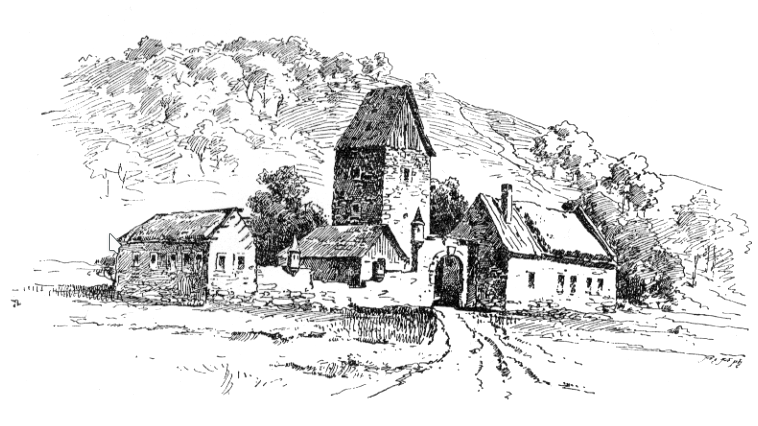
About this place
Kouskova Lhota is the remnant of a Gothic-Renaissance fortified manor (tvrz), standing at a hamlet called Černé Krávy roughly one kilometre northwest of the village of Neznašovy, within the municipality of Vrhaveč in the Klatovy District, Plzeň Region. Only a tower survives from the once larger residence, but the site carries several centuries of history tied to the lesser nobility of the Šumava foothills.
Where does the name Kouskova Lhota come from?
The settlement began in the Middle Ages under the name Lhotka — a common label for newly founded villages granted a temporary tax exemption. It only took on its present name later, borrowed from the Kousek family of Sobětiček, burghers from Klatovy who acquired the estate in the 16th century. The pairing of the old settlement name with the owners' surname produced the name that has survived, even though the village itself no longer exists in its original form.
Who held the manor before the Kouseks?
The earliest references to the estate connect it to the Bendů family of Šťáhlav. That changed in 1543, when the property was bought by Jan Kousek of Sobětiček, a Klatovy burgher who had been raised to noble rank in 1529. From then on, the estate stayed linked to his family for decades — though not without interruption.
How did the Thirty Years' War affect the estate?
After the Bohemian Estates Uprising broke out in 1618–1620, the Kousek family lost their land, a typical fate for nobility caught up in the revolt against the Habsburgs. Roughly thirty years later, however, their descendants managed to buy the estate back — a sign of both determination and the family's remaining resources. In the second half of the 17th century, the property finally passed to Vilém Albrecht Krakovský of Kolovraty, and the whole hamlet, tvrz included, was absorbed into the large Týn estate. The year 1686 is generally taken as the point when the building stopped functioning as a noble residence altogether, its structures either disappearing or merging into the adjoining farmyard.
What survives of the tvrz today?
Despite losing its residential role, the tower of the tvrz has held up well, still standing to a height of two storeys — a notable survival for a structure of such age. Next to it stands a barn, built in part from the old fortified walls. Traces of the wider defensive layout can still be made out on the ground: a pond, earthen ramparts with a moat, and sections of protective walling that together let visitors piece together the original shape of the site. The tvrz is listed as a protected cultural monument.
Can Kouskova Lhota be visited?
The tvrz sits on private land and is not currently open to the public. That makes it a site better suited to enthusiasts of regional history and fortified architecture than to a typical sightseeing itinerary — but it is worth knowing about when passing through the countryside around Vrhaveč and Neznašovy, where the landscape still shows traces of medieval settlement.
Frequently asked questions
Where exactly is Kouskova Lhota located? It is a former settlement, now the site known as Černé Krávy, about one kilometre northwest of the village of Neznašovy, within the Vrhaveč municipality (Klatovy District, Plzeň Region).
Are Kouskova Lhota and Neznašovy the same place? No — they are two distinct, though nearby, locations. Neznašovy is an existing village, while Kouskova Lhota is the name of a vanished settlement with the remains of a fortified manor, lying a short distance northwest of it.
What remains of the old tvrz? Mainly a tower preserved to a height of two storeys and an adjacent barn, alongside surface traces of a pond, ramparts with a moat, and fragments of defensive walls.
When did the tvrz stop being a noble residence? The year 1686 is treated as the turning point, when the building finally lost its residential function in favour of farm use.
Can the tvrz grounds be entered? No — the site is privately owned and not open to visitors.
Nearby places

Earn badges for the places you visit
Download NextOnTrip, discover new places and check off your trails.