About this place
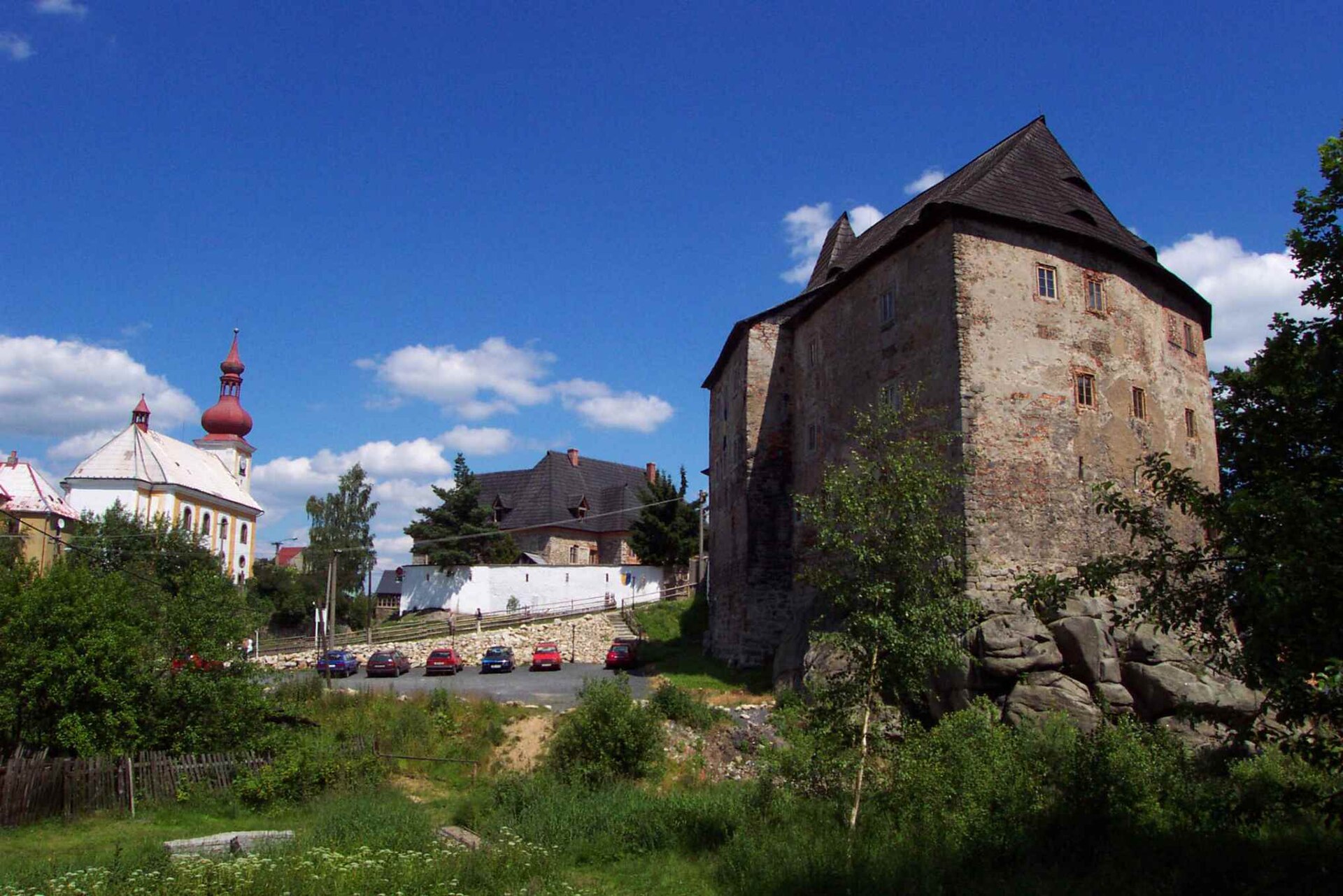
Kopaniny Chateau is a ruined late-Renaissance residence standing in the village of Kopaniny, now part of the town of Aš, in the Cheb District of the Karlovy Vary Region, right on the border with Germany. Held for centuries by the noble Zedtwitz family, it survived the Thirty Years' War and generations of rebuilding, only to fall into ruin in the second half of the twentieth century - today it is being slowly brought back by a private family.
Where is Kopaniny Chateau located?
Kopaniny is a small settlement absorbed into Aš, a town at the westernmost tip of the Czech Republic, in the so-called Aš Salient, directly against the German border. The area belongs to the Cheb District of the Karlovy Vary Region and feels like a quiet rural borderland, well off the region's main tourist routes despite lying close to Aš itself.
What is the history of the chateau?
The village of Kopaniny first appears in written sources in 1315, when it belonged to the Feiltsch family of Sachsgrün, and later passed to the Neuberg family. By 1413, the estate is recorded as property of the Zedtwitz family - one of the most important noble houses of the Aš region - and it remained in their hands into the twentieth century.
The castle itself is first mentioned as a fortified building in 1537, most likely founded by the Zedtwitzes. A late Gothic manor house, probably raised around the turn of the fifteenth and sixteenth centuries under Jan (John) of Zedtwitz, was rebuilt in the early seventeenth century into a late-Renaissance chateau with distinctive corner towers. The building was damaged in the Thirty Years' War and reconstructed between 1677 and 1678 under Josef Adam of Zedtwitz, who also added a new wing known as the "New House."
Who were the last owners?
The last members of the family to hold Kopaniny were Franz Josef Zedtwitz (1873-1954) and his son Franz Xaver Zedtwitz (1906-1942). The younger Zedtwitz was known not only as heir to the family estate but also as a naturalist, writer and journalist - he was killed in action at Sevastopol in 1942, during the Second World War.
What happened to the chateau in the twentieth century?
After 1945, following the expulsion of the German-speaking population from the border regions, the Zedtwitz estate passed to the state and was placed under a state farm. Neglect and use of the historic residence as a mere agricultural outbuilding led to steady deterioration over the following decades. The final blow came in 2007, when a fire broke out in the already dilapidated buildings, destroying a substantial part of the structure.
Can the chateau be visited today?
Since 2010, the chateau ruins have been protected as a cultural monument of the Czech Republic, and since 2013 the family of František Hupka has been carrying out continuous restoration work - in 2024, repairs began on the roof of the former stable. The site has no official, regular opening hours or organized visitor access; a fundraising campaign for further restoration is ongoing, and anyone interested in visiting or supporting the rebuilding should follow the chateau's social media page or contact the Aš Information Centre.
Frequently asked questions
Where exactly is Kopaniny Chateau located? In the village of Kopaniny, part of the town of Aš, in the Cheb District of the Karlovy Vary Region, right on the border with Germany.
When was the chateau built? The castle is first mentioned in 1537; it took its present late-Renaissance form with corner towers in the early seventeenth century and was rebuilt again in 1677-1678 after damage suffered during the Thirty Years' War.
Who owned the chateau? From 1413 until the mid-twentieth century, the estate belonged to the Zedtwitz family, whose last owners were Franz Josef Zedtwitz and his son Franz Xaver Zedtwitz.
Is the chateau open to visitors? There are no fixed opening hours or organized tours - the building is under private restoration, carried out by the family of František Hupka since 2013.
What happened to the chateau after World War II? After 1945 it passed to a state farm and fell into disrepair, then burned in 2007; since 2010 it has been protected as a cultural monument and is gradually being restored.
Nearby places

Earn badges for the places you visit
Download NextOnTrip, discover new places and check off your trails.