About this place
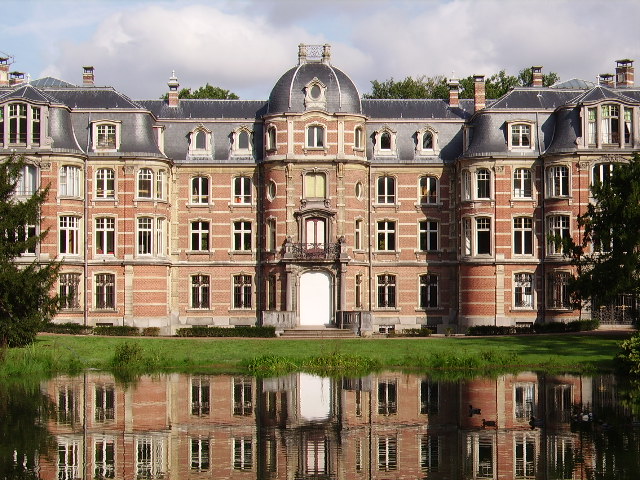
Kasteel Reigershof is a small, privately owned country house in Berendrecht, a district of Antwerp that belongs to the wider Berendrecht-Zandvliet-Lillo area of Belgium. Standing along the Reigersbosdreef lane, surrounded by what was once open farmland, the building isn't set up as a museum or visitor attraction, yet it remains one of the more telling architectural witnesses to the rural history of this part of northern Antwerp.
Why does it go by several names?
The estate is known under more than one label. Besides Kasteel Reigershof, it also appears as Kasteel Sterrehof, Hof van Delft, and Hof Le Grelle. The latter two point directly to the families who shaped its history: Hof van Delft recalls the van Delft family, who held the property across several centuries, while Hof Le Grelle refers to Daniël Legrelle, a more recent resident of the house.
How did the estate begin?
The van Delft family already held various properties in the Kempenhoek area of Berendrecht from at least the 17th century onward. Whether Jan van Delft, who lived from 1592 to 1662, bought the estate or inherited it isn't definitively known. On his death, the property passed to his son Gerard van Delft, a canon at Cambrai, and it's this period that is credited with the construction of the tower and the southern wing of the building. Tellingly, the structure didn't start out as a grand residence at all — it began life as a hunting lodge.
What changed over the following centuries?
In 1692 the estate passed to Jean-Baptist van Delft, under whom the northern wing was added. A record of the layout from that era survives on the Ferraris map, drawn up between 1771 and 1778: at the site of today's castle and the adjoining castle farmhouse along the Reigersbosdreef, the map marks a roughly square-plan volume, behind which stood two L-shaped structures separated by outbuildings. This tells us that by the second half of the 18th century, the complex already had the sprawling, multi-building character typical of rural noble estates of the period.
The next significant change came much later, around 1934, when the owner at the time, L. van Delft, had the southern side wing enlarged. That this modernization happened at all shows the house kept serving as a family residence well into the 20th century, still being adapted to the needs of successive generations rather than falling into disuse.
Why does this place matter?
Kasteel Reigershof isn't the kind of site with ticketed entry and guided tours — it's better understood as a piece of residential architecture that has survived on essentially the same spot since the 17th century, even as Antwerp and its surrounding area underwent sweeping urban and industrial transformation. For anyone curious about the history of the Berendrecht-Zandvliet-Lillo district, or about the landed families of the Brabant countryside more broadly, the building offers a tangible link between the region's feudal past and its present. Its documented chain of ownership — from Jan van Delft through successive generations of the same family down to its later residents — makes it a rare example of continuity in a landscape that has otherwise changed at the pace of a major metropolitan port city.
Frequently asked questions
Can Kasteel Reigershof be visited? Available sources give no indication that the property is regularly open to the public — it remains a private estate.
What other names does the castle go by? It is also known as Kasteel Sterrehof, Hof van Delft, and Hof Le Grelle.
When were the oldest parts of the building built? The tower and southern wing are attributed to the time of Gerard van Delft, in the 17th century, while the northern wing was added after 1692.
Nearby places

Earn badges for the places you visit
Download NextOnTrip, discover new places and check off your trails.