About this place
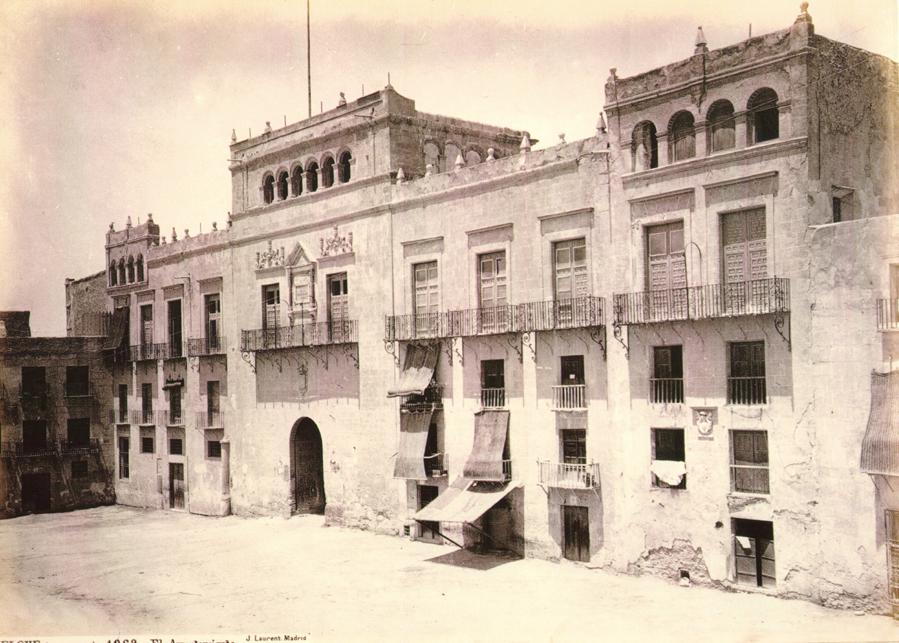
Jorge Juan Palace is a Baroque townhouse in Elche (Elx), standing at Carrer del Pont dels Ortissos 7, right in the heart of the city's historic quarter. The building sits on an irregular trapezoidal plan joining two street-facing façades, which gives it its distinctive corner profile visible from a distance.
What will you see?
The palace has three floors. The ground floor is marked by an ashlar stone base that rises all the way to the first floor at the corner, with rustication repeated on the door jambs and lintels — a typical device of Baroque civil architecture. The richest decoration, though, belongs to the noble floor (piano nobile), the first floor above street level. Right at the corner, the coat of arms of the Santacilia family is set into the wall, alongside a continuous balcony with wrought-iron railings that runs along the façade — today the building's most recognisable feature.
The house was built at the turn of the 17th and 18th centuries as a residence of the Santacilia family, Valencian nobility who had held land in Elche since 1616 through the maternal line. It was this family that produced Jorge Juan y Santacilia — mathematician, naval officer and geographer, one of the leading figures of the Spanish Enlightenment — after whom the palace is named. The family also built a second residence in Elche, the so-called Casa Gran (now in the Bayas district), but it is this palace on Pont dels Ortissos street that bears the family's coat of arms.
How do you get there?
The palace stands in central Elche, within walking distance of the city's main landmarks, such as the Basilica of Santa María and the Altamira Palace. It fits naturally into a walking route through the historic old town — pairing the visit with nearby sights is the best approach, since exploring the centre usually takes about half a day.
When should you visit?
Elche lies in the province of Alicante, where summers run hot, so spring (April–June) or autumn (September–October) are the most comfortable times to walk the old town, with milder temperatures and more pleasant strolling along the stone streets. The façade looks best in the afternoon light, when the sun brings out the texture of the rusticated stonework.
History and heritage protection
Jorge Juan Palace was declared a Bien de Interés Cultural (Spain's highest heritage protection status) by decree of 18 January 1968, together with the Basilica, the Altamira Palace and the building known as La Calahorra, forming a jointly protected heritage ensemble in Elche's centre. Between 1994 and 1997 the building underwent a thorough restoration led by architect M. J. Fuster, which recovered its original appearance, including the stone detailing and the wrought-iron balcony railing.
Frequently asked questions
Can you go inside Jorge Juan Palace? The building now serves institutional purposes and interior access can be limited — the safest bet is to check current opening arrangements on site or at the local tourist information office.
Where does the palace's name come from? From Jorge Juan y Santacilia, the celebrated 18th-century mathematician and naval officer whose family had owned property in Elche for generations and built this residence.
How much time should you set aside? Viewing the exterior takes 10–15 minutes, but it's worth combining the visit with a walk through Elche's old town, which takes around 2–3 hours in total.
What's the standout architectural detail? The corner of the noble floor, where the Santacilia family coat of arms meets the wrought-iron balcony — the most photographed feature of the whole façade.
Nearby places

Earn badges for the places you visit
Download NextOnTrip, discover new places and check off your trails.