About this place
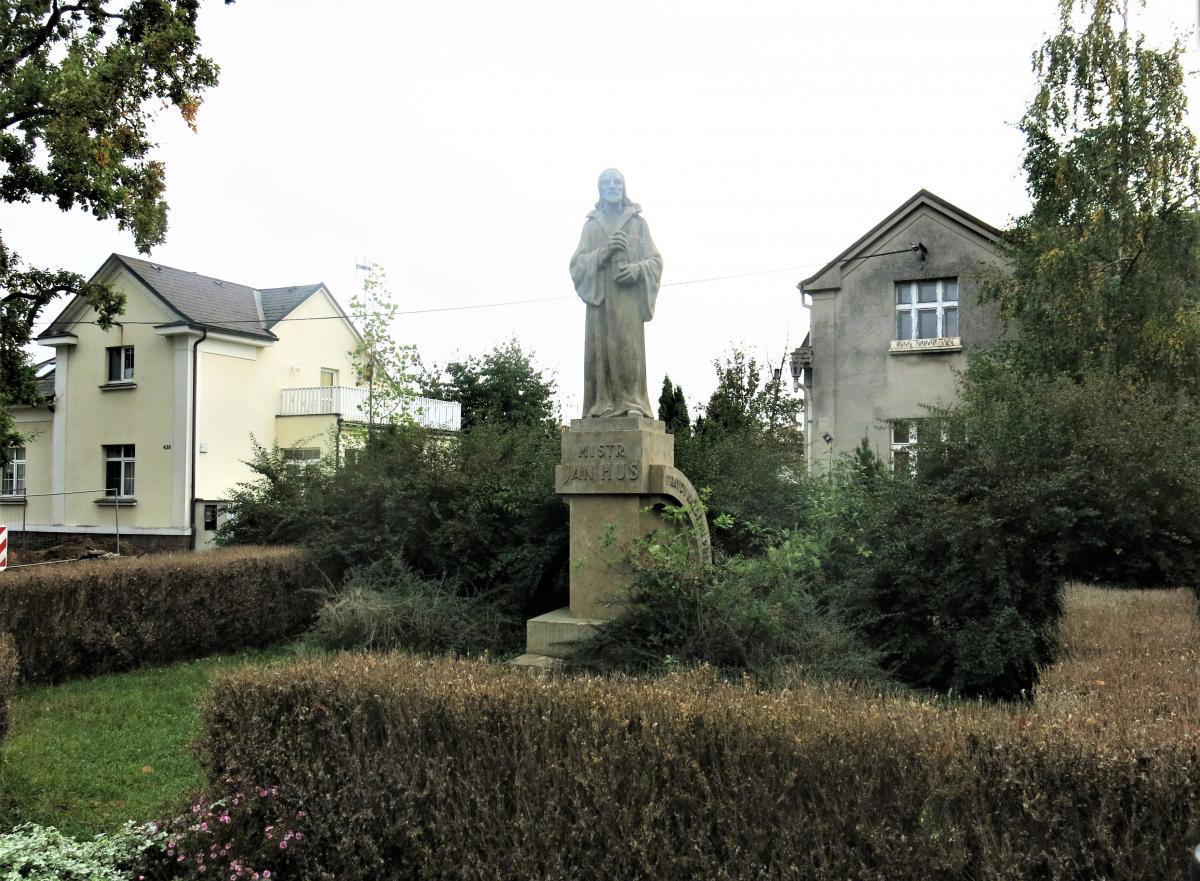
Jan Hus (statue) is a monument to Master Jan Hus standing on Husovo náměstí, the main square in the centre of Velký Osek, a small town in the Central Bohemian Region, in the Kolín district of the Czech Republic. The roughly seven-metre-tall sandstone figure is one of the town's most recognisable landmarks, honouring the Czech preacher and religious reformer who was burned at the stake in Constance in 1415.
Who created the monument and when?
The monument was made by sculptor Josef Bílek and unveiled in 1935 on the town's main square, which has been known as Husovo náměstí (Hus Square) ever since. Erecting a monument to Hus was far from unusual at the time — in interwar Czechoslovakia, Jan Hus had become a national symbol, and towns across the country raised statues in his honour to mark the struggle for religious and national independence of thought.
What does the statue look like, and what do the inscriptions say?
Both the figure of Hus and its rectangular base, roughly a metre high, are carved from sandstone. The front face of the pedestal bears the inscription "Mistr Jan Hus" ("Master Jan Hus"), the right side reads "Pravdy každému přejte!" ("Grant everyone the truth"), and the left side reads "Milujte se vespolek!" ("Love one another") — phrases traditionally attributed to Hus's own writings and sermons.
What happened to the monument during the wartime occupation?
In 1941, during the German occupation of the Protectorate of Bohemia and Moravia, the sandstone blocks that make up the monument were taken apart. After the war, the statue was reassembled from the surviving stone pieces, and it still stands today in essentially its original form, on the same spot in the centre of town.
Why is Jan Hus such an important figure for Czechs?
Jan Hus (c. 1370–1415) was a theologian, preacher and rector of Charles University in Prague who criticised abuses within the church hierarchy and preached in Czech, bringing reformist ideas to ordinary believers rather than keeping them in Latin. Summoned before the Council of Constance, he refused to recant his views and was condemned to death, burned at the stake on 6 July 1415. His execution provoked outrage across Bohemia and helped trigger the Hussite Wars that followed. In the centuries since, Hus has become one of the central figures of Czech national identity, and the anniversary of his death is now a Czech public holiday.
Where exactly does the statue stand?
The monument stands on Husovo náměstí, the main square of Velký Osek, a town on the Elbe (Labe) river in the Kolín district of the Central Bohemian Region, a few kilometres north of the city of Kolín. The square is the town's central point, so the statue is easy to spot for anyone walking through the centre of Velký Osek, and it serves as a natural landmark for visitors.
Frequently Asked Questions
Who made the Jan Hus statue in Velký Osek? Sculptor Josef Bílek, in 1935.
What material is the statue made of? Both the figure and its base are carved from sandstone; the whole monument stands roughly seven metres tall.
Has the statue survived in its original form? Almost entirely — in 1941, during the wartime occupation, its stone blocks were dismantled, and after the war it was reassembled in its original shape.
What do the inscriptions on the base say? "Mistr Jan Hus" on the front, "Pravdy každému přejte!" on the right side, and "Milujte se vespolek!" on the left.
Where exactly is the statue located? On Husovo náměstí, the main square in the centre of Velký Osek, a town in the Kolín district of the Czech Republic.
Nearby places

Earn badges for the places you visit
Download NextOnTrip, discover new places and check off your trails.