About this place
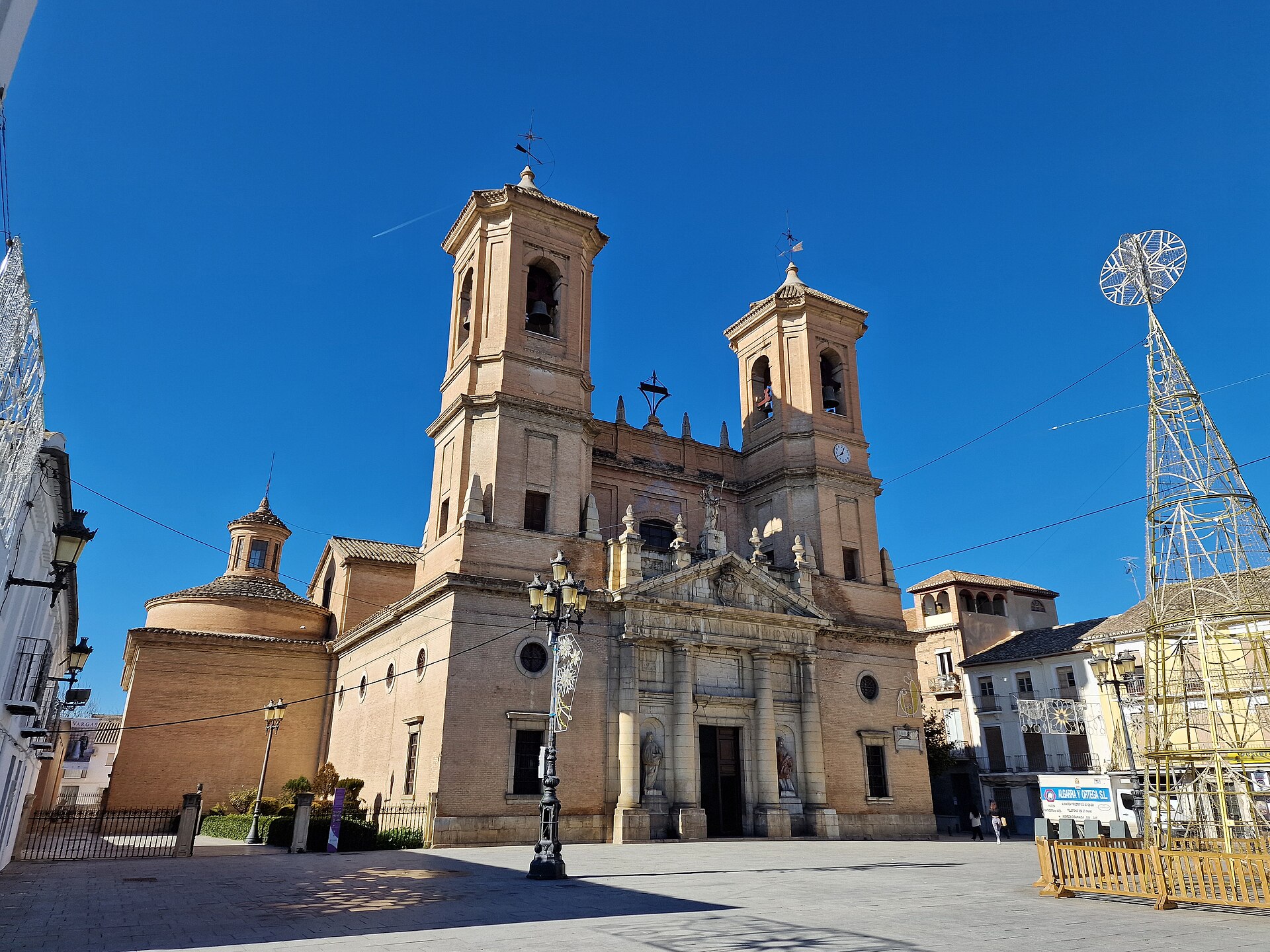
Iglesia de la Encarnación is the main parish church of Santa Fe, a small town in the province of Granada, Andalusia. It stands right in the historic center, and its twin towers rise above the surrounding rooftops, forming a landmark visible from most of the old town's streets.
What is the history behind the church?
Santa Fe began life as a military camp set up by the Catholic Monarchs during the siege of Granada at the end of the 15th century, and an early, modest chapel on this site is said to date from that founding period. That first building did not survive into later centuries — it was destroyed by an earthquake. In its place, the town decided to build a much larger church. Work on the present structure began on 10 February 1774. The architectural plan was drawn up by Ventura Rodríguez, one of the leading figures of Spanish neoclassical architecture, while the construction itself was carried out under Domingo Loys de Monteagudo, an architect linked to the Real Academia de San Fernando. The project took over a decade to complete, and the church was formally consecrated on 4 November 1785, the feast day of Saint Charles.
How is the church built?
The building follows a neoclassical design throughout, both inside and on its exterior. It is laid out as a Latin cross with three naves and a flat-ended chancel, while the transept is only lightly marked and does not project far beyond the main body of the church. The facade, designed by Ventura Rodríguez in 1783 and executed by Santos Ángel Ochandátegui, is fronted by a portico of four Tuscan-order columns topped with a triangular pediment crowned by decorative pinnacles. Flanking the facade are two powerful twin towers, square at the base and shifting to an octagonal form higher up — it is these towers that give the church its tall, distinctive profile, visible well beyond the town itself.
What details connect the church to the town's founding?
The facade carries several features that recall the origins of Santa Fe. Niches on either side of the entrance hold life-size statues of the Catholic Monarchs, Ferdinand and Isabella, who founded the town. A carved stone head, said to represent a Moor named Tarfe, also appears on the facade, tied to a local legend from the Reconquista era. Just as significant is a stone plaque commemorating the signing in Santa Fe of the so-called Capitulations — the 1492 agreement between the Catholic Monarchs and Christopher Columbus that cleared the way for his voyage across the Atlantic. Although the present church was built long after that event, it still stands as a symbolic link between the town and one of the defining moments of the Age of Exploration.
Does the church have heritage protection?
Given its architectural and historical value, the Iglesia Parroquial de la Encarnación in Santa Fe was listed as a Bien de Interés Cultural — Spain's equivalent of a protected heritage site — in 1983. That designation confirms its place as part of the cultural heritage of the Granada region, and its facade and towers remain among the most recognizable sights on the town's skyline.
Frequently Asked Questions
When was the current church in Santa Fe built? Construction started on 10 February 1774, and the church was consecrated on 4 November 1785.
Who designed the church? Ventura Rodríguez drew up the architectural plan, and Domingo Loys de Monteagudo carried out the construction.
Why are there statues of the Catholic Monarchs on the facade? Ferdinand and Isabella founded Santa Fe as a military camp during the siege of Granada, which is why their statues stand at the church's main entrance.
Is the church a protected historic site? Yes, it has been listed as a Bien de Interés Cultural since 1983, recognizing it as part of the protected heritage of the Granada province.
Nearby places

Earn badges for the places you visit
Download NextOnTrip, discover new places and check off your trails.