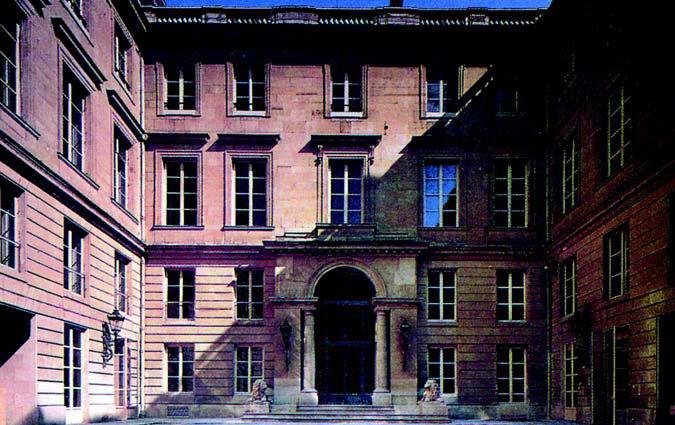
About this place
The Hôtel de Saint-Florentin is an 18th-century townhouse mansion in Paris, standing on the north-east corner of Place de la Concorde where it meets Rue Saint-Florentin - one of the grandest addresses of pre-revolutionary France and a building forever linked to the name Talleyrand.
Who built it, and why?
The mansion was commissioned by Count Louis Phélypeaux de Saint-Florentin, a close aide and friend of Louis XV, who in 1767 hired the then-young architect Jean-François Chalgrin - the man who would later design the church of Saint-Sulpice and the Arc de Triomphe. The facades facing the square came from Ange-Jacques Gabriel, the same architect behind the square itself, the Petit Trianon at Versailles, and the Ecole Militaire. Work on the interiors, finished by the end of the 1760s, drew on some of the leading artists of the day: sculptors Guillaume Coustou the Younger and Étienne Gois, painter Hubert Robert, and Jean-Simon Barthélemy, who painted the ceiling above the grand staircase in 1769.
How does Talleyrand fit into the story?
In 1812, the house was bought by Charles-Maurice de Talleyrand, one of the most influential diplomats of his generation, who lived there until his death in 1838. It was inside these rooms that he held the negotiations leading up to the Treaties of Fontainebleau and Paris - agreements that paved the way for the restoration of the French monarchy and for the Congress of Vienna. In April 1814, right after Russian troops entered Paris, Tsar Alexander I himself stayed at the mansion for two weeks, an episode still cited as proof of the building's outsized role in the diplomacy of the era.
What happened to the building afterward?
After Talleyrand's death, the mansion passed to his niece, the Duchess of Dino, who sold it to Baron James de Rothschild, then one of the wealthiest men in France during the July Monarchy. During the Second World War the German navy requisitioned the building, and in 1948 it was leased to the United States government. Washington became the outright owner in the early 1950s, and for decades the house served purposes ranging from administering the Marshall Plan to housing offices of the U.S. Embassy.
Can visitors go inside today?
The building still belongs to the U.S. government and today houses the George C. Marshall Center along with, since 2008, the offices of the law firm Jones Day. Because it functions as a diplomatic property, the interior is not open to casual visitors on a regular basis - the main chance to step inside comes once a year during the European Heritage Days (Journées du Patrimoine), when several of the reception rooms are opened to the public. On any other day, the mansion is best appreciated from outside, where its neoclassical facade is fully visible from Place de la Concorde and Rue Saint-Florentin.
Where exactly is it located?
The mansion sits in the 1st arrondissement of Paris, on Rue Saint-Florentin, just steps from Place de la Concorde and the Tuileries Garden, close to Rue de Rivoli and Rue Royale. It's an easy stop to combine with a visit to the square itself, its obelisk, and the nearby boutiques and Hôtel de Crillon on the opposite side of the square.
Frequently asked questions
Can you go inside the Hôtel de Saint-Florentin? Not as a rule - it's an active U.S. diplomatic property. The interior generally opens to the public only during European Heritage Days.
What is its connection to Talleyrand? Talleyrand bought the mansion in 1812 and lived there until his death in 1838, using its rooms for key diplomatic negotiations of the Napoleonic and Restoration era.
Who owns the building now? The United States government, which acquired it in the early 1950s; it now houses the George C. Marshall Center and the law firm Jones Day.
Where exactly is the mansion? On Rue Saint-Florentin in the 1st arrondissement of Paris, at the corner of Place de la Concorde, near the Tuileries Garden and Rue de Rivoli.
Nearby places

Earn badges for the places you visit
Download NextOnTrip, discover new places and check off your trails.