About this place
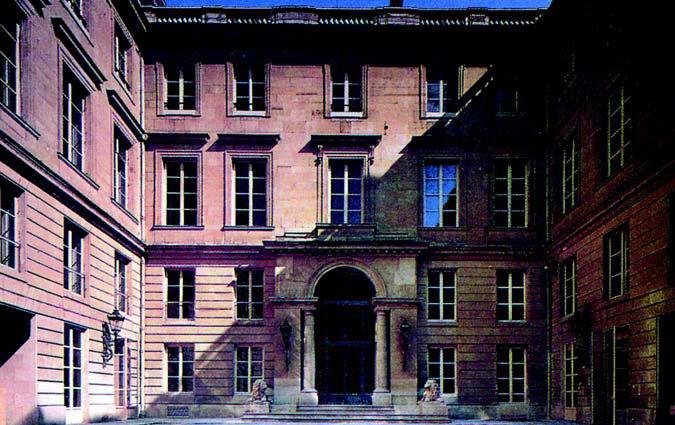
Hôtel Beauharnais stands among the most distinguished townhouses of Paris's 7th arrondissement, now serving as the official residence of Germany's ambassador to France.
A diplomatic address with two centuries of history
Sitting along the Seine in the 7th arrondissement, close to a cluster of embassies and government buildings, this hôtel particulier blends early 18th-century proportions with a striking Empire-era interior. Visitors strolling the left bank often pass it without realizing that behind its facade lies one of the more layered architectural stories in the neighborhood.
Who built it, and when
The mansion was designed by Germain Boffrand, an architect closely associated with the refined, rocaille-inflected classicism that shaped Parisian townhouses in the early 1700s. Construction wrapped up in 1714, at a time when wealthy Parisian families favored exactly this kind of layout: a private residence set back from the street, organized around a courtyard.
How Eugène de Beauharnais changed its story
The building's second life began in 1803, when it was bought by Eugène de Beauharnais — stepson of Napoleon Bonaparte and son of Empress Joséphine from her first marriage. He commissioned an extensive remodeling of the interiors and parts of the exterior in the Empire style, the bold, symmetrical decorative language that came to define Napoleonic France. That renovation is why the house still carries his family name today.
Why it holds protected status
The property was officially recognized as a monument historique on 25 July 1951, placing it under France's heritage protection framework. That listing has helped preserve the Empire-period rooms and original spatial layout largely as Beauharnais left them.
Can visitors go inside
Since the building functions as a working diplomatic residence, it isn't set up as a conventional tourist site with fixed opening hours. Interior access is generally limited to special occasions, most notably the Journées européennes du patrimoine (European Heritage Days), when a number of official residences across France briefly open to the public once a year. Outside those dates, admiring the riverside facade is the realistic option for most visitors.
What else to see nearby
The stretch of the Seine running through this part of the 7th arrondissement is lined with government buildings, embassies, and historic town houses, making it easy to fold a short stop at Hôtel Beauharnais into a longer walk through this diplomatically dense corner of the Left Bank.
Frequently asked questions
What is Hôtel Beauharnais used for today? It serves as the official residence of the German ambassador to France, located in the 7th arrondissement of Paris.
When was it built, and who designed it? Construction finished in 1714, based on a design by architect Germain Boffrand.
What is Eugène de Beauharnais's connection to the building? He purchased the property in 1803 and had it rebuilt in the Empire style, which is why the house bears his family name.
Is it open to the public? There are no regular visiting hours since it's an active diplomatic residence, but access is sometimes possible during heritage open days.
Nearby places

Earn badges for the places you visit
Download NextOnTrip, discover new places and check off your trails.