About this place
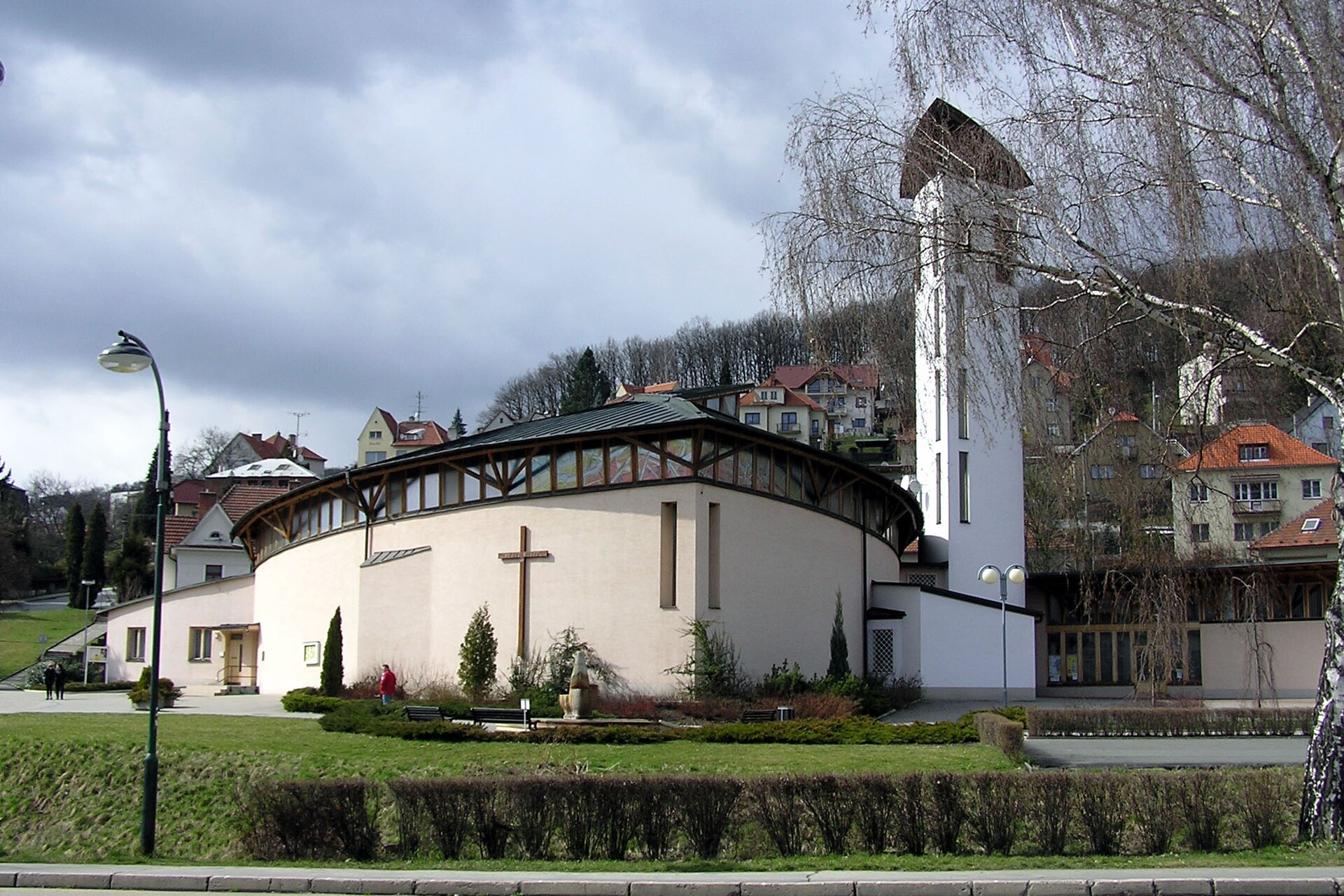
The Church of the Holy Family is a modern place of worship in Luhačovice, a well-known Moravian spa town. Although the building itself only went up in the 1990s, efforts to give the town a new church go back to the days of the Austro-Hungarian monarchy. Its unusual almond-shaped floor plan and the turbulent story behind its construction make it one of the more distinctive examples of post-communist sacred architecture in the Czech Republic.
Why did it take so long to build the church?
By the end of the 19th century, the existing church in Luhačovice could no longer accommodate the growing number of worshippers, which sparked discussions about erecting a new, larger building. Those plans, however, stalled for decades. First came the two world wars, then the opposition of the communist regime, which refused to allow new religious construction. A brief opening appeared during the political thaw of the 1968 Prague Spring, but even then the project failed to materialize. It was only the fall of communism after 1989 that finally cleared the way for construction to begin.
What is the connection to Pope John Paul II?
The cornerstone of the new church was blessed in 1990 by Pope John Paul II during his visit to nearby Velehrad, one of the most significant sites of religious pilgrimage in Moravia. At the time of the blessing, the cornerstone was dedicated to Saint Joseph. Only later was the dedication broadened to the entire Holy Family, a change reflected in the church's present-day name.
Who designed the building, and when was it completed?
The church, together with its adjoining parish building, was constructed in 1996-1997 to a design by architects Michal Brix and Petr Franta. The interior decoration, as well as the outdoor sculpture depicting the Holy Family, was created by academic painter Marek Trizuljak.
What makes the church architecturally distinctive?
The building's floor plan takes the shape of a mandorla - the almond form familiar from Christian iconography, where it traditionally symbolizes divine glory and the presence of the sacred. The lines that define this striking shape are not arbitrary: one boundary follows the course of the Šťávnice river, while the other traces the line of Pod kamennou street. As a result, the church's form is directly shaped by the topography of the plot on which it stands.
Where is the church located?
The church stands in Luhačovice, a popular Moravian spa town known for its salt-water inhalation towers and Art Nouveau resort architecture. Its geographic coordinates are 49.1016 N, 17.7572 E.
Frequently asked questions
How long did it take before the church was finally built? The idea of a new church emerged as early as the late 19th century, but its realization was repeatedly delayed by the two world wars and communist-era opposition - construction only began after 1989.
Why was the cornerstone originally dedicated to someone else? When Pope John Paul II blessed it in 1990, the cornerstone was dedicated to Saint Joseph. The dedication was extended to the whole Holy Family only in later years.
Who designed the church in Luhačovice? The 1996-1997 building was designed by architects Michal Brix and Petr Franta, while the interior decoration and the sculpture of the Holy Family were created by painter Marek Trizuljak.
What does the church's almond-shaped floor plan represent? The mandorla-shaped floor plan draws on Christian symbolism, and its outline is defined by features of the surrounding area - the Šťávnice river and Pod kamennou street.
Nearby places

Earn badges for the places you visit
Download NextOnTrip, discover new places and check off your trails.