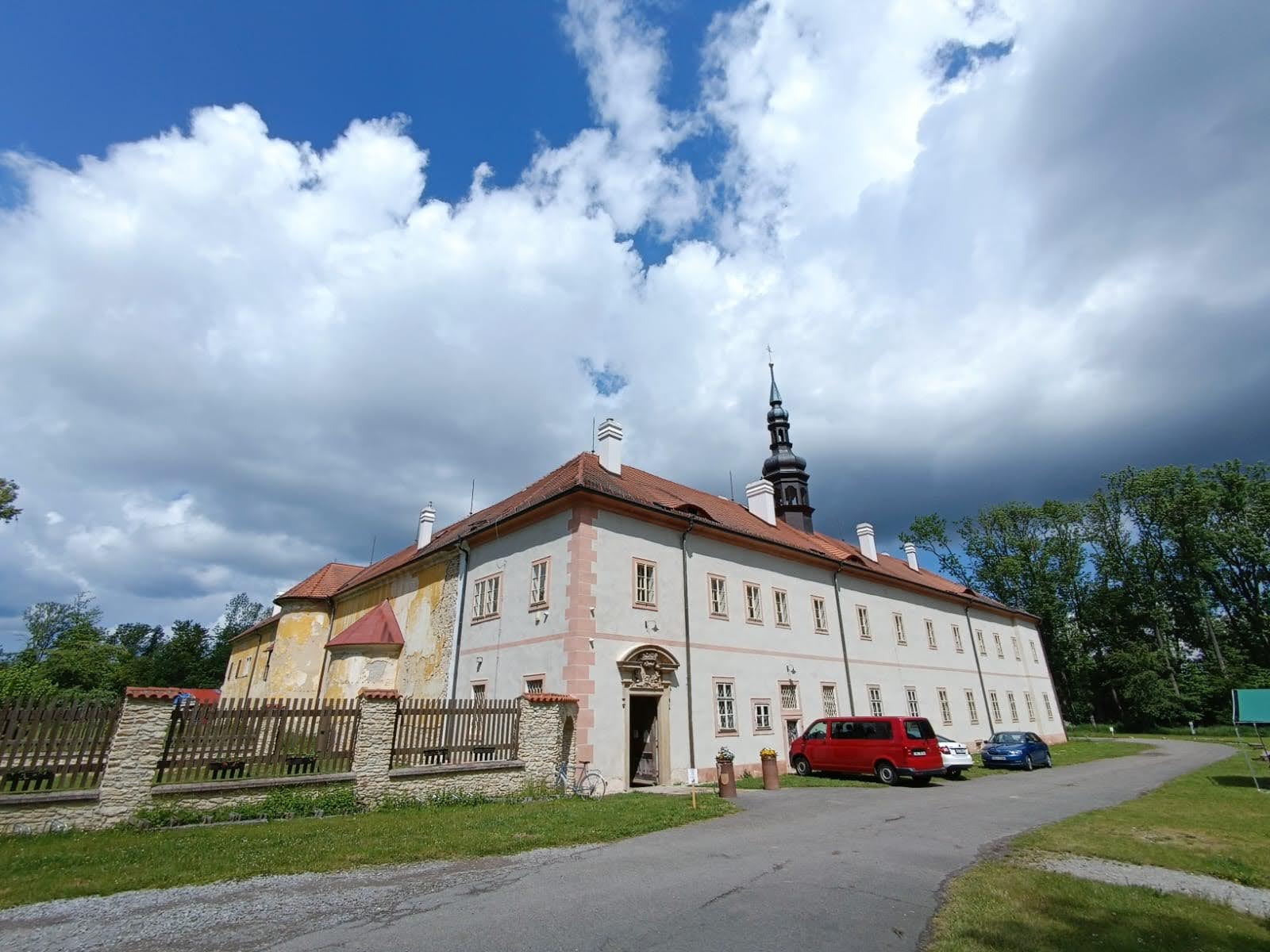
About this place
Hájek Monastery (Červený Újezd)
Hájek Monastery is a Franciscan pilgrimage complex tucked into a small woodland called Hájek, within the municipality of Červený Újezd, roughly 5 km from the western edge of Prague. The site brings together two very different chapters of history: a Baroque Loreto chapel nearly four centuries old, and a turbulent 20th century that turned the monastery to purposes far removed from prayer.
Who founded the monastery at Hájek?
The founder was Count Florián Jetřich Žďárský ze Žďáru, who laid the foundation stone in 1623 in the grove known as Hájek near Červený Újezd. The foundation was a votive gift, built in thanks for the birth of his son. The Franciscan monastery itself was added next to the chapel only later, in 1659 — meaning more than three decades passed between the founding of the site and the completion of the full monastic complex.
What is the Loreto chapel at Hájek?
At the heart of the complex stands the Loreto chapel of the Visitation of the Virgin Mary, built in the first third of the 17th century. It was designed by the architects Lurago and Orsi, and it ranks among the oldest Loreto chapels in the Czech Republic. Chapels of this type — replicating the dimensions and decoration of the Holy House of Loreto — were a popular form of Baroque pilgrimage site, and Hájek is one of the early, well-preserved examples of the type in the greater Prague region.
What pilgrimage route led to Hájek?
A historic pilgrimage path connected the monastery to the Loreto shrine in Prague's Hradčany district. Along this route, several wayside chapels have survived to this day — small roadside devotional structures that marked the path for pilgrims walking on foot from the city to the monastery in the woods. This arrangement, with an urban Loreto shrine as the starting point and a rural pilgrimage monastery as the destination, was a common Bohemian Baroque pattern that linked separate sites of worship into a single network.
What happened to the monastery in the 20th century?
Hájek's story in the last century diverged sharply from its original purpose. In the 1950s the complex was converted into an internment camp, and later it was used as a military storage depot. Only after many years did the monastery begin returning to Franciscan hands; the friars have since restored its religious function while carrying out repair work to bring the buildings back closer to their historic appearance.
Frequently asked questions
Where exactly is Hájek Monastery located? In a small wood called Hájek, within the municipality of Červený Újezd, about 5 km from the western edge of Prague.
Who founded the monastery, and when? Count Florián Jetřich Žďárský ze Žďáru laid the foundation stone in 1623 as a votive offering for the birth of his son. The Franciscan monastery building itself was added in 1659.
What is the complex's main landmark? The Loreto chapel of the Visitation of the Virgin Mary, built in the first third of the 17th century and designed by the architects Lurago and Orsi — one of the oldest chapels of its kind in the Czech Republic.
Where did the pilgrimage route to Hájek start? At the Loreto shrine in Prague's Hradčany; wayside chapels along the route still mark the path today.
Is the monastery still used for religious purposes? After being turned into an internment camp and later a military depot during the 20th century, the site returned to the Franciscans, who now use it for pastoral activity while restoring the complex.
Nearby places

Earn badges for the places you visit
Download NextOnTrip, discover new places and check off your trails.