Save this place and discover nearby attractions with NextOnTrip
In the app you can add it to your favorites, see what else is worth visiting nearby on the map, and earn a badge for your visit.
The app is available for iPhone and Android.
About this place
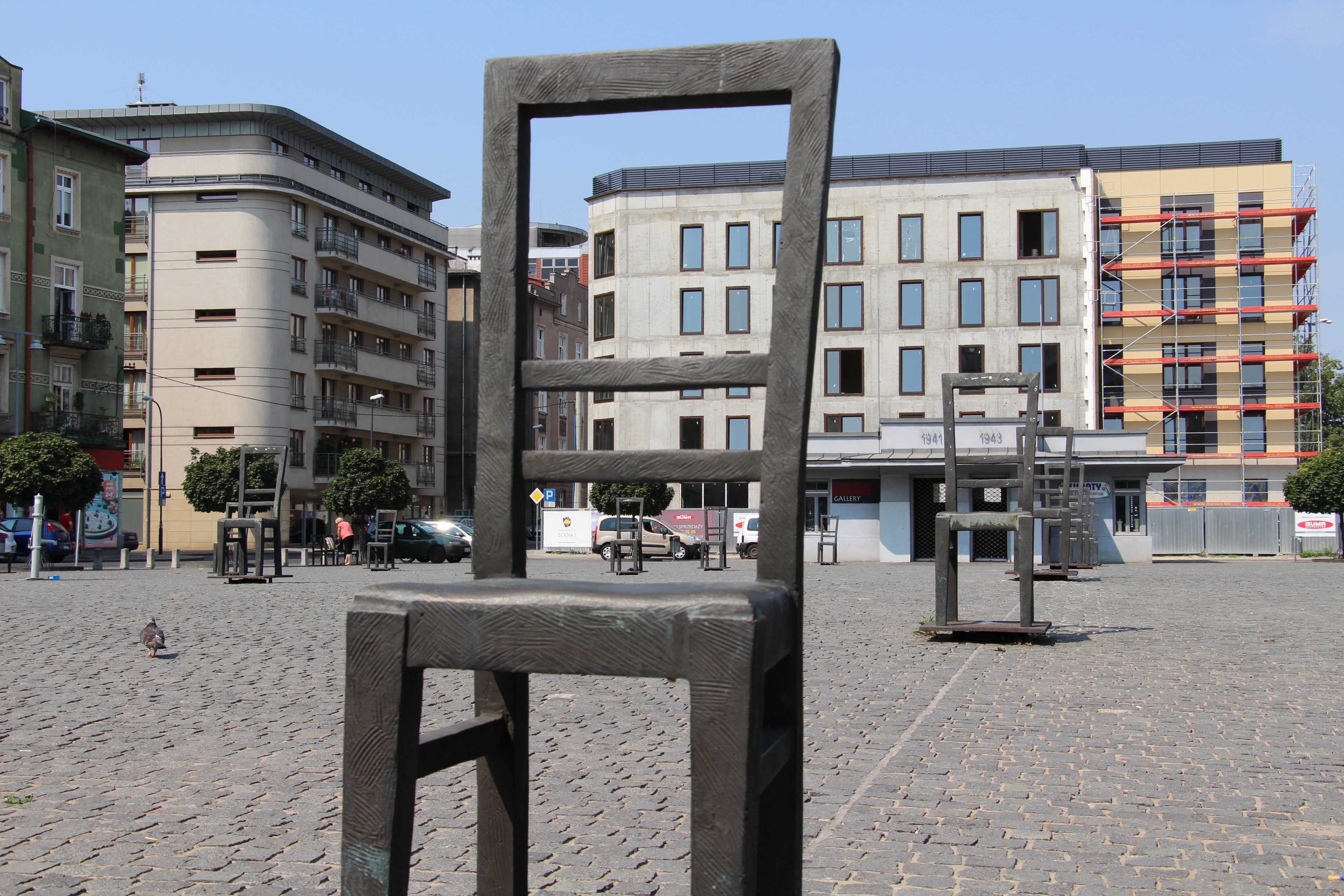
Ghetto Heroes Square (Plac Bohaterów Getta) in Kraków's Podgórze district is one of the most moving memorial sites in Poland. A former market square that became the central point of the wartime ghetto, it is now filled with 70 large chairs, a symbol of the emptiness left by people who never came home.
What is this place?
The square was laid out in the first half of the 19th century. For decades it served as an ordinary Podgórze marketplace, and later as a bus stop, taxi rank and car park. Its older name, Plac Zgody (Concord Square), sounds bitter against what happened here during the German occupation.
What is the history of the square?
In spring 1941 the Germans created a ghetto in Podgórze for Kraków's Jewish population. The square became its largest open space and the site of daily roll calls. Selections were carried out here, groups were sent from here to camps, and the most tragic scenes unfolded during the ghetto's liquidation in March 1943. Residents were sent to deportation or to the nearby Płaszów camp.
What are the chairs on the square?
The memorial, unveiled in 2005 after a thorough redesign of the square, consists of 33 large chairs of cast iron and bronze and 37 smaller ones you can actually sit on. An empty chair speaks of absence: people vanished, their belongings stayed behind. The chairs stand scattered, as if someone had left their homes in a hurry and abandoned the furniture in the street. A former car park became a place for reflection.
What is there to see nearby?
On the square stands the former Eagle Pharmacy (Apteka pod Orłem), now a branch of the Museum of Kraków. Its owner, Tadeusz Pankiewicz, was the only Pole to run a pharmacy inside the ghetto, and he chose to stay. He helped residents by handing out medicines, passing on news, hiding documents and offering shelter. After the war he was honoured as Righteous Among the Nations. In the former pharmacy rooms you will see original fittings, documents and an account of daily life in the ghetto.
A few hundred metres away, fragments of the ghetto wall survive, topped with a distinctive shape resembling tombstones. Nearby is also Oskar Schindler's former factory, now a museum about occupied Kraków.
How to visit
A quarter of an hour is enough to see the square, but it is worth staying longer. Walk slowly between the chairs, read the plaques and sit on one of the smaller seats. Mornings are usually calmer. The square lies across the Vistula from Kazimierz, so it combines easily with a walk through Podgórze, its market square and St Joseph's Church. This place calls for quiet and respect: it is not a photo backdrop but a site of remembrance.
Frequently asked questions
Is entry to the square paid? No, it is an open public space accessible at any time.
How do I get there from Kazimierz? On foot across the Piłsudski Bridge or the Silesian Uprisers Bridge, about 20-25 minutes.
Can I sit on the chairs? You can on the smaller ones. The large metal ones are a monument and deserve respect.
Is it worth combining with a museum visit? Yes, the Eagle Pharmacy and the former Schindler factory complete the story of the square.
Nearby places

Earn badges for the places you visit
Download NextOnTrip, discover new places and check off your trails.