About this place
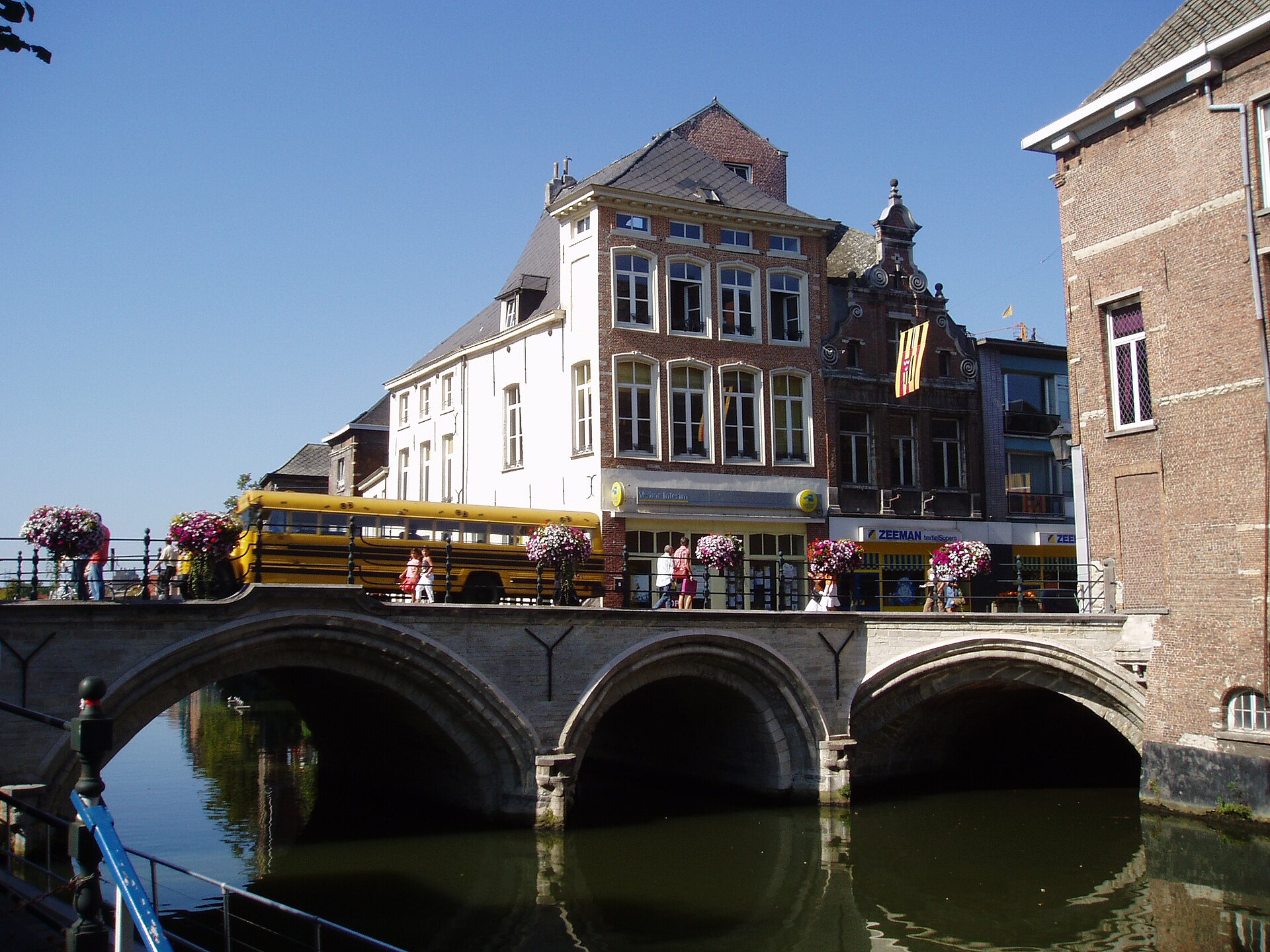
Fonteinbrug is an arch bridge spanning the river Dijle in Mechelen, sitting at the end of the Bruul street where it meets the Vijfhoek district. Its present-day structure combines two masonry spans with a central span built from metal beams — a mixed design that reflects a long and eventful history stretching back to the Middle Ages.
Where does the bridge's name come from?
The name Fonteinbrug, literally "fountain bridge," comes from a fountain that once stood on a lower platform right next to the crossing. In the 16th century this fountain was an elaborate work of art decorated with figures, including a metal image of the Virgin of Mechelen holding a unicorn in her lap. Although the fountain itself has long since vanished from the cityscape, its name lives on in the bridge that still carries traffic over the Dijle.
How has the bridge changed over the centuries?
The very first crossing on this spot was made of wood. In 1371 it was replaced by a Gothic arch bridge with three pointed arches, topped with crenellations that gave the structure an almost fortified appearance. In 1595, a gilded wooden figure of Christ was placed on the central arch, underlining the religious significance often attached to river crossings of this kind at the time.
The 18th century brought further change: between 1728 and 1732 the stone crenellations were removed and replaced with iron railings, a common modernization for bridges of this type in that period. The most decisive transformation came in 1820, when the central arch disappeared and was replaced with metal beams — which is why the bridge today shows a hybrid form, pairing its older masonry side spans with a more technical central section.
What historical significance does the area hold?
The surroundings of Fonteinbrug are also linked to a knightly order. Knights of the Commandery of Pitzemburg, a military order, settled in the city near this bridge toward the end of the 12th or beginning of the 13th century. Specifically, the Commandery of Pitzemburg was established in 1220 at the eastern end by Fonteinbrug — on the spot now occupied by the Royal Atheneum and its adjoining botanical garden, the Kruidtuin. This shows how the bridge has served for centuries not only as a means of crossing the river but also as a landmark tied to important institutions of the city.
What other bridges are worth seeing nearby?
Fonteinbrug is not the only historic bridge over the Dijle in the center of Mechelen. Nearby stand the Hoogbrug and the Kraanbrug, together forming a network of crossings that has shaped the city's urban layout for centuries, allowing residents to move freely between districts such as Vijfhoek and Bruul.
Frequently asked questions
What is Fonteinbrug? It is a historic arch bridge over the river Dijle in Mechelen, connecting the Vijfhoek district with the Bruul street.
Where does the bridge's name come from? From a fountain that once stood beside the bridge, decorated with elaborate figures including an image of the Virgin of Mechelen with a unicorn.
When was the current bridge built? The Gothic three-arch bridge dates from 1371, replacing an earlier wooden crossing. It has been rebuilt several times since, most recently in 1820 when the central arch was replaced with metal beams.
What other historic sites are nearby? The Commandery of Pitzemburg, a knightly order, was founded near the bridge in 1220, and the city center holds other historic bridges over the Dijle, namely the Hoogbrug and the Kraanbrug.
Nearby places

Earn badges for the places you visit
Download NextOnTrip, discover new places and check off your trails.