About this place
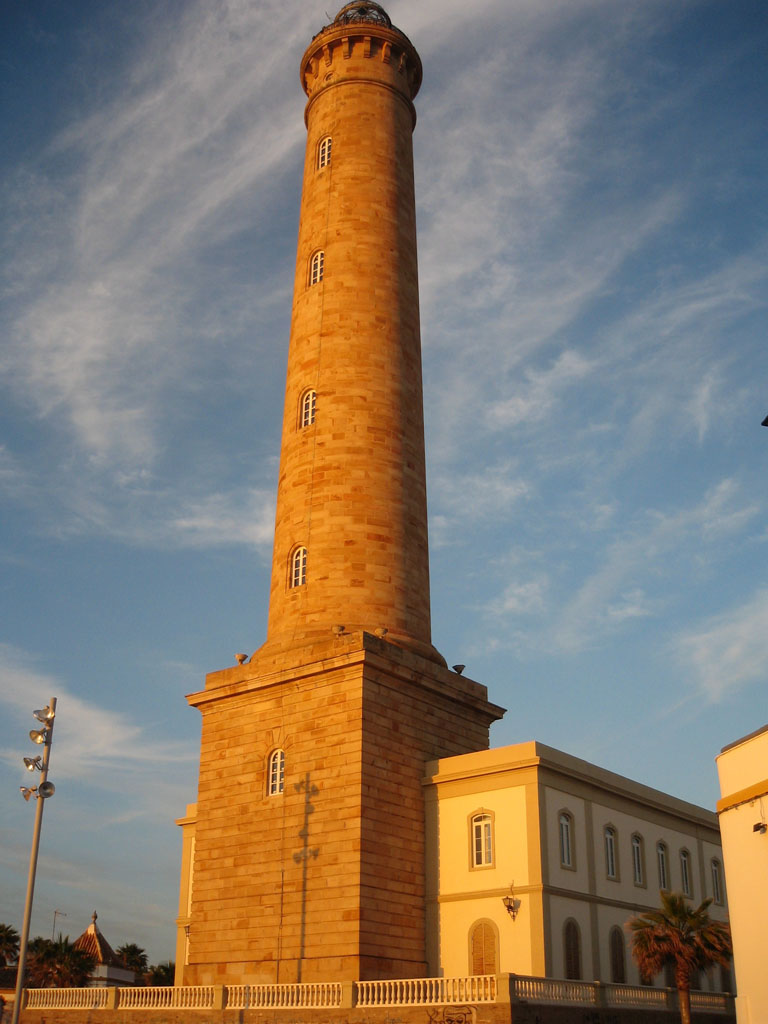
Faro de San Sebastián is a lighthouse in Cádiz, standing on the rocky islet that closes off La Caleta beach, on the same spit of land occupied for centuries by the defensive fort of San Sebastián.
How do you get there?
The lighthouse sits on a small islet at the far end of La Caleta, one of the most recognisable beaches in Cádiz's old town. A stone causeway links the outcrop to the mainland, a link rebuilt in its current form during 19th-century works that re-fortified the island. Walking from Cádiz's historic centre along the seafront to the base of the lighthouse usually takes no more than a quarter of an hour, and the route itself is one of the nicer stretches of the city's waterfront promenade, with open ocean on one side and the old town skyline on the other.
What will you see?
The site's story stretches back well beyond the lighthouse itself. The islet's defensive role has roots going back to Phoenician times, though the layout visible today largely took shape in the 18th century, during Cádiz's golden age as Spain's principal Atlantic port handling trade with the Americas. Earlier still, in 1457, the crew of a Venetian ship recovering from an outbreak of plague built a small chapel on the islet dedicated to Saint Sebastian, which gave the whole fortress its name. In 1860 those earlier makeshift defences were replaced with a more substantial fortification equipped with casemates, and it was during this same period that the solid causeway connecting the island to the historic city centre was built.
The lighthouse has its own history, closely tied to the fort but distinct from it. A light signal warning sailors away from the rocks had existed on this spot since at least the 16th century, long before the current tower was built. Construction of today's lighthouse began in 1907, roughly 70 metres from the earlier structure, though it took years to come into service: the project was revised so the tower could be lit electrically using a voltaic arc lamp, a novel technology at the time. The light was finally switched on for the first time on 30 September 1913, making it the second installation in Spain to use this type of electric lighting. The lighthouse today is operated by the port authority of the Bay of Cádiz (Puerto de la Bahía de Cádiz), while the fort itself has been protected as a Bien de Interés Cultural, Spain's heritage-site designation, since 1993.
While exploring the grounds, look out for the thick defensive walls, the casemates built into the fortification, and the various viewpoints along the causeway — from here you get one of the best views over the Bay of Cádiz and the old town's coastline.
When should you visit?
The islet is one of the most popular spots in Cádiz for watching the sunset, and the causeway and grounds around the fort fill up with locals and visitors as evening approaches. Early morning is also worth considering, when La Caleta beach and the causeway are still quiet, making it easier to walk the fortifications and take photos without crowds.
Frequently Asked Questions
Can you go inside the lighthouse tower? The tower itself remains under the port authority's management and isn't generally open to visitors in the same way as the surrounding fort — it's worth checking current access rules locally, as they can change.
What's the difference between the Faro de San Sebastián and the Castillo de San Sebastián? They're two parts of the same complex on the islet: the castle is the 18th-century fortification with much older roots, while the lighthouse is a separate, considerably younger tower built within its grounds between 1907 and 1913.
Why is the site called San Sebastián? The name comes from a small chapel dedicated to Saint Sebastian, built in 1457 by the recovered crew of a Venetian ship that had stopped on the islet after an outbreak of plague on board.
How do you walk to the lighthouse from central Cádiz? The easiest route is on foot along the seafront promenade and La Caleta beach, then across the causeway onto the islet — the whole walk from the historic centre typically takes 20 to 30 minutes at a relaxed pace.
Nearby places

Earn badges for the places you visit
Download NextOnTrip, discover new places and check off your trails.