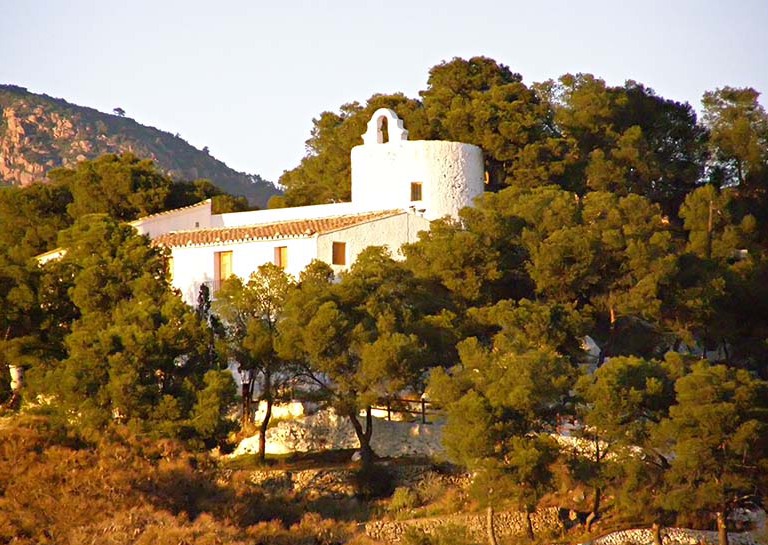
About this place
Ermitori de la Magdalena is a small hermitage standing on the Castell Vell hill above Castelló de la Plana, on the very site where the medieval town once stood before its people resettled on the plain below.
Where did this hermitage come from?
The earliest recorded procession to the Castell Vell hill dates back to 1375, when the town was struggling with an outbreak of plague. The hermitage visible today, however, was built later: construction began in 1451, commissioned by a friar locally known as "el frare barbut" (the bearded friar), who belonged to the Cistercian monastery of Santes Creus. Builders reused the remains of the old castle together with an existing cistern already carved into the rock, which helped cut down on both cost and construction time.
What did the original building look like?
The interior was laid out as two parallel naves, divided by simple, roughly hewn arches and covered with barrel vaulting. The friar overseeing construction dedicated one altar to Saint Mary Magdalene and the other to Saint Bernard of Clairvaux, founder of the Cistercian order he himself belonged to. Between 1455 and 1590 the complex went through repeated expansion and renovation: a portico was added, and the site grew to include kitchens, a dining hall, cisterns and lodging rooms for pilgrims, since from the Middle Ages onward it served as a destination for prayer and religious journeys.
What role did the hermitage play in the life of the town?
The site's importance to the people of Castelló grew steadily over time. In 1503 the town council established seven processions to be held during periods of drought, one of which led specifically to the hermitage of Santa María Magdalena. Decades later, between 1562 and 1570, a vote among the clergy and town authorities established an annual penitential procession to be held every third Saturday of Lent.
What does today's pilgrimage commemorate?
The modern pilgrimage, known as the Romería de les Canyes, commemorates the resettlement of the population from the hill down to the plain in 1251. Thousands of people from Castelló walk roughly 8 kilometers from the town center up to the Castell Vell hill, symbolically retracing in reverse the route taken by the town's first settlers in 1252. The event takes place on the third weekend of Lent, as part of the Magdalena Festival, one of the city's most important annual celebrations.
Are there other landmarks along this route?
Yes: along the pilgrimage route, in the village of Canet, stands the Ermita de Sant Roc, built in 1652 by converting an old farmhouse into a shrine dedicated to the saint invoked against plagues. This small chapel is used almost exclusively once a year, serving as the final stop of the Romería de les Canyes before pilgrims reach the hermitage on Castell Vell hill.
Frequently asked questions
When was the current hermitage built? Construction began in 1451, with expansion works continuing until 1590.
Who built the Ermitori de la Magdalena? A Cistercian friar from the Santes Creus monastery, known as "el frare barbut," who built it on top of the ruins of the old Castell Vell castle.
Why does this place matter to Castelló? It is the destination of the annual Romería de les Canyes, which commemorates the town's move from the hill to the plain in the 13th century, and it has hosted religious processions since medieval times.
Nearby places
-

Chapel of Sant Francesc de la Font
Castelló de la Plana
-
Basílica de la Mare de Déu del Lledó
Castelló de la Plana
-
Monestir dels Pares Carmelites del Desert de les Palmes
Benicàssim
-
Cementeri de Sant Josep
Castelló de la Plana
-
Ermita de Sant Isidre i Sant Pere
Castelló de la Plana
-
Ermita de Santa Águeda y Santa Lucía (Cabanes)
Cabanes
Earn badges for the places you visit
Download NextOnTrip, discover new places and check off your trails.