About this place
The Dominican monastery in Malá Strana is a former monastic complex in Prague's historic Lesser Town, standing close to Charles Bridge. Over the centuries the site has passed through several very different roles — medieval convent, Baroque monastery, post office, police barracks, and today a music museum.
How did the monastery come to be built here?
Before the Dominicans founded their monastery on this spot in 1604, the same site was already occupied by an older convent of the Magdalenite order, connected to the Church of St. Mary Magdalene. That earlier community existed as far back as before 1329, but its buildings were destroyed in 1420. It was only at the start of the 17th century that the Dominicans took over the site and built their own monastery and church there.
Who designed the Baroque church?
The monumental Baroque church was constructed between 1654 and 1679. Its design came from the Italian architect Francesco Caratti, who is also known for the Czernin Palace at Hradčany, one of the grandest noble residences in Prague. A chapel within the complex became the burial place of the architects Kryštof Dientzenhofer and his son Kilián Ignác Dientzenhofer, two of the most important names behind Prague's Baroque churches.
What happened to the monastery after the Josephine reforms?
In 1783, as part of Emperor Joseph II's church reforms, the Dominican monastery was dissolved. A year later, the building received a new, Classicist finish on its façade. From 1791 to 1849, it housed Prague's first — and for a long time only — post office, a use far removed from its original monastic purpose. After postal operations ended, the building was converted into police barracks, and during that rebuilding two distinctive towers with Baroque onion-shaped domes, which had previously crowned the church, were removed.
What is housed in the former monastery today?
The building, registered under number 388, today houses the Czech Museum of Music (České muzeum hudby). Despite repeated changes of use — from post office to barracks to cultural institution — a visible trace of the building's original sacred character survives in its dome with an octagonal lantern, which still rises above the rooftops of this part of Malá Strana.
Frequently asked questions
When was the Dominican monastery in Malá Strana founded? The Dominicans established their monastery here in 1604, on the site of an earlier medieval Magdalenite convent that had existed before 1329.
Who designed the monastery church? The Baroque church, built between 1654 and 1679, was designed by the Italian architect Francesco Caratti.
Why did the monastery stop operating? It was closed in 1783 as a result of Emperor Joseph II's Josephine church reforms, which dissolved many religious orders across the Habsburg monarchy.
What was the building used for after the monastery was dissolved? It served in turn as Prague's first post office (1791–1849), then as police barracks, and today as the Czech Museum of Music.
Can the original monastery church still be recognized? Yes — despite later rebuilding, the dome with its octagonal lantern has survived, although the two Baroque onion-domed towers were removed when the building was converted into barracks.
Nearby places
-

Church of Saint Lawrence in Malá Strana, Hellichova
Praha
-
Church of Our Lady of Victories
Praha
-
Church of Our Lady beneath the Chain
Praha
-
Statue of Wenceslaus I, Charles Bridge
Praga
-
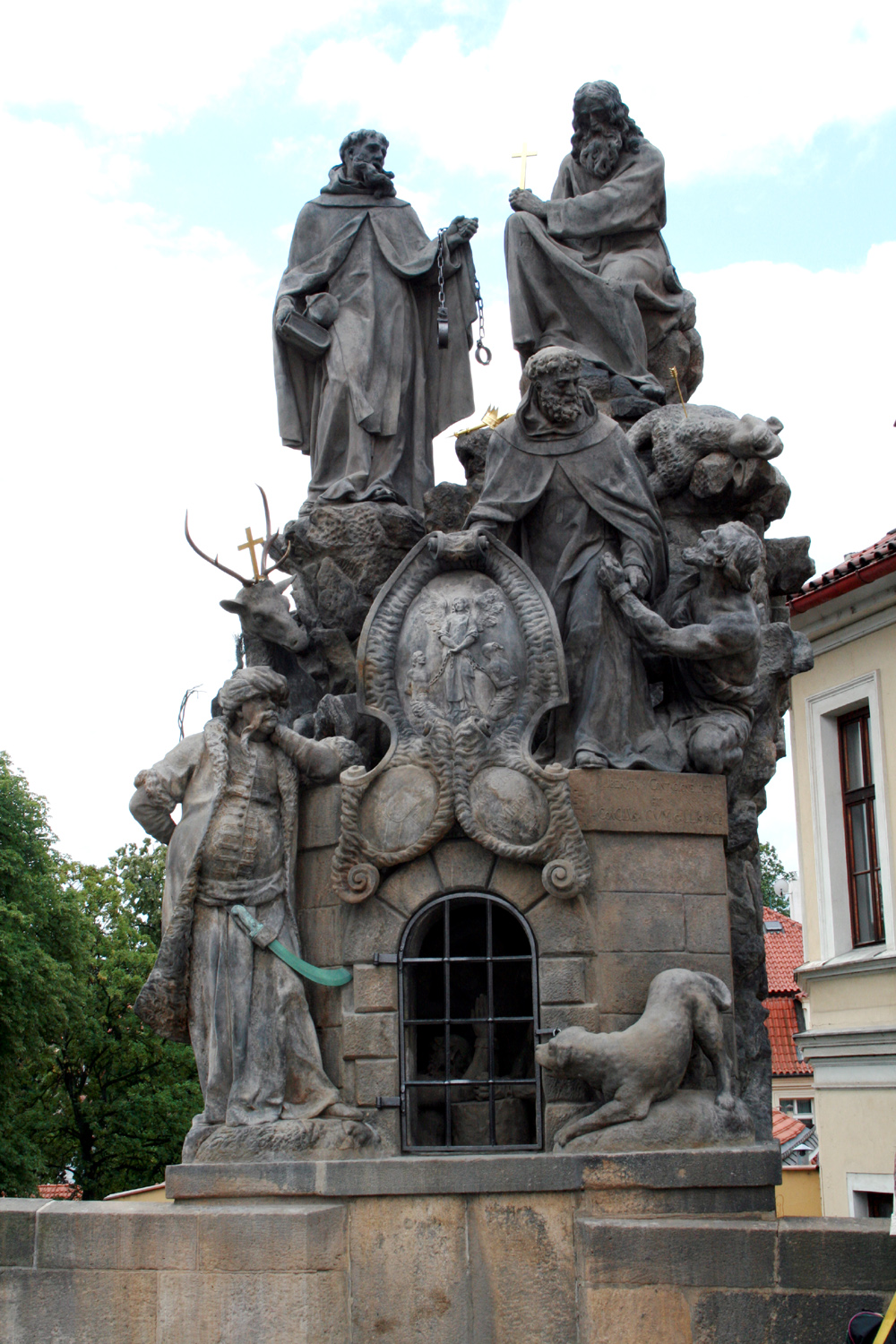
Statues of John of Matha, Felix of Valois and Saint Ivan, Charles Bridge
Praga
-
Statues of Saints Cosmas and Damian, Charles Bridge
Praga
Earn badges for the places you visit
Download NextOnTrip, discover new places and check off your trails.