About this place
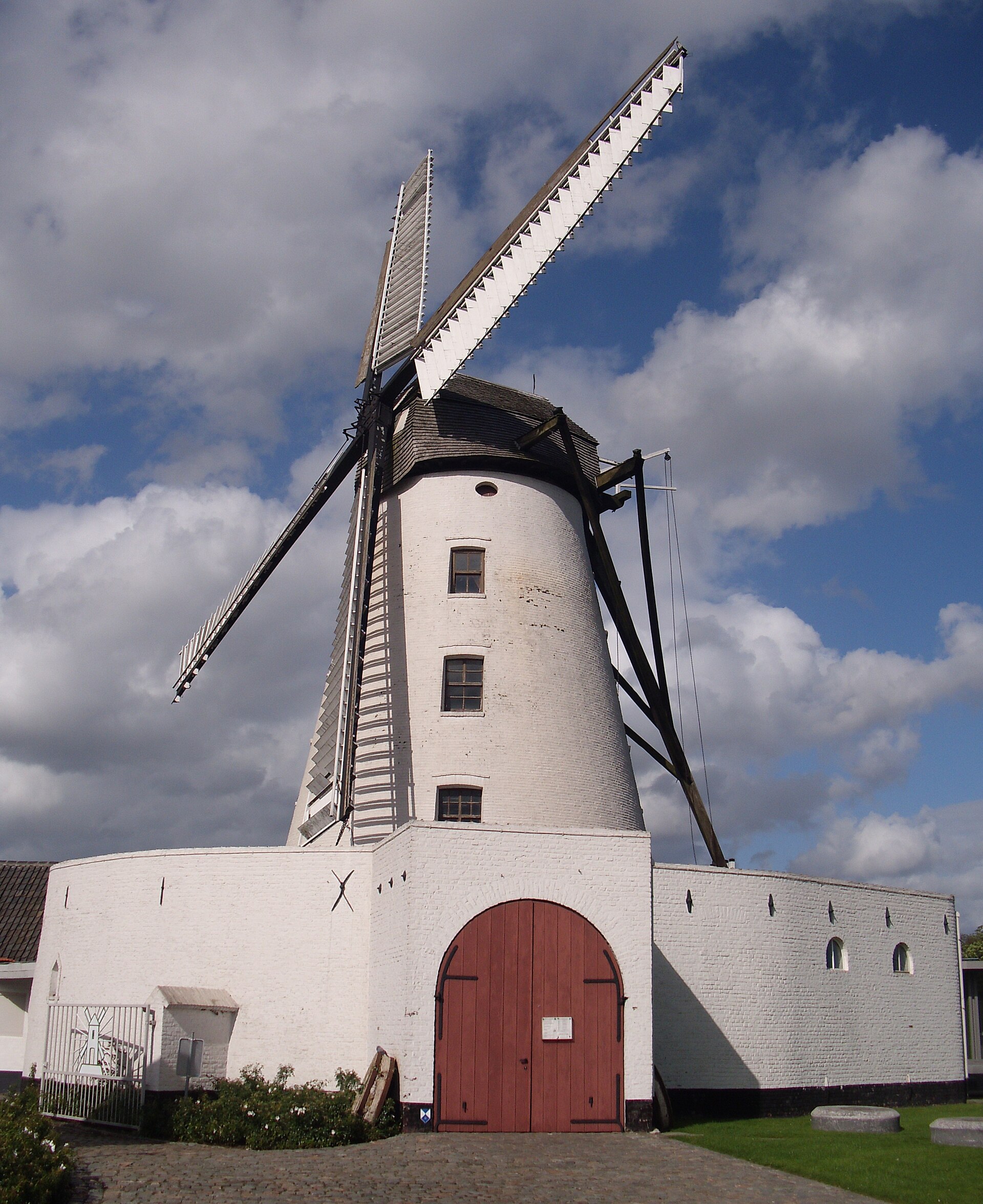
De Grote Macht is a historic stellingmolen (a post mill mounted on a raised platform) standing in Moorsele, a village that is part of the municipality of Wevelgem in West Flanders, Belgium. It ranks among the larger surviving windmills in the country and stands as a landmark of the region's industrial heritage.
Where did the mill come from and how did it start?
The mill was built in 1817 on the initiative of Philippe Vandenberghe, an oil trader from Menen. From the start it served a dual purpose typical of 19th-century West Flanders windmills: grinding grain and pressing oil from oilseeds. In 1857, to keep production running regardless of the weather, a steam engine was added alongside the sails — a common upgrade at a time when wind alone could not guarantee steady output.
What happened to the mill during the First World War?
West Flanders suffered heavily during the First World War, and De Grote Macht did not escape the destruction. In October 1918, the mill and its milling equipment were severely damaged. Despite this, the structure was not abandoned. In 1922 the milling facility was rebuilt and expanded, with an oil press added to the operation, allowing the mill to keep working for several more decades.
How long did the mill stay in operation?
De Grote Macht remained active until roughly 1955. Like many windmills across Europe in this period, it gradually lost its economic relevance as industrial, electrically powered mills took over grain and oil processing, and it slipped into disuse.
How was the mill saved from disappearing?
The turning point came in the 1990s. In 1993, a foundation was established specifically to restore the aging windmill. Three years later, in 1996, De Grote Macht was granted protected monument status, formally shielding it from demolition or further decay. In 1998, the mill was leased to the Mill Foundation De Grote Macht for a 27-year term, with a clear mandate: preserve and restore the structure for future generations.
Can the mill still be seen working today?
The restoration effort paid off. Since 2005, the sails of De Grote Macht have been able to turn again — a rare feat among historic windmills, many of which survive today only as static exhibits. Being able to watch the mechanism actually operate makes this site especially appealing to visitors interested in industrial heritage and traditional milling.
Frequently asked questions
Where exactly is De Grote Macht located? In Moorsele, part of the municipality of Wevelgem in the province of West Flanders, close to the French border.
What type of windmill is it? A stellingmolen — a windmill raised on a masonry base with an external gallery (the "stelling") from which the miller operated the sails, a construction style typical of the flat Flemish landscape.
What was the mill originally used for? Grinding grain and pressing oil from oilseeds, a dual industrial function common in the region during the 19th century.
Can visitors see the mill actually turning? Yes. Since the restoration was completed in 2005, the sails turn again, setting it apart from many historic windmills that only serve as static museum pieces today.
Who manages the site now? The Mill Foundation De Grote Macht, which took over the lease in 1998 with a long-term mandate for preservation and conservation.
Nearby places

Earn badges for the places you visit
Download NextOnTrip, discover new places and check off your trails.