About this place
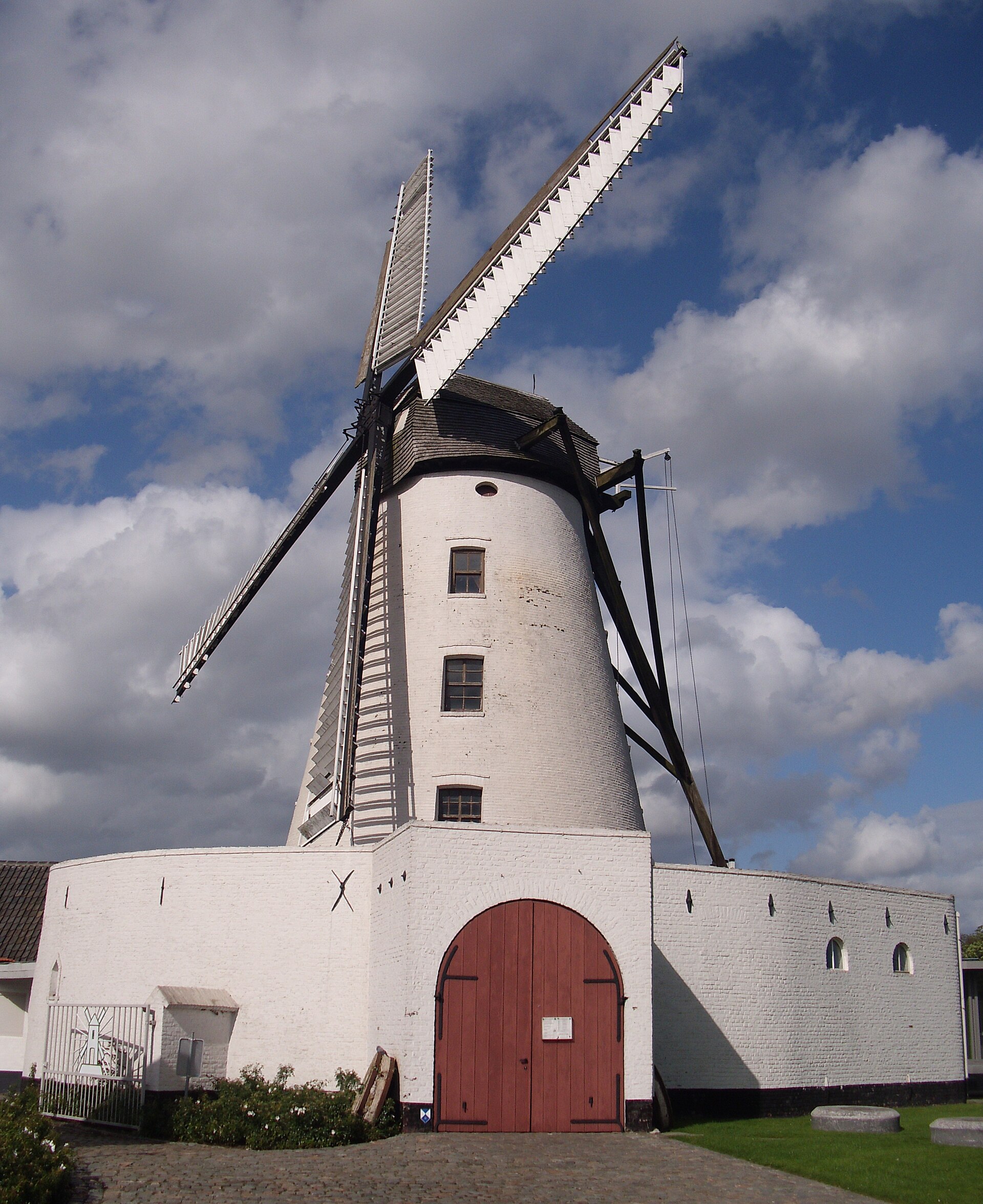
De Goede Hoop is a historic windmill in Menen, Belgium, the last survivor of thirteen mills that once operated in this town near the French border. It stands at coordinates 50.799167, 3.136944, in a landscape that for centuries was shaped by farming activity around Kortrijk.
Where does the mill's story begin?
The site's history dates back to 1643, when Laurens de Heuse purchased the land on which the mill would eventually be built. The original structure was a wooden oil windmill, a type of mill built to press oil from seeds rather than grind grain. Such oil mills were common across West Flanders, where oilseed cultivation formed an important part of the rural economy.
Who owned the mill over the centuries?
For decades the mill remained in the hands of the Vandenberghe family, oil pressers from Menen who ran it as part of their trade. In 1856 ownership passed to Louis van Hollebeke, marking a turning point in the mill's history. Under this family, the building gradually shifted from an oil mill toward a grain mill, adapting to the changing needs of local farmers and residents.
How was the mill modernized, and why did it fail?
In 1890, Louis van Hollebeke's son installed a steam engine inside the mill, hoping to boost output regardless of wind conditions. The experiment was short-lived: the steam drive was already decommissioned by 1894. The windmill itself kept working for several more decades, but milling activity finally stopped in 1946, after which the building began to fall into disrepair.
What happened during the 1968 fire?
Left unused and poorly maintained, the mill became increasingly vulnerable, and in September 1968 a fire broke out inside it. The blaze destroyed part of the ceiling and the beams between the stone floor and the milling floor, and also damaged the lower base structure supporting the mill. The damage accelerated the building's decline, and it stood neglected and exposed to the elements for more than three decades afterward.
How was the mill eventually saved?
The turning point came in 1981, when the town of Menen bought the windmill with the intention of restoring it and opening it to residents and visitors. That decision preserved the last remaining example of what had once been a sizeable fleet of windmills in the town — a reminder of an era when wind power drove the local food and craft economy.
What can visitors expect today?
De Goede Hoop now functions as a piece of local heritage and a vantage point over the surrounding area of Menen. Visitors can trace its full arc, from a modest oil mill through an attempted steam-powered upgrade to postwar decline and eventual conservation efforts. It is a fitting stop for anyone interested in industrial heritage, traditional Flemish milling architecture, or a quiet walk away from the region's busier tourist routes.
Frequently asked questions
Is De Goede Hoop the only surviving windmill in Menen? Yes, it is the last of thirteen windmills that historically operated within the town.
What was the windmill originally used for? It began as an oil mill, pressing oil from seeds, before later being adapted for grinding grain.
Why did the mill stop operating? Milling ended in 1946, and a fire in 1968 caused further damage, leaving the building abandoned for years afterward.
When did efforts to save the mill begin? The town of Menen purchased the windmill in 1981 with plans to restore it and open it to the public.
Nearby places

Earn badges for the places you visit
Download NextOnTrip, discover new places and check off your trails.