About this place
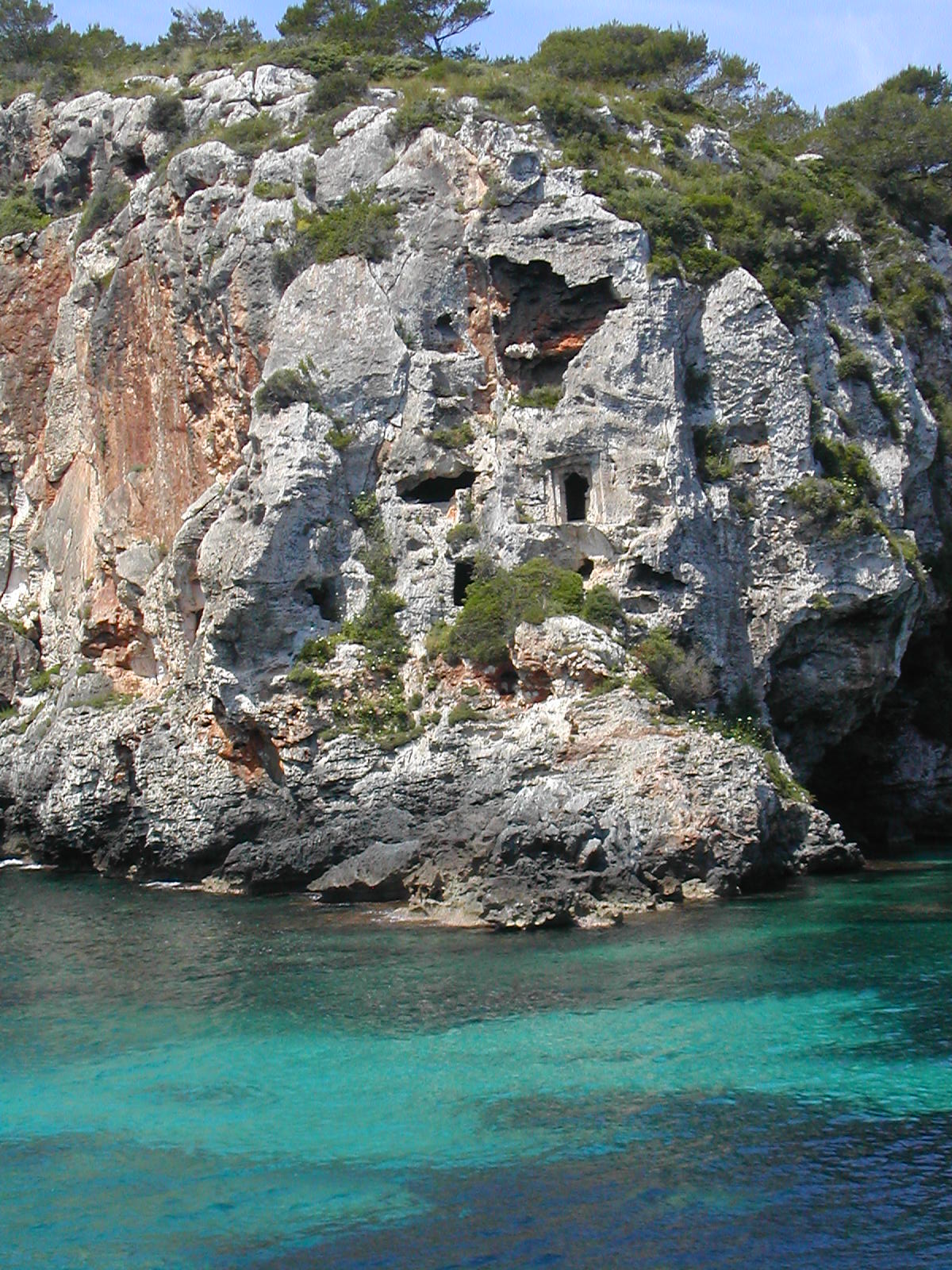
Cova dels Jurats is a cave at Calescoves cove, on the coast of the municipality of Alaior in Menorca, recognised as one of the island's most significant archaeological sites linked to Talayotic culture. Unlike most of the neighbouring caves at Calescoves, which served as tombs, this one functioned as a sanctuary.
What does the inside of the cave look like?
The interior stretches roughly 20 metres and ends in an apse-shaped chamber. Research has shown the site was already in ritual use from the 3rd century BC, during the final phase of Talayotic culture. That early date is what makes Cova dels Jurats stand out — it is the first rock sanctuary documented for Talayotic culture anywhere, whether on Menorca or on neighbouring Mallorca.
Why did the cave remain important in Roman times?
The site's significance did not end with the Talayotic period. Under Roman rule the cave continued to serve a religious purpose, though the character of the cult changed. The proof lies in 29 epigraphic panels — inscriptions carved into the rock at the entrance — dated to the 2nd and 3rd centuries AD. This continuity of use across two very different cultures, on the exact same spot, is unusual in the Balearics and gives Cova dels Jurats real research value.
How do we know so much about the cave's history?
Most of what is known comes from excavations carried out between 2010 and 2012. That fieldwork established the two distinct phases of use — Talayotic and Roman — and set Cova dels Jurats apart from the surrounding caves at Calescoves, most of which were burial sites rather than places of worship.
Where exactly is Cova dels Jurats located?
The cave sits within Calescoves, a small cove on Menorca's southern coast, in the municipality of Alaior. Calescoves is best known for its extensive complex of caves cut into the limestone cliffs around the inlet, forming one of the island's largest Talayotic necropolises. Within that complex, Cova dels Jurats is the exception: a sanctuary rather than a burial chamber.
What should visitors know before heading there?
Calescoves combines natural scenery with archaeology — a cliff-lined cove with clear water, reached most comfortably by boat or along the coastal footpath. Because this is a protected archaeological site, visitors should treat the location with care, particularly the inscriptions on the cave walls, which are an irreplaceable source of information about Menorca's history.
Frequently Asked Questions
What sets Cova dels Jurats apart from the other caves at Calescoves? Most caves in the cove were used as tombs, while Cova dels Jurats served as a sanctuary — first for Talayotic ritual, later for Roman worship.
How far back does its use as a place of worship go? Ritual use dates back to the 3rd century BC, and the site's religious role continued into Roman times, as shown by inscriptions from the 2nd and 3rd centuries AD.
What did archaeologists find during excavation? Fieldwork carried out between 2010 and 2012 confirmed the two phases of use and identified 29 epigraphic panels near the cave entrance.
Is the cave easy to find on your own? It lies within Calescoves cove in the municipality of Alaior. Since the area is fairly remote, it's worth planning access in advance, either by boat or via the coastal footpath.
Nearby places

Earn badges for the places you visit
Download NextOnTrip, discover new places and check off your trails.