Save this place and discover nearby attractions with NextOnTrip
In the app you can add it to your favorites, see what else is worth visiting nearby on the map, and earn a badge for your visit.
The app is available for iPhone and Android.
About this place
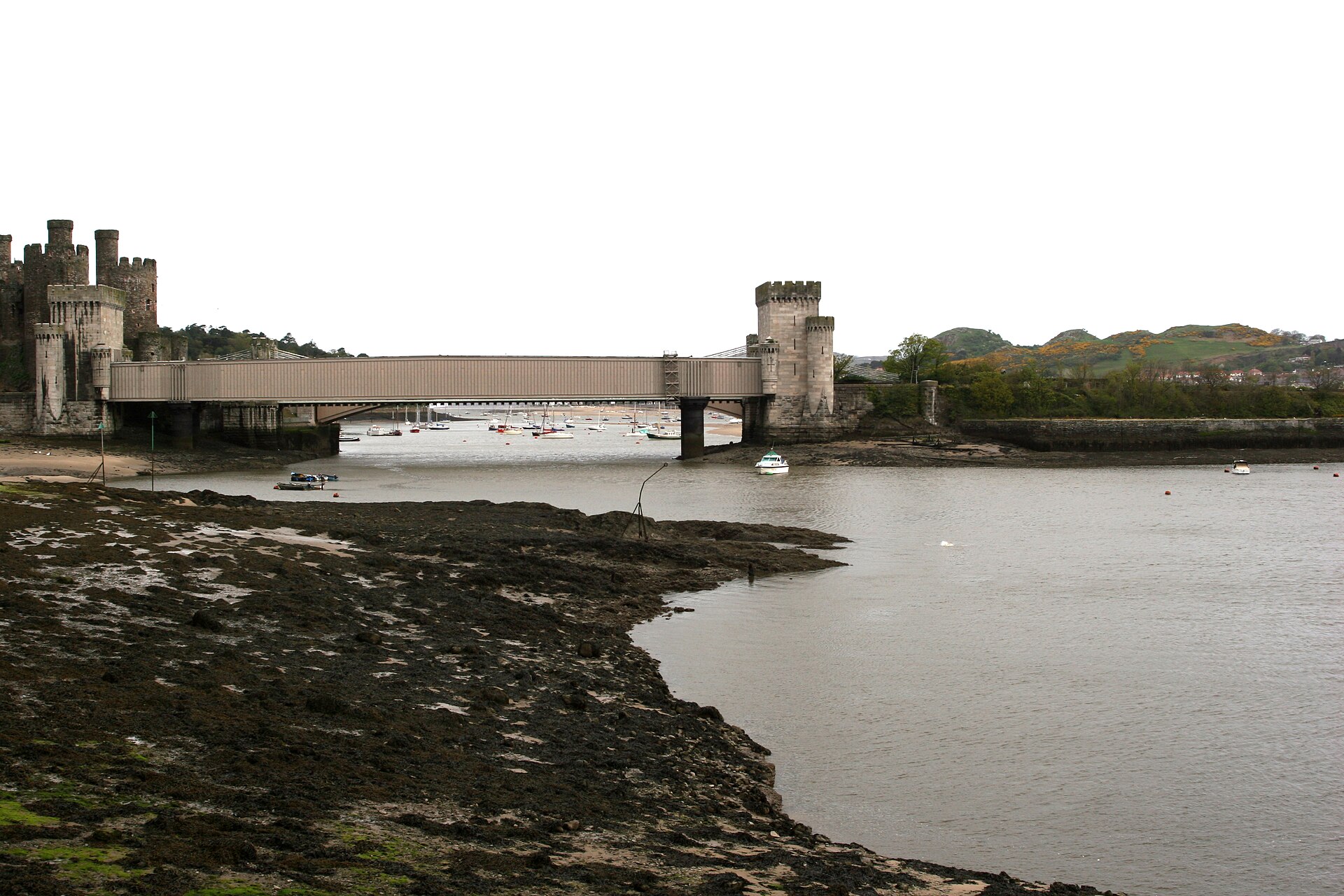
Conwy Railway Bridge is a Grade I listed wrought iron tubular bridge that carries the North Wales coast railway line across the River Conwy, linking Llandudno Junction with the walled town of Conwy. It was built in the 1840s and is the last surviving bridge of its kind by Robert Stephenson, which makes it a small piece of engineering history hiding in plain sight on the Welsh coast.
What makes Conwy Railway Bridge special?
Most railway bridges are open frameworks of girders or arches. This one is different: the trains run inside two long, parallel rectangular tubes made of riveted wrought iron plates. The structure crosses the estuary in a single span of roughly 400 feet, about 120 metres. Seen from the quay, it looks like a pair of severe iron boxes resting on stone abutments, a shape that feels almost industrial next to the medieval stonework nearby.
The design was a bold experiment at the time. Stephenson worked on it together with the shipbuilder and engineer William Fairbairn and the mathematician Eaton Hodgkinson, who tested how iron tubes behave under load. The contractor on site was William Evans. The Conwy tubes served partly as a trial for the much larger Britannia Bridge over the Menai Strait, built on the same principle.
Why is it the last of its kind?
Stephenson used the tubular idea on several crossings, including a very long bridge in Canada. Over time the others were replaced or lost. The Britannia Bridge was badly damaged by fire in 1970 and was rebuilt as a two-tier truss arch bridge, so Conwy is now the only surviving example of this Stephenson design. That rarity is the main reason for its Grade I status.
A later addition
The bridge was not left entirely untouched. Around 1899, supporting piers were added, one on each side of the main channel, to give the long tubes extra support. The bridge is still in daily use and is owned and maintained by Network Rail.
What to see nearby
The bridge stands in one of the most photogenic spots in North Wales. Within a few minutes on foot you can reach the other river crossings and the historic town:
- the Conwy Suspension Bridge, a Thomas Telford design from the 1820s, now a pedestrian crossing;
- the road bridge alongside;
- Conwy Castle and the town walls, a short stroll from the water.
Together these crossings show nearly two centuries of bridge building in one view, from a stone-towered suspension bridge to a Victorian iron tube.
How to see it
The best views are from the quayside in Conwy and from the riverbank on the Llandudno Junction side. The tubes look especially dramatic at low light, when the iron plates and rivets stand out against the water. If you arrive by train, you will cross the bridge yourself, though from inside the tube you will see mostly the iron walls rather than the structure itself.
Frequently asked questions
Who designed Conwy Railway Bridge? Robert Stephenson led the design, with significant input from William Fairbairn and Eaton Hodgkinson. William Evans built it.
Can you walk across it? No. It carries an active railway line, so it can be admired only from the banks or from a passing train.
Why is it so important? It is the only surviving tubular bridge of this type by Stephenson, after the Britannia Bridge was rebuilt following the 1970 fire.
Where exactly is it? It crosses the River Conwy between the town of Conwy and Llandudno Junction, on the North Wales coast line.
Nearby places

Earn badges for the places you visit
Download NextOnTrip, discover new places and check off your trails.