About this place
Colegio-convento de Agonizantes is a historic building right in the heart of Alcalá de Henares, at Plaza de Cervantes 12 — today the seat of the town hall (Ayuntamiento). At first glance it reads as a classic 19th-century municipal palace, but its story actually begins two centuries earlier, during the city's university golden age.
How to get there?
The building stands on Plaza de Cervantes, the main square of Alcalá de Henares, a short walk from the Alcalá de Henares train station (C-2 line from Madrid). This is the same square around which most of the historic center's landmarks cluster, so a visit pairs easily with a look at the nearby Universidad Complutense or the Magistral Cathedral.
What will you see?
The college-convent was founded in 1655 by Father Salvador Falconi, vice-provincial of the Order of Clerks Regular, Ministers of the Sick (the Camillians), after securing approval from both the Archbishop of Toledo, Baltasar Moscoso y Sandoval, and the university. Construction ran from 1652 to 1675. The friars of the Order of St. Camillus de Lellis had a duty to give spiritual comfort to people nearing death — which is why locals nicknamed the building Convento de Agonizantes, the "convent of the dying."
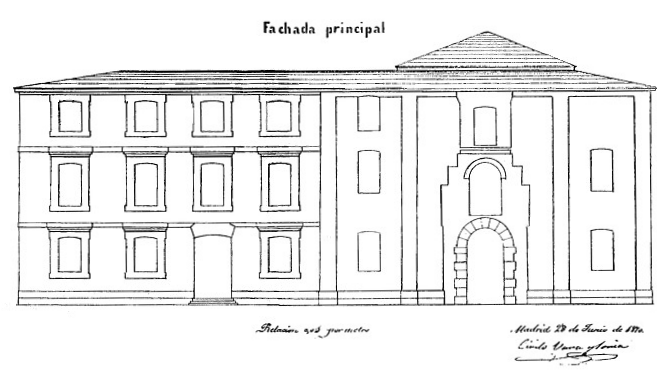
After the Madoz secularization of church property in 1855, the convent was left empty. City officials moved quickly to claim the building for the town hall, formally securing it in 1868. Two years later, in 1870, architect Cirilo de Vara y Soria drew up a renovation plan that placed the town hall, the National Militia, and three schools inside the old complex. The rebuilding and refurbishment work continued until 1875.
Since November 11, 1870, the building has served as the Palacio Consistorial — the seat of Alcalá de Henares's municipal government — a role it still holds today. Walking the square, it's easy to appreciate how a piece of 17th-century religious architecture was reshaped into a stately administrative building while keeping the original college's layout and proportions largely intact.
When to visit?
The best time to see the building is during weekday office hours, when the façade and entrance are visible without crowds. Plaza de Cervantes is most pleasant in spring and autumn, when the weather is comfortable for longer walks through the historic center and temperatures haven't climbed to the summer highs.
Frequently asked questions
Can you go inside the building as a visitor? As an active town hall, the interior isn't generally open for casual sightseeing — access depends on office hours and the purpose of the visit.
Where does the name "Agonizantes" come from? From the Camillian order (St. Camillus de Lellis), who ran the convent here and were tasked with offering spiritual comfort to the dying — "agonizantes" in Spanish.
Since when has the building been the town hall? Formally since 1868, and it has functioned continuously as the Palacio Consistorial since November 11, 1870.
What else is worth seeing nearby? Plaza de Cervantes and the adjoining historic center of Alcalá de Henares, including the Universidad Complutense and the Magistral Cathedral, can all be covered on one walking route.
Nearby places

Earn badges for the places you visit
Download NextOnTrip, discover new places and check off your trails.