About this place
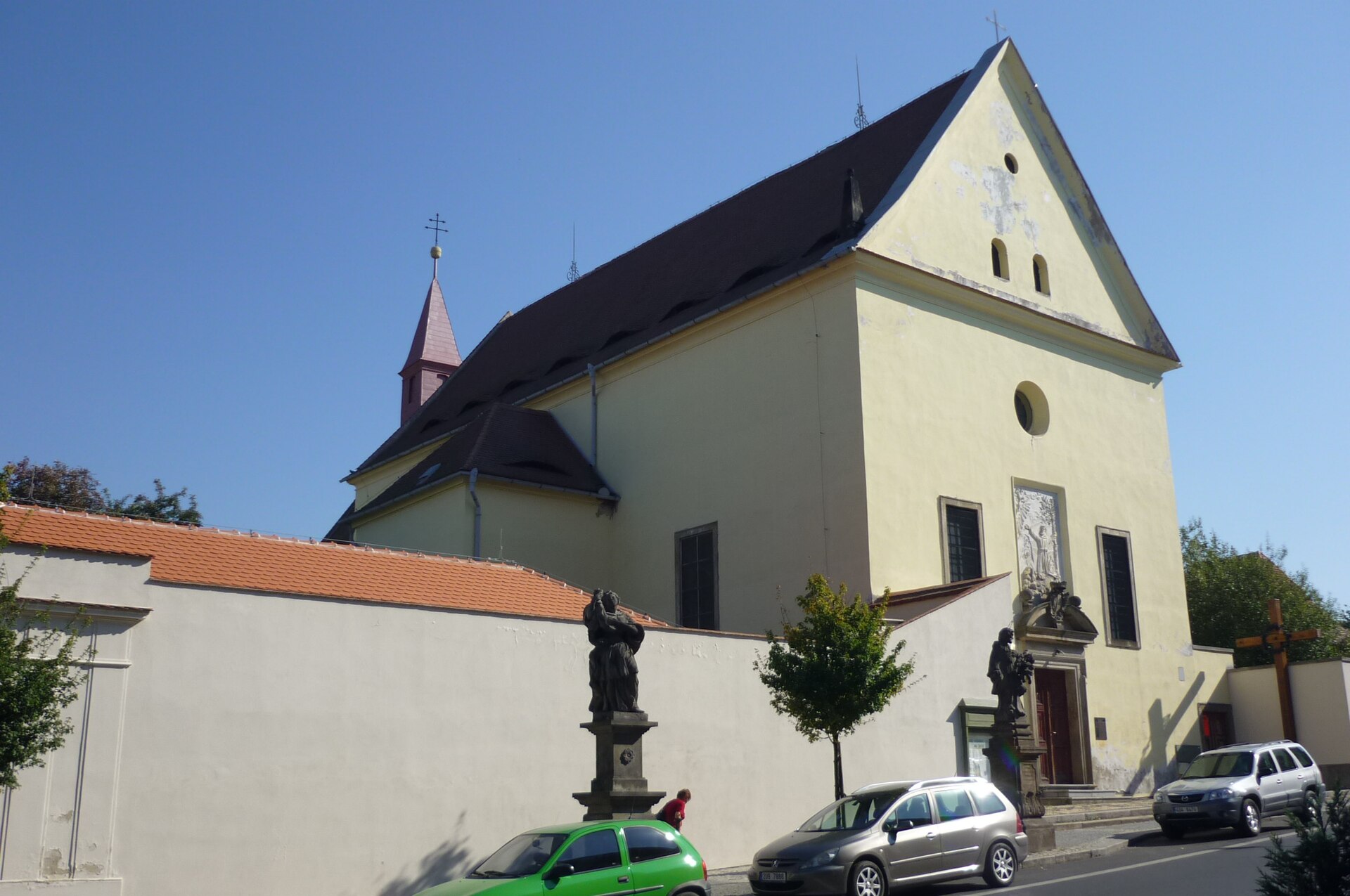
The Church of the Assumption of the Virgin Mary in Žatec is an imposing Gothic-Baroque landmark standing in the northern part of the connected string of Žatec squares — Svobody, Hošťálkovo and Žižkovo — directly opposite the former Kněžská Gate, once the main entry point into the town. Protected as a cultural monument since 1965, it remains one of the most recognizable silhouettes on the Žatec skyline.
How old is the building, really?
The church you see today did not appear out of nowhere. It occupies the site of a large late-Romanesque basilica raised in the first half of the 13th century. That earlier structure formed the foundation for everything that followed, giving the present-day building its layered, centuries-deep character.
Who was behind the Gothic reconstruction?
Between 1340 and 1370 the church underwent a major Gothic-style rebuilding, carried out with the involvement of a building lodge connected to the workshop of Peter Parler — the architect whose name is most closely tied to St. Vitus Cathedral in Prague. That pedigree explains why the church's massing feels so architecturally mature for a provincial town.
What did the later Baroque work change?
Another decisive phase came in 1740–1741, when Baroque elements were added, giving the interior a more decorative, theatrical feel. Earlier still, between 1724 and 1728, a side chapel dedicated to St. John of Nepomuk — a saint widely venerated across 18th-century Bohemia — was attached to the main structure. The bell tower that now dominates the surrounding rooftops was built between 1770 and 1773 by local master builder Jan Pavel Loschmann.
What should visitors look for inside?
The visual centerpiece is the main altar painting depicting the Assumption of the Virgin Mary, painted in 1668 by the Prague-based artist Antonín Stevense. In front of and behind the church stands a gallery of stone saint statues, most of them carved by the Žatec sculptor Jan Karel Vetter during the first third of the 18th century. Walking a full loop around the exterior is worthwhile precisely because of this outdoor sculpture ensemble, which is easy to miss if you only step inside.
How do you get there?
The church sits right in the heart of historic Žatec, along the chain of squares linking Svobody, Hošťálkovo and Žižkovo — an area fully walkable from the old town's main market square and its other historic sights. The coordinates (roughly 50.3313° N, 13.5431° E) make it simple to plot a walking route in any map app.
When is the best time to visit?
Žatec is best known internationally for its hop-growing tradition, and the town is liveliest in summer and early autumn, when local festivals celebrating that heritage take place. Timing a visit to coincide with one of these events lets you pair the church with a broader taste of the town's historic center and local culture.
Frequently asked questions
Is the church officially protected as a monument? Yes — it has been listed as a cultural monument under Czech law since 1965.
How old is the oldest part of the structure? The foundations date back to the first half of the 13th century, when a late-Romanesque basilica stood on the site, though the current form results mainly from later Gothic and Baroque rebuilding.
Who painted the main altarpiece? The Assumption of the Virgin Mary altar painting was created in 1668 by Prague painter Antonín Stevense.
Are there statues to see outside the church? Yes, a gallery of saint statues stands in front of and behind the building, most of them carved by local sculptor Jan Karel Vetter in the early 18th century.
Nearby places

Earn badges for the places you visit
Download NextOnTrip, discover new places and check off your trails.