About this place
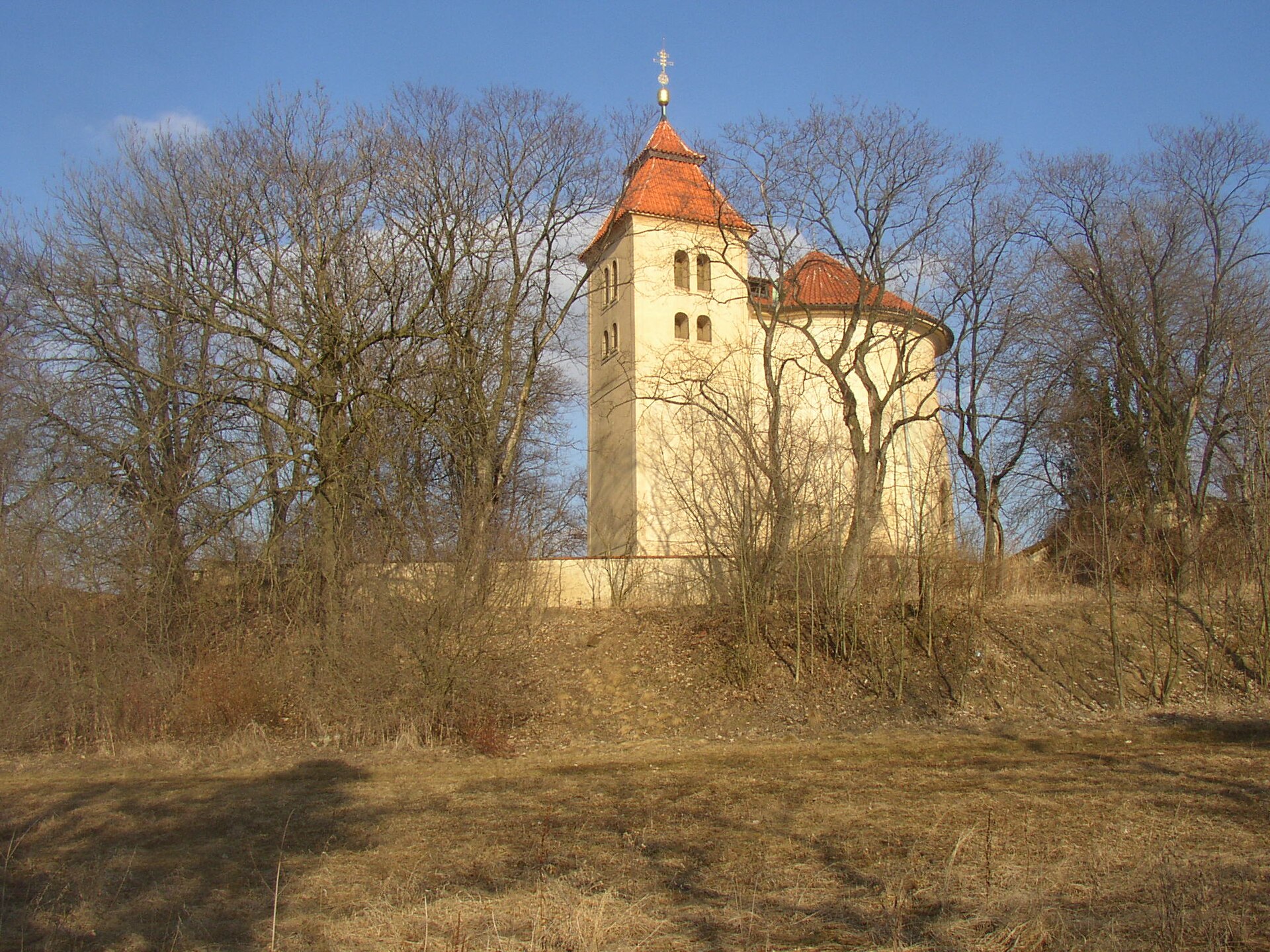
The Church of St Peter and St Paul at Budeč is a small Romanesque rotunda standing on the grounds of a former hillfort near the villages of Kováry and Zákolany, in the Kladno district of central Bohemia, Czech Republic. It is considered the oldest surviving building on Czech territory, and one of the most significant monuments of the early Přemyslid state.
How do you get to Budeč?
The hillfort sits on a hill between the villages of Kováry and Zákolany, roughly a dozen kilometres west of Prague. It lies away from the main tourist routes, so the easiest way in is by car or bike, with the final stretch covered on foot along a path crossing the old earthworks of the fort. The site's coordinates are 50.191175, 14.24481389.
What will you see there?
The main attraction is a small stone rotunda a little over 8 metres in diameter, built largely from original early medieval masonry. Inside, the vault rises to a height of about 13 metres. The building was commissioned by Duke Spytihněv I after the year 895, at a time when the Duchy of Bohemia was taking shape under the Přemyslid dynasty. It was first dedicated to St Peter; in the 12th century a Romanesque tower was added and the dedication was extended to include St Paul. In the 16th century the original apse was replaced with a rectangular presbytery and sacristy, giving the church the shape it still has today.
The Budeč hillfort itself was, in the 9th and 10th centuries, one of the more important strongholds of the early Přemyslid rulers, guarding trade routes through central Bohemia. According to 10th-century legends of St Wenceslaus, it was here that Duke Vratislav I sent his son Wenceslaus — the future saint and patron of the Czech lands — to learn reading, writing and Latin. That episode permanently tied Budeč to the beginnings of Czech statehood and Christianity.
Archaeological research carried out by Miloš Šoll in 1990, later revised by Andrea Bartošková in 2003, confirmed that the rotunda is most likely the oldest still-standing Christian building in the present-day Czech Republic. The site is protected as a national cultural monument.
When is the best time to visit?
The hillfort and rotunda form an open-air site, best visited during daylight hours when you can walk the hill and take in the surroundings at a relaxed pace. Spring and summer make for easier walking around the old fortifications, while autumn and winter can bring muddier, less comfortable approach paths.
Who is this place for?
Budeč appeals mainly to visitors interested in early Czech history, Romanesque architecture and the legend of St Wenceslaus. It also makes a rewarding stop for hikers and cyclists exploring the countryside around Prague who are looking for a quieter, less crowded historic site.
Frequently asked questions
Why is the rotunda at Budeč so important? It is regarded as the oldest surviving building in the Czech Republic — its earliest masonry dates back to the time of Duke Spytihněv I, before the year 900.
What is the connection between Budeč and St Wenceslaus? Early legends say that Duke Vratislav I sent the young Wenceslaus here to learn reading, writing and Latin, before he became duke and later a saint.
Can you go inside the church? The rotunda stands within the former hillfort as an architectural monument; access to the interior can be limited, so it's worth checking current visiting conditions beforehand.
How large is the rotunda? It measures a little over 8 metres in diameter, with a vault reaching about 13 metres in height — an impressive scale for a structure built more than a thousand years ago.
Nearby places

Earn badges for the places you visit
Download NextOnTrip, discover new places and check off your trails.