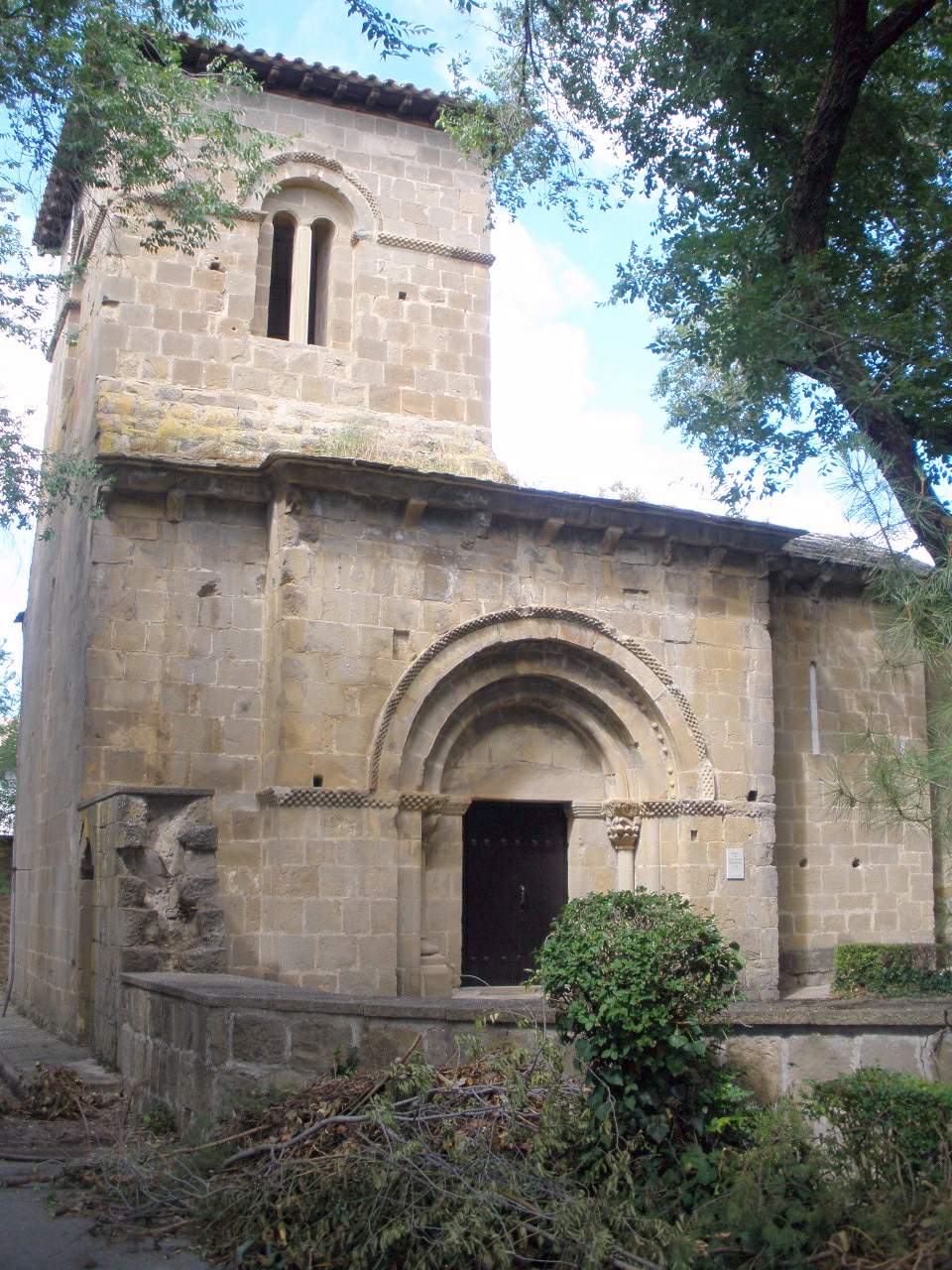
About this place
The Church of San Adrián de Vadoluengo, roughly two kilometers from Sangüesa in Navarre, is one of the region's best-preserved examples of rural Romanesque architecture. The building sits on the edge of the Aragón river valley, and its name comes from the very ford it once guarded: "vado luengo," a Navarro-Aragonese term for a long, wide river crossing.
Why is the site named after a river ford?
The place is documented as early as 1035, when King Sancho the Great divided his kingdom among his sons. His son Ramiro received the lands that later became the county of Aragón, and the eastern border of that territory ran right through Vadoluengo, near Sangüesa. The ford across the Aragón, close to where it meets the Onsella river, likely marked a crossing point on an ancient route that grew into a Roman road and, later, a medieval trade and pilgrimage path. Once a stone bridge was built at Sangüesa, the ford gradually lost its practical importance.
Who built the church, and when was it consecrated?
Construction was commissioned by Fortún Garcés Cajal, an Aragonese nobleman closely tied to King Alfonso the Battler, ruler of both Navarre and Aragón. The church was consecrated in 1141, placing it squarely within the great wave of Romanesque building that spread along the roads connecting Navarre and Aragón during the twelfth century.
What should visitors look for?
The church has a simple rectangular plan with a single nave, closed at the east end by a cylindrical apse — a hallmark of Romanesque design from this period. A square tower rises at the west end, near the entrance. The real highlight, though, is the doorway: arches resting on richly carved capitals, a plain lintel, and a tympanum carved with a Trinitarian chrismon of the Huesca type, a symbol representing the Holy Trinity that has survived in remarkably good condition given its age. This carved portal is considered one of the finer examples of Romanesque sculpture in Navarre.
What protection status does the church hold?
Its historical and artistic value was formally recognized in 1983, when it was declared a Monumento Histórico-Artístico (a monument of historical and artistic significance) under Spanish heritage law. That designation keeps the small, isolated church legally protected, even though it sits well away from Sangüesa's main tourist circuit and draws a mostly niche audience of Romanesque architecture enthusiasts.
How do you get there, and what should you expect on arrival?
The church stands outside the town, in open countryside along the Aragón valley. The easiest way to reach it is on foot or by car; walking from central Sangüesa typically takes somewhere between fifteen and twenty-five minutes, depending on the route chosen along the riverbank. Part of the approach runs along unpaved or gravel tracks, so comfortable footwear and a bottle of water are worth bringing, since there's no visitor infrastructure on site.
When is the best time to visit?
Because the surroundings are open and exposed, with no shade or facilities nearby, spring and autumn tend to offer the most comfortable conditions, and the Aragón valley looks especially attractive during these seasons. In summer, an early morning or late afternoon visit is a better choice than the middle of the day.
Frequently asked questions
What does "Vadoluengo" mean? It refers to a long, wide ford — from the Navarro-Aragonese "vado luengo," describing the point where travelers once crossed the Aragón river.
When was the church built? It was consecrated in 1141, though the site itself appears in documents dating back to 1035.
What is the most notable architectural feature? The carved doorway, topped by a well-preserved Trinitarian chrismon of the Huesca type and flanked by decorated capitals.
Is the church a protected monument? Yes — it was declared a Monumento Histórico-Artístico in 1983, granting it legal heritage protection.
Nearby places

Earn badges for the places you visit
Download NextOnTrip, discover new places and check off your trails.