About this place
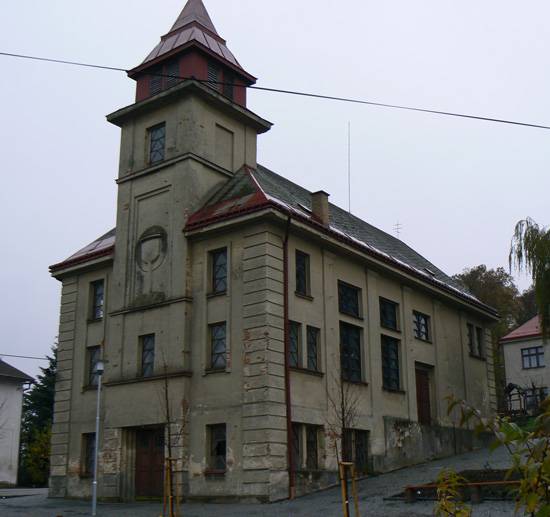
Church of Saint Procopius stands on the western edge of Hodkovice nad Mohelkou, right beside the town cemetery, and remains the active parish church of this small town in the Liberec Region. The current Baroque building dates from the early 18th century and has been listed as a protected cultural monument since 1966.
How old is the parish here?
Church life in Hodkovice nad Mohelkou goes back much further than the building seen today. The first written record of a church on this site dates to 1352, when a wooden structure likely stood here, rebuilt several times over the following centuries. That earlier building was destroyed by fire in 1692, and the present stone church was raised between 1717 and 1721 on the same spot. In 1845, local builder F. Havlína raised the height of the tower, giving it the silhouette visitors see today.
What does the church look like inside and out?
The church is a rectangular, single-nave building divided into four bays, its façade marked by vertical pilaster strips. Two side annexes flank the main body, and a semicircular presbytery closes the east end. A square-based tower rises at the western front. Inside, a barrel vault resting on pilasters covers the nave, and a two-story wooden gallery at the western end still holds its original Baroque organ.
Most of the interior furnishings date from 1896 and follow a pseudo-Renaissance style. The high altar carries a painting of Saint Procopius signed "A. Lhota 1850." A rarer survival is a set of 24 small oil paintings from around 1700, mounted on the sacristy doors, each depicting a different pilgrimage image of the Virgin Mary. The church also holds works attributed to Josef Führich or his school, including Nativity and Crucifixion scenes from 1826 and depictions of Saint John of Nepomuk and Saint Anne. A townscape painting from 1806 shows a fire in the town watched over by Saint Lawrence and Saint Florian, both traditionally invoked against fire.
What else is worth seeing around the church?
The grounds around the church and cemetery hold several smaller monuments. A former cemetery chapel, once used as an ossuary, still preserves fragments of a tabernacle. A Rococo gravestone from 1763 is set into the wall of the church porch, and stone and cast-iron grave markers from 1812 to 1841 survive among the burial plots. On the way up to the church, visitors pass the Chapel of Saints Peter and Paul from 1754, and a Baroque statue of Saint John of Nepomuk from 1733 stands near the cemetery. An outdoor Way of the Cross, built between 1818 and 1820, completes the route, its main chapel rebuilt in 1867.
Further afield, look for a Baroque Marian column from 1707, decorated with statues of six patron saints, a sculptural group of Saint Helena from 1750, and a set of figures of Saint Anne and the Virgin Mary from 1753. The oldest piece in this small cluster of monuments is a wayside shrine carrying a Calvary relief from 1678, moved to its present location in 1761.
Frequently asked questions
When was the current Church of Saint Procopius built? The present building went up between 1717 and 1721, replacing an earlier church that burned down in 1692.
Since when has the church been a protected monument? It has held cultural monument status since 1966.
What is the most notable piece inside the church? A set of 24 oil paintings of pilgrimage Madonnas from around 1700, mounted on the sacristy doors, along with the church's original Baroque organ.
Are there other historic sites near the church? Yes — the Chapel of Saints Peter and Paul (1754), a Baroque Marian column (1707), and an 18th-century Way of the Cross all stand close by.
Nearby places

Earn badges for the places you visit
Download NextOnTrip, discover new places and check off your trails.