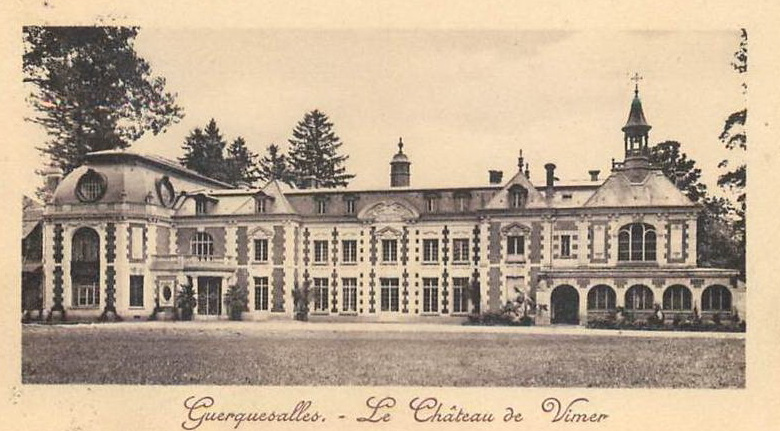
About this place
Château de Vimer stands in Guerquesalles, a small commune in the Pays d'Auge area of Normandy, roughly 14 km southeast of Livarot. Set within its own landscaped grounds, the estate is a good example of a country house that grew in layers over three centuries, each generation of owners leaving a visible mark on the building.
How did the estate begin?
The site started out modestly, as a 17th-century hunting lodge. The manor house seen today was built in the first half of the 18th century by Louis François de Nolet, lord of Malvoué and Vimer. His family's coat of arms still survives on a fireplace slab kept in the estate's farm building — one of the few objects that ties the property directly back to its founder.
Architecturally, the château follows a layout common to French country houses of the period: a central block flanked by two forward-set wings, giving the facade a balanced, formal symmetry.
Who owned it after the Nolet family?
The estate changed hands in 1774, when it was bought by René de Chazé. A more dramatic chapter opened in 1815: after the fall of Napoleon's Empire, General Watier, Count of Saint-Alphonse, took refuge at Vimer. He commissioned restoration work and had a chapel built on the grounds.
Another wave of changes arrived at the turn of the 20th century. Between 1897 and 1903, Baron de Mackau brought in Parisian architects to restore the chapel and modernise the château's west-facing front. Shortly after, the facades were unified with new stone facing, and an additional wing was added to house a library and a dining room. The result is a building that reads as a single coherent whole at first glance, even though it actually stitches together work from three separate centuries.
What else is there to see beyond the château itself?
The grounds are worth a visit in their own right. The garden was laid out in 1840 by landscape architect Bühler, a recognised name in 19th-century French landscape design. It includes a formal tree-lined walk, a greenhouse, and a kitchen garden, and the whole ensemble is listed in France's pre-inventory of remarkable gardens. It's a rare chance to see a 19th-century French garden concept preserved largely in its original layout.
How do you get to Guerquesalles?
Guerquesalles sits at the heart of the Pays d'Auge, a region known for its apple orchards and half-timbered farmhouses. The nearest useful base is Livarot, a short drive away, connected by rural roads that wind through classic Normandy countryside. The area suits a slower, car-based day trip that takes in several small villages nearby.
When is the best time to visit?
Spring and early summer show the garden at its fullest, with the tree-lined walk and the planting around the greenhouse in full leaf. Autumn brings a different appeal, with softer light flattering the architecture and the surrounding Pays d'Auge orchards turning colour in the background.
Frequently asked questions
Can you visit Château de Vimer? The château is privately owned, so access to the interior and grounds can be limited. It's worth checking current visiting arrangements locally or through the region's tourism organisations before planning a trip.
Who built Château de Vimer? The present building was constructed in the first half of the 18th century by Louis François de Nolet, lord of Malvoué and Vimer, on the site of an earlier 17th-century hunting lodge.
What is the estate's most notable feature besides the château? The garden, designed in 1840 by landscape architect Bühler, is listed in France's pre-inventory of historic gardens and remains one of the estate's standout features.
How far is it to the nearest larger town? Livarot, the nearest sizeable landmark, is about 14 km northwest of Guerquesalles.
Nearby places

Earn badges for the places you visit
Download NextOnTrip, discover new places and check off your trails.