About this place
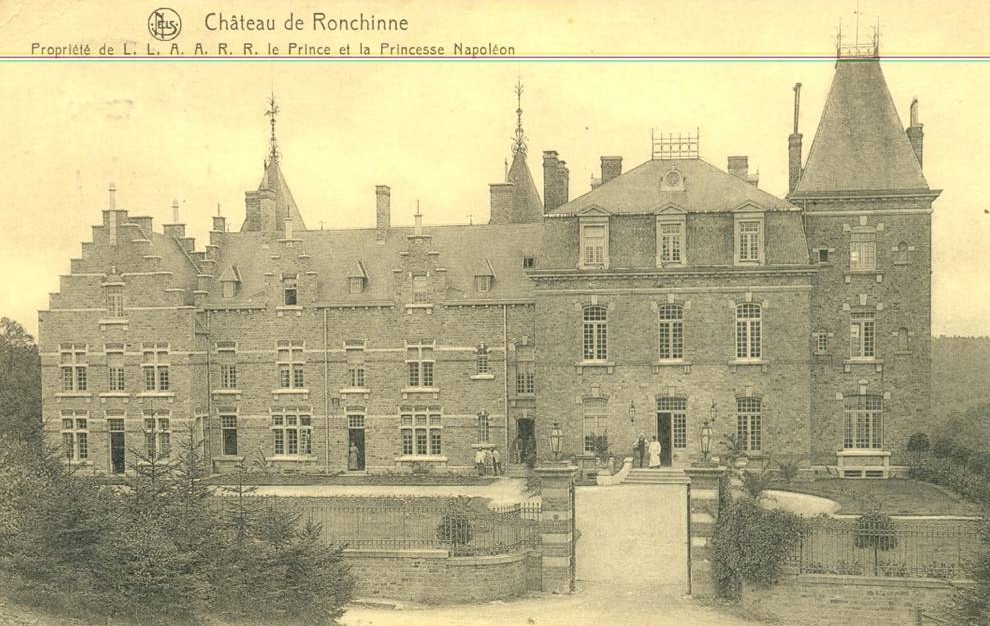
Château de Ronchinne is a 19th-century Romantic-style mansion tucked inside a large forest estate near the hamlet of Ronchinne, in the municipality of Maillen (Assesse), in the province of Namur in Wallonia. The building stands on what was once a domain of well over two hundred hectares of woodland and parkland, giving the site the feel of a secluded retreat deep in the Condroz countryside.
Who built the castle and when?
The mansion was constructed between 1884 and 1890 to a design by architect Théodore Semaille. The project was commissioned by Charles-Joseph Logé, a notary from Namur, who chose to raise an imposing residence on the wooded Ronchinne estate. The resulting building combines neo-Renaissance features with elements typical of late 19th-century Belgian country houses - turrets, steep roofs and a sprawling silhouette wrapped around terraces.
What is the castle's connection to the Belgian royal family?
The best-known chapter in the history of Château de Ronchinne runs from 1912 to 1945, when the residence became the home of Prince Victor Napoléon and his wife, Princess Clémentine of Belgium, daughter of King Leopold II. After her husband's death in 1926, Princess Clémentine remained at Ronchinne and commissioned a major redesign of the surrounding park. The work was carried out by Jules Buyssens, one of the leading Belgian landscape architects of the era, known for blending formal avenues with more naturalistic plantings. Traces of that layout are still visible in the grounds today.
What happened to the estate after the war?
After the princely period ended, the estate was purchased in 1957 by the Special Assistance Fund for Postal Workers, a mutual aid organisation that turned the grounds into a holiday centre for postal staff. This social and recreational role continued for several decades before the property changed hands again at the start of the 21st century.
What does the castle look like today?
In 2006 the domain was acquired by a hotel group, and the renovated property welcomed its first guests in 2009. Today, Château de Ronchinne operates as a hotel with a wellness section, making use of the historic building and the landscaped park once designed by Buyssens. Visitors can walk through the grounds of the former princely estate, admire the mature trees and the 19th-century architecture, and enjoy modern tourist facilities built into a genuinely historic setting.
Why visit Château de Ronchinne?
The site layers three distinct histories together: the bourgeois ambition of a Namur notary, an aristocratic episode tied to the Belgian royal family, and a postwar social history as a workers' holiday centre. For visitors, that means a chance to explore a heritage building and a park with a unique design pedigree, set in the quiet, wooded scenery of Namur province, away from the region's main tourist routes.
Frequently asked questions
Can the castle be visited? The building operates as a hotel, so access to the interior is mainly reserved for guests, while the park is sometimes accessible more broadly as part of the region's tourism offer.
Who designed the park? The park's present layout is the work of Jules Buyssens, commissioned by Princess Clémentine in the first half of the 20th century.
How large was the original estate? The Ronchinne forest domain originally covered well over two hundred and thirty hectares of woodland and green space.
Nearby places

Earn badges for the places you visit
Download NextOnTrip, discover new places and check off your trails.