About this place
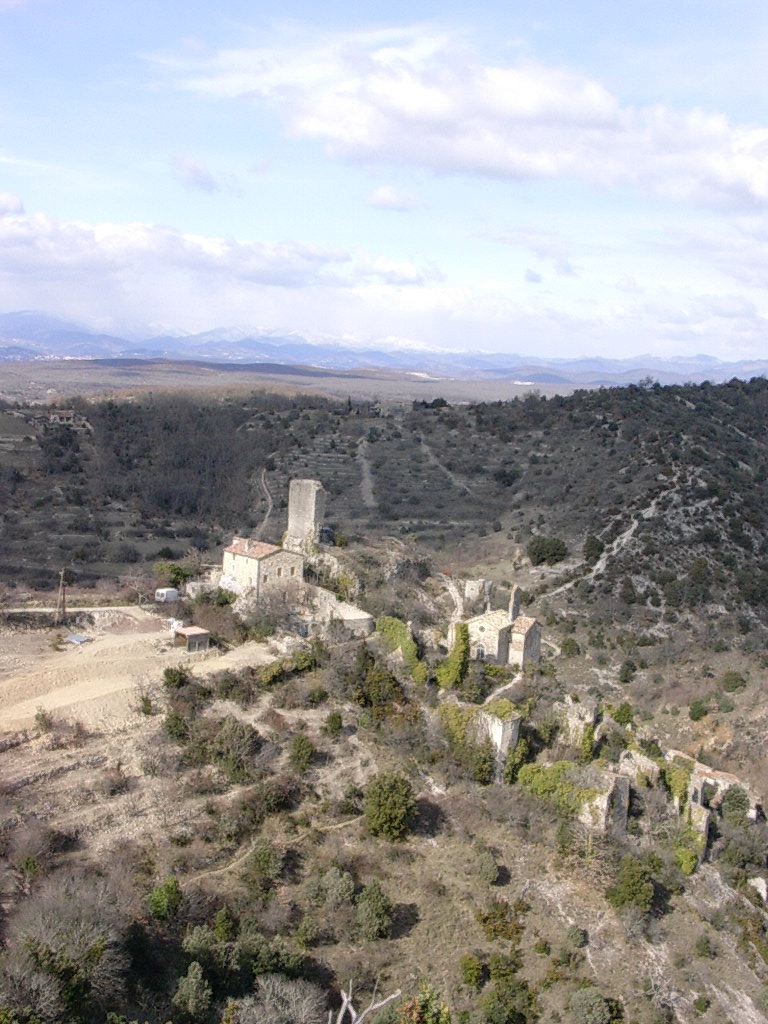
Château de Montalet stands on a rocky spur above the Cèze valley in the commune of Molières-sur-Cèze, in the Gard department of southern France's Occitanie region. Its weathered walls, keep and cistern trace a story that begins in the twelfth century, and today the site draws history lovers and hikers looking for a quieter alternative to Provence's better-known fortresses.
How old is the castle, and who built it?
The earliest written trace of Montalet appears in Latin documents from 1199 and 1202, which place the stronghold in the hands of the Bérard de Montalet family, local lords controlling this stretch of the Cèze valley. At its height, the fortress was ringed by defensive walls punctuated by seven towers, with the keep itself reached only through a barbican — an outer defensive work built to slow down any attacker before they reached the castle's core.
A property division drawn up in 1248 between two brothers, Arnault and Bertrand de Montalet, offers an unusually detailed snapshot of the site: the document lists dwellings, towers, gates and a cart road within the walls, evidence that Montalet was not just a lord's residence but a small fortified village in its own right.
What survives to visit today?
Several parts of the medieval complex are still standing: the seigneurial hall that once served as the lord's private apartments, a grain hall used for storing the estate's harvest, a great hall for gatherings, a reception room that occupies the former guardroom, the keep, and a cistern that once collected rainwater for the community inside the walls. Walking between them gives a fairly complete picture of how a fortified medieval settlement actually functioned, from storage and defense to daily household life.
Since 25 July 1997, the castle, its ramparts and the grounds of the former settlement have been listed on France's supplementary inventory of historic monuments. The site's upkeep is driven largely by a local preservation association, which runs restoration workshops around Easter and through the summer months — volunteers work directly on the stonework, picking up traditional building techniques from more experienced hands as they go.
How do you get there, and when should you visit?
Access follows two waymarked routes, a botanical trail and a geological trail, both of which share part of the PR7, one of Gard's network of local hiking paths. That means a walk up to the castle doubles as a chance to take in the valley's plant life and rock formations along the way, so sturdy shoes are worth packing given the uneven ground typical of a defensive promontory.
Guided visits run year-round on Sundays, from 10 a.m. to 5 p.m. On other days, and for group bookings, visits need to be arranged in advance by phone.
Who is this site for?
Montalet suits travelers drawn to medieval history and military architecture who'd rather skip the crowds found at the region's larger châteaux. It also works well for families: the nature trails around the ruins are gentle enough for children, and the surviving rooms make it easy to picture what daily life inside a medieval fortified village looked like.
Frequently Asked Questions
Where exactly is Château de Montalet located? The castle sits in the commune of Molières-sur-Cèze, in the Gard department, overlooking the Cèze valley in France's Occitanie region.
When can you visit? Guided tours run year-round on Sundays from 10 a.m. to 5 p.m. Visits on other days, particularly for groups, must be arranged by phone in advance.
Is the castle a protected historic monument? Yes. Since 25 July 1997, the castle, its walls and the grounds of the former settlement have been listed on France's supplementary inventory of historic monuments.
What else can you do near the castle? Two waymarked routes, a botanical trail and a geological trail, both using part of the PR7 hiking path, let visitors combine the ruins with a walk through the Cèze valley's landscape.
Nearby places

Earn badges for the places you visit
Download NextOnTrip, discover new places and check off your trails.