About this place
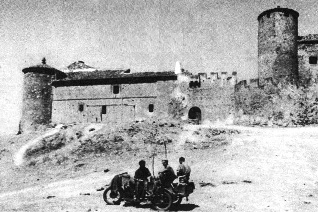
Castillo de Magacela crowns the hilltop above the village of Magacela, in the province of Badajoz, Extremadura. Its fortified silhouette is visible for miles across the La Serena district, making it one of the region's most recognizable landmarks.
Why was a fortress built here?
The hill has served defensive purposes since ancient times. Celtic settlers occupied it first, followed by the Romans, who valued its command over the surrounding grain plains. The name Magacela likely derives from the Latin Magna Cella — "great granary" — a nod to the fertility of the farmland below. Local tradition even claims the legendary Lusitanian chieftain Viriathus met his end in this area.
The fortress reached its true golden age in the Middle Ages. After the period of Arab rule, King Ferdinand III handed Magacela over to the military Order of Alcántara in exchange for Trujillo. The Order established its priory headquarters here, and the town became the de facto capital of the entire La Serena district, with authority over neighboring settlements including Villanueva de Magacela, La Haba, Quintana, La Guarda, Campanario and Aldehuela. This was the castle's — and the town's — moment of greatest splendor.
What dramatic episode unfolded here?
The walls of Castillo de Magacela witnessed one of the more turbulent chapters in the Order of Alcántara's history. Alonso de Monroy, the Order's last Master, was held prisoner here for two years during a power struggle known as the "War of the Clavero." The dispute over control of the fortress was finally settled in 1473, when Monroy — freed and named Master — regained command of the castle.
By the end of the 15th century, the Order relocated its priory to Villanueva, and Magacela gradually faded into obscurity, its fortress falling into the same slow decline.
What can you see today?
The best-preserved element is the Torre del Homenaje, the keep — an octagonal tower dating to the late 12th century with an irregular floor plan (an extra, eighth face results from a chamfered corner on its northern side). Its interior, however, is completely sealed off and cannot be visited; that said, more adventurous visitors do climb to the top via the exterior stonework, with care.
Beyond the keep, you'll find the remains of other towers — notably a fortified gate tower — along with sections of the old defensive walls, and the ruins of the church of Santa Ana, Magacela's original parish church, together with its adjoining old cemetery.
The real reward for the climb, though, is the view. Castillo de Magacela now functions as a natural lookout point over the whole of La Serena — on a clear day you can pick out the Sierra de Orellana, the Sierra de Castuera, the foothills of the Sierra Morena, and, if visibility is exceptional, even the Villuercas range in the distance.
When should you visit?
Spring and autumn are the best seasons, when Extremadura's temperatures are milder than the scorching summer heat and the uneven terrain of the hill is easier — and more pleasant — to climb. Early morning or late afternoon light is worth planning around too, since it brings out the texture of the stone ruins and makes the views from the tower especially rewarding.
Frequently asked questions
Can you go inside the keep? No — the interior of the Torre del Homenaje is completely sealed. Visits are limited to viewing it from outside, with the option of climbing to the top via the exterior route for those comfortable with heights.
Is there an entrance fee? The castle sits in open terrain on the hilltop, and access to the ruins is free, with no ticket booths or gates.
How long does a visit take? Walking the ruins and climbing the hill typically takes 1 to 1.5 hours, depending on your pace and how long you linger over the panorama.
What else is worth seeing nearby? Alongside the castle ruins, it's worth visiting the village of Magacela itself at the foot of the hill, as well as the remains of the church of Santa Ana and the old cemetery right beside the fortress.
Nearby places

Earn badges for the places you visit
Download NextOnTrip, discover new places and check off your trails.