About this place
Casa Montañés is an 18th-century townhouse on Calle San Agustín in San Cristóbal de La Laguna, Tenerife, one of the Canary Islands' best-preserved historic towns and a UNESCO World Heritage Site. The building was raised in 1746 by Francisco Montañés, a cavalry sergeant major, whose family name it has carried ever since.
What can you see there?
Above the entrance, the Montañés family coat of arms sits carved into the lintel — an immediate clue that this was the home of a wealthy family rather than an ordinary town house. Behind the door, the entrance hall is wide enough for a cart to have once driven straight through and unloaded goods next to the ground-floor storerooms.
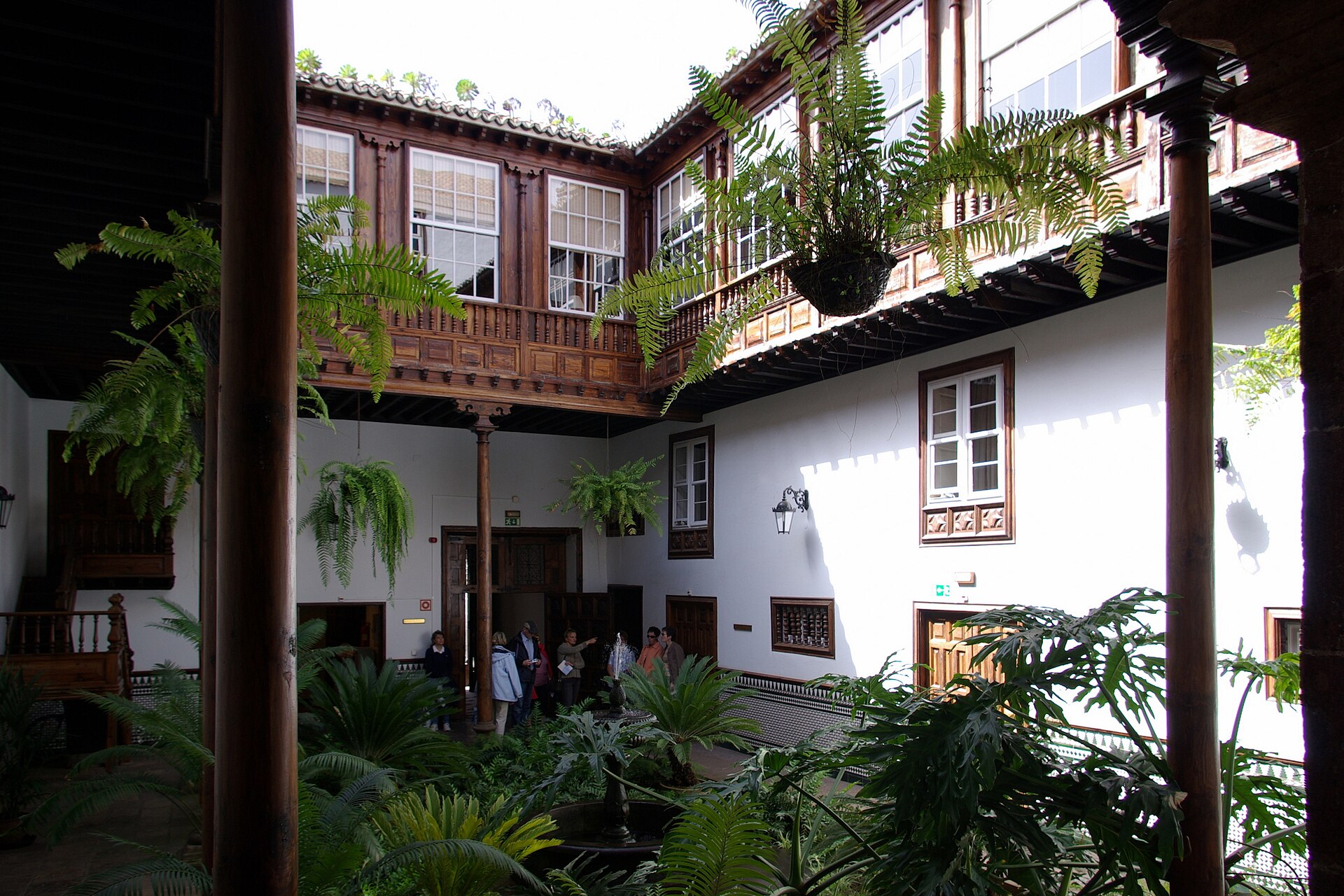
The heart of the building is a square, Andalusian-style courtyard set within the layout of a traditional Castilian stately home. A stone fountain stands at its centre, ringed by wooden balconies with an Italian flavour and windows built in the English style — a mix that says a lot about how colonial-era Tenerife architecture borrowed from several European traditions at once.
The house rises three floors plus a mezzanine, and the floor plan mirrors the old social order of the household: the ground floor held storerooms and servants' quarters, the family lived on the floor above, and the top floor was used to store grain.
How do you get there?
Casa Montañés sits right in the historic core of La Laguna, inside the UNESCO-protected old town, so the easiest way to reach it is on foot from the city centre — it's only a few minutes' walk from the cathedral or Plaza del Adelantado. La Laguna is well connected to Santa Cruz de Tenerife by tram, and most of the old quarter is closed to cars, which makes exploring on foot the natural choice.
Can you go inside?
Since 1986 the building has served as the headquarters of the Consejo Consultivo de Canarias, the regional government's consultative council. The property passed into the ownership of the Autonomous Community of the Canary Islands in 1985. Because of this administrative role, the interior isn't open as a museum-style attraction, but the façade, courtyard and overall architecture make it a worthwhile stop on a walk through La Laguna's historic centre.
When is the best time to visit?
La Laguna enjoys mild weather year-round, and spring and autumn are the most pleasant seasons for wandering the old town, with comfortable temperatures and fewer visitors than in summer. It's worth pairing a stop at Casa Montañés with a visit to the nearby cathedral and other period townhouses, since the historic centre packs many similar residences into just a few hundred metres.
Frequently asked questions
Who built Casa Montañés and when? The house was built in 1746 for Francisco Montañés, a cavalry sergeant major, who gave the building its name.
Can you visit the inside of Casa Montañés? The building has housed the Consejo Consultivo de Canarias, the Canary Islands' consultative council, since 1986, so the interior serves an administrative rather than a museum function. Visitors mainly view the façade, the coat-of-arms entrance and the exterior architecture.
What's the most distinctive architectural feature? The square Andalusian courtyard with its stone fountain, combined with a Castilian stately-home layout, Italian-style wooden balconies and English-style windows.
Where exactly is Casa Montañés located? On Calle San Agustín in San Cristóbal de La Laguna, within the historic centre listed as a UNESCO World Heritage Site.
Nearby places

Earn badges for the places you visit
Download NextOnTrip, discover new places and check off your trails.