About this place
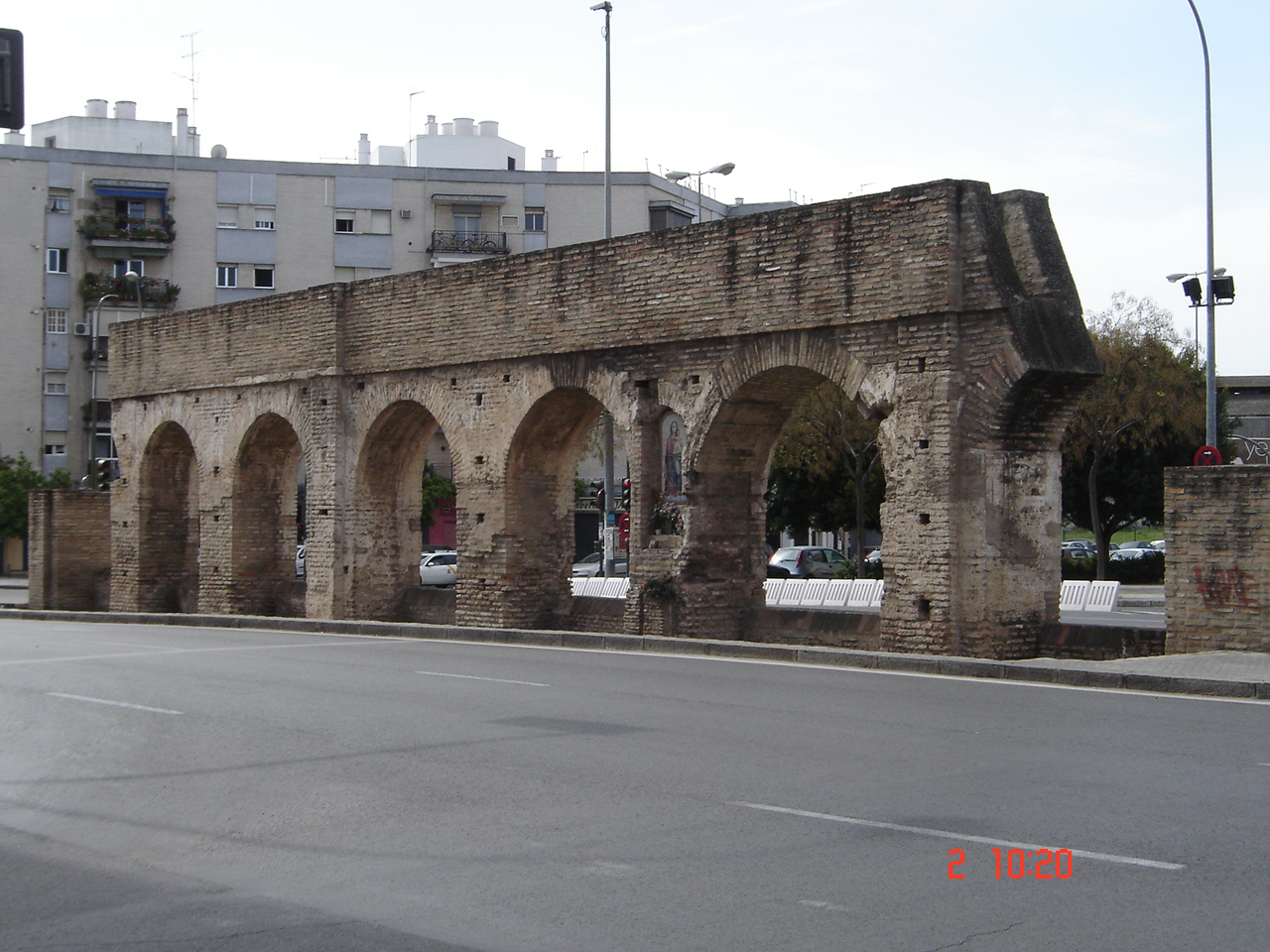
Caños de Carmona is what remains of a Roman aqueduct, with surviving stretches still standing on the outskirts of Seville as a reminder of the scale of Roman engineering in southern Spain.
Where did Roman Seville get its water?
Construction began in the first century BC, when Seville was known as Hispalis, one of the key cities of the Roman province of Hispania Ulterior. The aqueduct carried water from a spring near what is now Alcalá de Guadaíra — the Roman town of Irippo — over a distance of roughly fifteen kilometres to the city. Most of the route ran underground, with the structure rising above ground only where the terrain required it. Those raised sections, built as stone walls and arcades, are the parts that have survived and that visitors can still see today.
What did the Almohads change in the twelfth century?
The aqueduct didn't fall out of use when Roman rule ended — later generations in the region kept relying on the same spring near Alcalá de Guadaíra. In the twelfth century, while Seville was under Almohad rule, the structure was renovated and parts of it rebuilt. That intervention kept the aqueduct functioning for centuries afterward, layering Islamic-era hydraulic engineering on top of the original Roman work — a common pattern across Al-Andalus, where existing Roman infrastructure was often adapted rather than replaced.
Why was it torn down in 1912?
What makes Caños de Carmona unusual is how long it stayed in active use: the aqueduct remained fully operational right up to the early twentieth century. It was finally demolished in 1912, as Seville modernised its water supply and reshaped its urban layout, leaving the old Roman-Almohad structure obsolete. The demolition wasn't total, though — several stretches escaped destruction and are still standing, giving a sense of how the aqueduct once ran across the landscape.
What can you actually see there today?
The surviving portions of Caños de Carmona are exposed sections of wall and arcade scattered along the old route between Seville and Alcalá de Guadaíra, rather than a single intact monument. Walking along them lets you trace, in fragments, the path water once took into the city nearly two thousand years ago. The site is catalogued as a building located in Seville Province, with coordinates placing it on the eastern edge of the city.
How do you get to Caños de Carmona?
The remaining stretches sit along the corridor linking Seville to Alcalá de Guadaíra, easily reached from the city centre — usually within half an hour by car or public transport. It makes a worthwhile stop for anyone exploring beyond Seville's historic core, especially paired with a visit to Alcalá de Guadaíra itself, the site of the original spring that fed the aqueduct.
Frequently Asked Questions
Is Caños de Carmona one single structure? No — it's a scattering of surviving fragments from the original aqueduct rather than one intact building, spread across several points along the old route between Seville and Alcalá de Guadaíra.
Why is it called Caños de Carmona? The name reflects the direction the aqueduct partly followed, toward the area of present-day Carmona, even though the water itself originated from a spring near Alcalá de Guadaíra.
Was the aqueduct in continuous use since Roman times? Not entirely without interruption, but it stayed functional for an unusually long stretch — from the first century BC, through a twelfth-century Almohad renovation, until its demolition in 1912.
Is there an entry fee to see the remaining sections? The surviving fragments stand in public space on the outskirts of Seville, so they can be viewed freely while walking along the old route.
How much time should I plan for a visit? Seeing the fragments themselves doesn't take long, but it's worth allowing extra time if you're also visiting Alcalá de Guadaíra and the site of the spring that once fed the aqueduct.
Nearby places

Earn badges for the places you visit
Download NextOnTrip, discover new places and check off your trails.