About this place
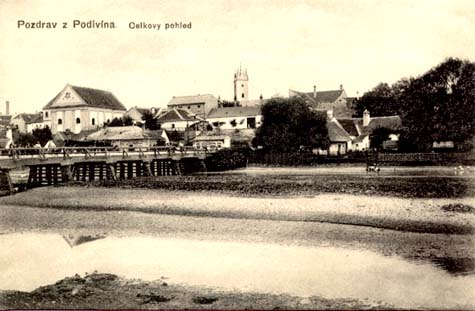
Býv. synagoga — the former synagogue of Podivín — marks the site of a Jewish house of prayer that once stood at the heart of one of the town's two Jewish quarters in southern Moravia. The building itself is long gone, but the surrounding streets still carry traces of a community whose history stretches back centuries, making this a worthwhile stop before continuing on to nearby Břeclav.
Where is Podivín, and where does the town's name come from?
Podivín lies in southern Moravia, roughly 8 km northwest of Břeclav and about 220 km southeast of Prague. German-language sources referred to the town as Kostel. According to the 12th-century Chronicle of Cosmas, the legendary founder of the town's long-vanished castle was a baptized Jew named Podiva — historians generally treat this as legend rather than documented fact, but it is from this figure that the town is said to take its name.
How did the Jewish community here develop?
Jewish presence in Podivín is traditionally dated to the early 17th century, though some accounts trace settlement back as far as the 15th century. The Thirty Years' War took a heavy toll: by 1647, only four Jewish families remained. Numbers recovered toward the end of the century as families fleeing Poland settled here. By 1768 there were 42 families, and by 1787 the community had grown to 81 families totaling 412 people — a cap that stayed in place until the mid-19th century. The community peaked in 1857, when 684 residents of Jewish faith made up 31% of the town's population, then declined steadily: 435 people in 1900 (16%), and just 196 by 1930 (under 8%). The Jewish religious community was never reestablished after the Second World War. Among the local rabbis, documented by name from the 17th century onward, were authors of noted religious and philosophical works — including Simon Mandl, who served from 1894 to 1899, and Koppel Duschinsky, rabbi from 1904 to 1907, who later settled in London.
Where did the synagogue stand, and what happened to it?
The town had two separate Jewish quarters at opposite ends of its historic core: one southwest of the main square, comprising more than 20 houses along with the synagogue and a ritual bath (mikveh), and a larger one north of the square, with around 40 houses. Housing from both quarters has largely survived. The synagogue stood in the southern quarter — likely built in the 17th century and remodeled in the 19th. It was damaged during the fighting of 1945 and later torn down, which is why it is remembered today only as the "former synagogue." Surviving descriptions indicate it was a masonry structure in a style typical of Central and Eastern European synagogues of its era.
What else remains of the town's Jewish past?
Although the synagogue itself is gone, other traces of this history survive in Podivín. An earlier Jewish cemetery, whose exact location and age remain unknown, went out of use sometime in the 17th century and has since disappeared without a trace. A second cemetery, possibly established in the second half of the 17th century and last expanded in 1872, lies on the northern edge of town, about 600 meters from the main square; burials continued there even after the Second World War. The cemetery was damaged by the Nazis, but it still holds its oldest surviving tombstone, dated 1694, along with valuable examples of Baroque and Classicist gravestones.
Frequently asked questions
Can the synagogue building in Podivín still be seen today? No — the synagogue was damaged in 1945 and later demolished, so only the surrounding streets of the former Jewish quarter remain, not the original building.
When was the Podivín synagogue built? Most likely in the 17th century, with a rebuilding in the 19th century.
Where exactly did the synagogue stand? In the smaller of the town's two Jewish quarters, southwest of the main square, an area that included more than 20 houses and a ritual bath.
What else connected to the town's Jewish history can visitors see? The surviving houses of the former Jewish quarters and the Jewish cemetery on the northern edge of town, with tombstones dating back to 1694.
Nearby places

Earn badges for the places you visit
Download NextOnTrip, discover new places and check off your trails.