About this place
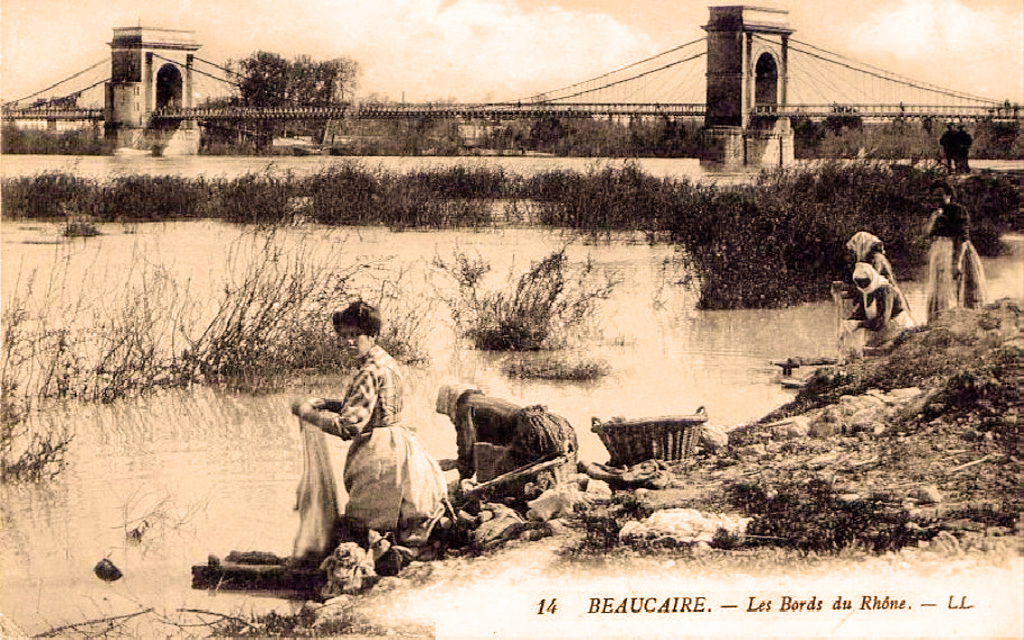
The bridge between Beaucaire and Tarascon spans the Rhône and links two historic towns sitting in different French departments – Gard on the Beaucaire side and Bouches-du-Rhône on the Tarascon side. For centuries this stretch of river has been a natural crossing point, and today the bridge is one of the defining landmarks of this part of the Rhône valley, flanked on both banks by imposing castles that once guarded the border of Provence.
How did travelers cross the Rhône here in the past?
Long before a permanent bridge existed, the river was crossed here by a floating bridge made of boats. The crossing became especially busy during Beaucaire's famous trade fairs, when merchants converged on the town from across the region and the boat bridge had to cope with heavy traffic of people and goods. It was only in the 19th century that a permanent structure was finally built: in 1829 a suspension bridge nearly 500 metres long opened to traffic, designed by engineer Marc Seguin, one of the pioneers of suspension-bridge construction in France. That structure stood for over a century until it suffered severe damage during the Second World War – on 15 August 1944, Allied bombing raids destroyed part of the spans, and the section on the Tarascon side was completely severed.
What does the bridge look like today?
The current structure is a cable-stayed bridge roughly 407 metres long, notable for its remarkably slender deck, only 0.7 metres thick. It was completed in the late 1990s, replacing the earlier post-war crossing solutions. Today it carries cars, cyclists and pedestrians alike, and it doubles as one of the best vantage points in the area: from the middle of the bridge, visitors can look one way toward the towering silhouette of the castle at Tarascon and the other way toward the walls and towers of the castle at Beaucaire.
What is worth seeing on either side of the bridge?
On the Tarascon side, the skyline is dominated by the Château du Roi René, begun in 1400 on the orders of Louis II of Anjou, Count of Provence. Stone quarried near Beaucaire was shipped across the river to build it, and construction was finally completed in 1449 under René of Anjou, a ruler remembered for his patronage of art and architecture. The fortress sits right on the riverbank and for centuries watched over the western border of Provence, facing directly across the water into Gard. On the Beaucaire side rises the Château des Comtes de Toulouse, whose ruins still make an impression despite the damage inflicted during Cardinal Richelieu's era. Crossing the bridge on foot takes only a few minutes, yet it carries visitors between two historic regions of France and two distinct medieval building traditions, that of Provence and that of Languedoc.
Frequently Asked Questions
Can you walk across the bridge between Beaucaire and Tarascon? Yes, the bridge has a dedicated lane for pedestrians and cyclists, so visitors can cross freely between the two towns while enjoying views of both castles and the Rhône below.
Which towns does the bridge connect, and in which departments do they lie? It connects Beaucaire, in the Gard department, with Tarascon, in the Bouches-du-Rhône department – the Rhône itself forms the administrative border between the two.
Is today's bridge the same structure as Marc Seguin's historic bridge? No. The 19th-century suspension bridge designed by Seguin was badly damaged during the bombing raids of 1944, and the current, much newer cable-stayed bridge was built in the late 1990s.
Why are there castles facing each other across the bridge? Since the Middle Ages the Rhône has marked the border between Provence and Languedoc, so both towns built fortresses to guard the river crossing and control trade and traffic passing over it.
Nearby places

Earn badges for the places you visit
Download NextOnTrip, discover new places and check off your trails.